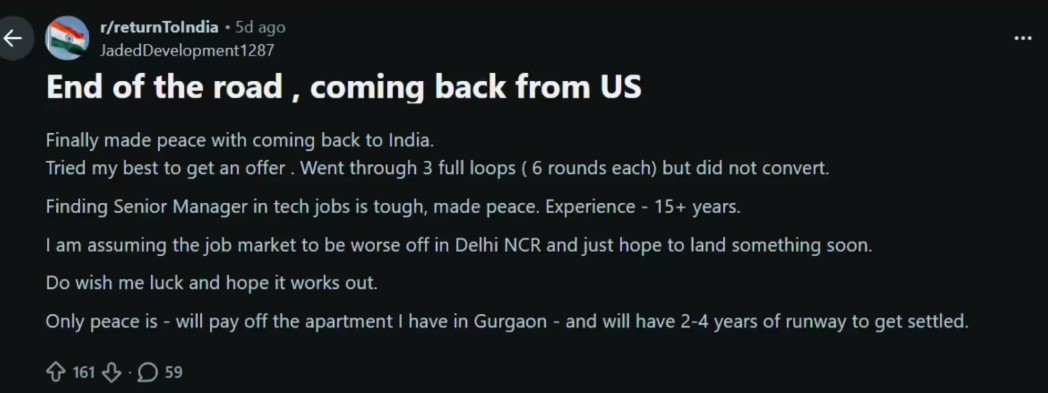
The American tech dream is breaking down for mid-career immigrants. Tech professionals with 15 years of experience, robust portfolios, and histories of scaling systems find themselves stuck. They endure three or four intense interview cycles only to face rejection. The hard truth is that the US tech job market has shifted fundamentally. Experience alone doesn't guarantee a seat at the table anymore.
A growing number of highly skilled Indian tech workers are packing their bags and heading home. The combination of visa bottlenecks, a brutal tech layoff cycle, and the rise of India's domestic tech ecosystem has changed the math. Staying in the US used to be the default choice for career growth. Now, it looks like a grind with diminishing returns.
The Reality Behind the US Job Market Shifts
The US tech market shifted heavily toward cost containment and extreme efficiency over the last few years. Companies aren't hiring for potential or general seniority anymore. They want hyper-specific matches for their current tech stack. If an open role requires experience with a specific cloud-native database or a particular machine learning infrastructure, having 15 years of general software engineering leadership won't save you.
Interview loops have become marathons of endurance rather than assessments of capability. Candidates frequently report going through five to seven rounds of interviews. These include coding tests, system design grillings, behavioral panels, and executive check-ins. Compounding this is the reality that many open roles are "ghost jobs"—postings kept active to signal growth or collect resumes, with no immediate intent to hire.
For non-citizen workers, the emotional and financial toll of this environment is amplified by the H-1B visa system. Losing a job or failing to secure a new one within the strict 60-day grace period means facing immediate self-deportation. For professionals who built families, bought houses, and spent over a decade in the country, this precarity is exhausting.
The Reverse Brain Drain to India is Real
While the US market tightens, India's tech ecosystem has matured into a global powerhouse. It's no longer just a hub for back-office outsourcing. Bangalore, Hyderabad, and Pune host critical R&D centers for global tech giants alongside a booming domestic startup ecosystem.
US Tech Environment (2026)          India Tech Environment (2026)
--------------------------          -----------------------------
Strict 60-day visa deadlines        Massive local venture funding
High living & housing costs         Rapidly growing local market
Extended 5-7 round interviews       High demand for global leaders
Returning home isn't viewed as a failure anymore. It is a strategic pivot. Mid-career professionals moving back to India often land leadership roles like Director of Engineering, VP, or CTO. They bring valuable global perspective to companies scaling for hundreds of millions of local consumers.
Financially, the gap has closed significantly too. When you factor in the purchasing power parity and the lower cost of local services, a top-tier tech salary in Bangalore offers a quality of life that rivals or exceeds what a mid-career engineer can achieve in the expensive San Francisco Bay Area or Seattle.
Navigating the New Tech Landscape
If you find yourself stuck in endless interview loops without an offer, you need to change your approach immediately. Stop relying on your years of experience as your primary selling point.
Focus heavily on deep technical specialization. General engineering management roles are scarce because layers of middle management were permanently cut during recent industry restructuring. Re-verify your hands-on coding and system design skills.
Build a strong portfolio that demonstrates your direct impact on business revenue or infrastructure cost reduction. Companies want to see exactly how you saved money or accelerated product delivery in your previous roles.
Expand your geographic horizon. If the US immigration framework is creating a ceiling for your career, look closely at the engineering leadership roles opening up in India's top-tier tech firms. The opportunities there are expanding rapidly, and they value your international experience far more than a tight US job market currently does. Focus your energy where your expertise is treated as a premium asset, not a line-item liability.