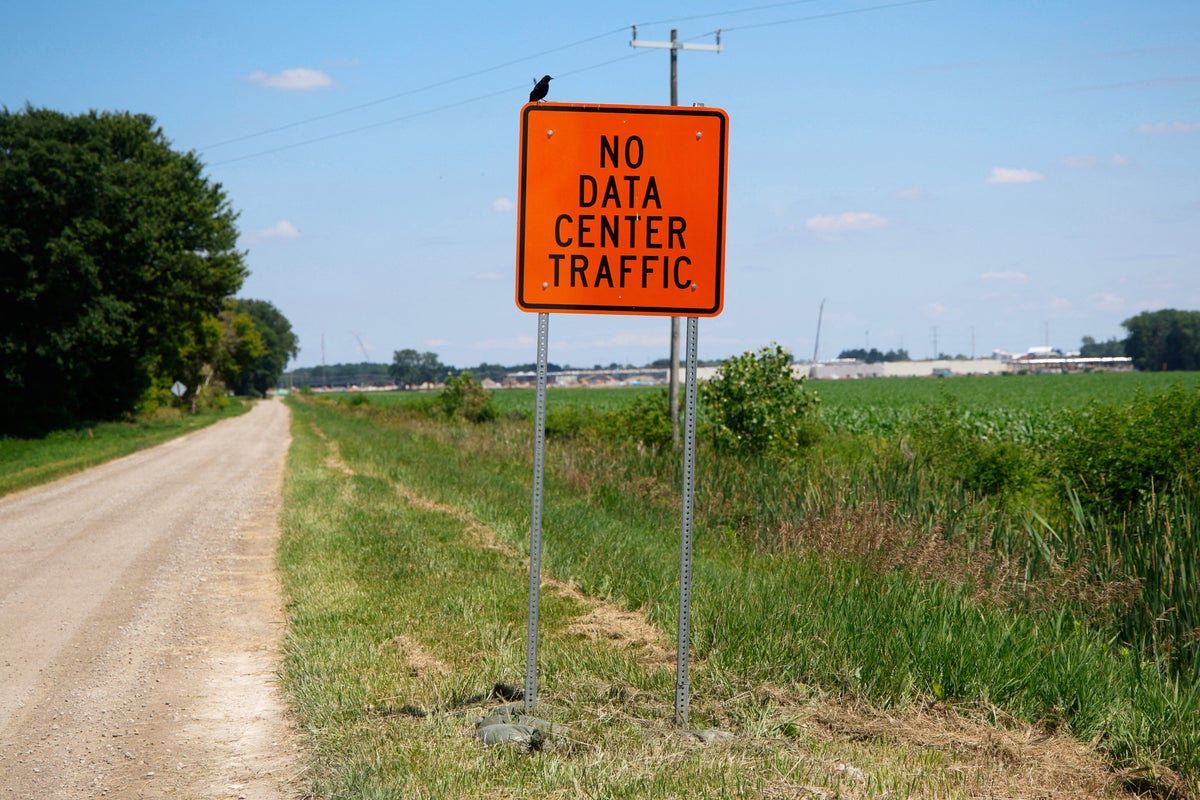
The gravel of Austin Road crunches underfoot with a dry, hollow rattle. If you stand near the edge of Tammie Bruneau’s property on a hot afternoon, you can smell the rich, heavy scent of turned Michigan earth—the kind of soil that has sustained generations of families in Saline Township. For over a century, this corner of Washtenaw County was defined by its quietude: the gentle lowing of cattle, the rustle of dry corn husks in the autumn wind, and the steady, reassuring flow of well water deep beneath the glacial till.
Now, there is a new sound. It is a deep, low-frequency hum that vibrates in your chest before you even realize you are hearing it.
Across the road, a project codenamed "The Barn" is rising from the dirt. The name sounds rustic, almost pastoral, but it is an illusion. The Barn is a $16 billion artificial intelligence data center campus, a massive three-building digital monolith built for Oracle and OpenAI. Spanning 250 acres of what used to be pristine farmland, it is designed to channel a staggering 1.4 gigawatts of electricity to power the next generation of artificial intelligence, including the highly anticipated Stargate infrastructure project.
To the Silicon Valley executives orchestrating this build from thousands of miles away, this is progress. To the politicians who stood beside OpenAI Chief Executive Sam Altman and Governor Gretchen Whitmer at the groundbreaking, it is a monument to the future.
But to the people who live here, the project feels less like a monument and more like a giant straw inserted directly into their lives. And they are terrified that it is going to drink them dry.
The Illusion of Consent
The story of Saline Township is a cautionary tale about who actually controls the resources we all rely on. It began with what the locals believed was a victory.
In September, the township board gathered in a cramped meeting room, surrounded by residents carrying "No Data Center" signs. The community’s concerns were not abstract; they were deeply practical. They worried about the noise of thousands of industrial cooling fans running 24 hours a day, the massive strain on a local power grid already prone to summer brownouts, and above all, the water.
By a decisive 4-to-1 vote, the board rejected the developer's rezoning request. The room erupted in cheers. Democracy, it seemed, had worked.
The celebration lasted exactly forty-eight hours.
Two days after the vote, Related Digital filed a massive lawsuit against the township, alleging exclusionary zoning. For a rural municipality with a tiny annual budget and no legal resources to fight a multi-billion-dollar developer backed by Wall Street giant Blackstone, the lawsuit was an existential threat. The town was faced with a brutal choice: fight a losing battle in court and face bankruptcy, or settle.
They settled.
Within weeks, the rejection was overturned, replaced by a settlement package that offered $14 million in community benefits, including funds for the local fire department and some farmland preservation. In return, the heavy machinery rolled in.
"I think the plan was to move as fast as possible," one resident muttered, looking out over the construction site where topsoil was being scraped away to lay concrete pads. "So by the time anyone challenged it, they could say it was too far along to stop."
The Hidden Thirst of the Machine
When we think of artificial intelligence, we think of the ethereal. We think of the cloud, of weightless algorithms, of code floating invisibly through space.
But the cloud is made of concrete, steel, and copper. Most of all, it is made of water.
Inside the massive buildings of the Saline campus, thousands of high-performance microchips will run at peak capacity, generating immense heat. If those chips overheat, the system fails. To keep them cool, data centers traditionally rely on evaporative cooling systems that consume millions of gallons of water every day.
To put the scale into perspective, consider a single interaction with a generative AI model. A researcher from the University of California, Riverside, estimated that a standard exchange consisting of 10 to 50 prompts with an AI model effectively "drinks" a 500-milliliter bottle of water. When multiplied by hundreds of millions of users asking questions every second, the physical footprint of our digital curiosity becomes staggering.
AI Water Consumption Projection (U.S. Data Centers)
===================================================
2023: 17 Billion Gallons
2028: 73 Billion Gallons (Projected)
2030: 600 Billion Gallons (Projected Global Total)
===================================================
The developers of the Saline project point out that they are using a closed-loop, air-cooled system designed to protect Michigan’s water. They promise that the ongoing water consumption will be comparable to that of a standard office building.
But local hydrologists and skeptical residents know that promises made during a public relations push do not always hold up under the pressure of operational demands. If a closed-loop system experiences a leak, or if extreme summer temperatures force a temporary switch to backup evaporative systems, the local aquifer—the sole source of drinking water for hundreds of homes—could be depleted in a matter of weeks.
The fear is not hypothetical. Across the country, communities are discovering the hidden cost of the AI boom. In New Mexico, another massive project requires an 11-million-gallon one-time fill in a rural desert county. In other states, residents have reported sudden drops in water pressure, only to discover that nearby data centers had been quietly drawing millions of gallons of water over several months.
Once the water is drawn from the ground and evaporated, it is gone from the local cycle. It does not return to the wells
The Sixteen Billion Dollar Thirst
technology, news
The dirt in southeastern Wisconsin has a specific smell in the early morning. It is damp, heavy, and rich with the memory of glacier-carved clay. For generations, the people living on the outskirts of Mount Pleasant knew exactly what that soil could do. It grew cabbage. It grew corn. It held onto water like a sponge, sustaining families through dry summers and deep winters.
Now, the clay is being scraped away.
In its place rises a monument of concrete and steel, a $16 billion monument to the future. It does not grow crops. It does not breathe. Instead, it hums.
This is the new frontier of artificial intelligence. To the tech executives in California and Seattle, it is a triumph of infrastructure, a vital node in the global neural network of the modern world. But to the people who live down the road, it looks like a giant straw inserted directly into their water supply.
To understand why a tech giant would spend $16 billion in a quiet Midwestern town, you have to understand the physical reality of the digital world. The cloud is not an ethereal, weightless concept. It is heavy. It is hot. And above all, it is incredibly thirsty.
The Fever in the Machine
Every time you ask an AI to write an email, generate an image, or analyze a spreadsheet, a silent chain reaction occurs. Your request travels to a server farm, perhaps one of the massive warehouses now dominating the Wisconsin horizon. Inside, thousands of silicon chips scream to life.
They work so hard, and so fast, that they generate immense, destructive heat.
Think of your laptop. Run a heavy video editing program, and the fan begins to whir. Put it on your bare knees, and the heat becomes uncomfortable. Now, scale that up. Imagine hundreds of thousands of those chips packed into a building the size of four football fields, all running at maximum capacity, twenty-four hours a day.
If they get too hot, they melt. The system crashes. The digital world grinds to a halt.
To prevent this catastrophe, data centers must be cooled. There are two ways to do this. You can use massive air conditioning systems, which consume astronomical amounts of electricity. Or, you can use water.
Water is cheap. Water is incredibly efficient at absorbing heat. In many modern data centers, water is sprayed into the incoming air stream to cool it through evaporation, or it is run through pipes directly alongside the scorching server racks.
The water absorbs the fever of the machine. Then, much of it evaporates into the sky, gone from the local watershed forever.
The scale of this consumption is difficult to grasp. A single large data center can easily go through millions of gallons of water every single day. When you multiply that by a $16 billion campus, the numbers transition from statistical curiosities into existential threats for the surrounding communities.
A Tale of Two Wells
Consider Art. He is a retired machinist who has lived on a modest plot of land just a few miles from the new development for forty years. He is a hypothetical composite of the very real, very worried residents who have attended local town hall meetings, their brows furrowed over maps of the local aquifers.
Art’s life is measured in simple, reliable rhythms. The sound of the wind through the oak trees. The reliable pressure of the shower head in the morning.
Lately, though, Art finds himself staring at his pressure gauge.
"They tell us Lake Michigan has plenty of water," he says, gesturing toward the east. "And maybe it does. But the lake isn't the only water around here. What happens when they start digging deeper? What happens to the water table under our feet?"
The anxiety is not unfounded. The massive construction project requires heavy utility infrastructure. While the tech company has secured permits to draw millions of gallons of water daily from the municipal system—which pulls from Lake Michigan—the sheer volume of the diversion has sent shockwaves through local conservation groups.
The Great Lakes are protected by an international compact designed to prevent distant, thirsty entities from draining them. Yet, local municipal agreements have carved out exceptions for industrial growth. To the town's leadership, the project represents jobs, prestige, and a tax base that could fund schools and roads for decades. It is progress.
But progress has a habit of flowing uphill toward money, while the consequences run downhill to everyone else.
The fundamental conflict is one of scale. A town of twenty thousand people is suddenly playing host to an industrial titan with the resource demands of a major metropolitan city. When a private corporation’s water bill rivals that of the entire residential population combined, the power dynamic shifts. The town ceases to be a community that happens to host a data center. It becomes a data center that happens to have a town attached to it.
The Hidden Cost of the Answer
We have become accustomed to thinking of digital technology as clean. We talk about "green energy" and "paperless offices." We treat our interactions with AI as frictionless, free from the messy, polluting realities of the old industrial age.
This is an illusion.
Every line of code written by a machine has a physical footprint. When you ask a chatbot to write a recipe, you are indirectly evaporating a cup of fresh water. When a corporation trains a new, massive language model, it can consume millions of liters of water before the system ever answers its first public query.
The tech companies are not blind to this. Many have pledged to become "water positive" by the end of the decade, promising to restore more water to local basins than they consume. They invest in projects to clean up local rivers, install smart irrigation systems for farmers, and fund wetland restoration.
These promises sound comforting in corporate sustainability reports. But they do little to soothe the immediate anxieties of a homeowner whose well water suddenly tastes metallic, or a local farmer watching the creek on his property shrink during a July dry spell.
You cannot drink a future sustainability pledge. You cannot water your crops with a corporate press release.
The reality of water restoration projects is that they are often executed miles away from the communities experiencing the actual drawdown. A wetland restored fifty miles to the north does not replenish the local aquifer under Art’s backyard today.
The True Price of Progress
The hum of the data center continues, a low, relentless vibration that carries through the damp Wisconsin air. It is the sound of the modern economy breathing, processing, and growing.
The true conflict in Mount Pleasant is not between good and evil, or even between corporate greed and environmental purity. It is a conflict of values. It is a choice between the immediate, tangible needs of a physical place and the insatiable, abstract demands of a digital future.
We want the answers. We want the AI to diagnose our illnesses, write our code, and drive our cars. We want the convenience of a world that runs on lightning-fast data.
But as the trucks roll in and the massive pipes are laid beneath the clay, the residents of one Wisconsin town are left to ponder a question that no algorithm can yet solve.
When the silicon chips are finally cool, and the servers are fully fed, what will be left in the well?