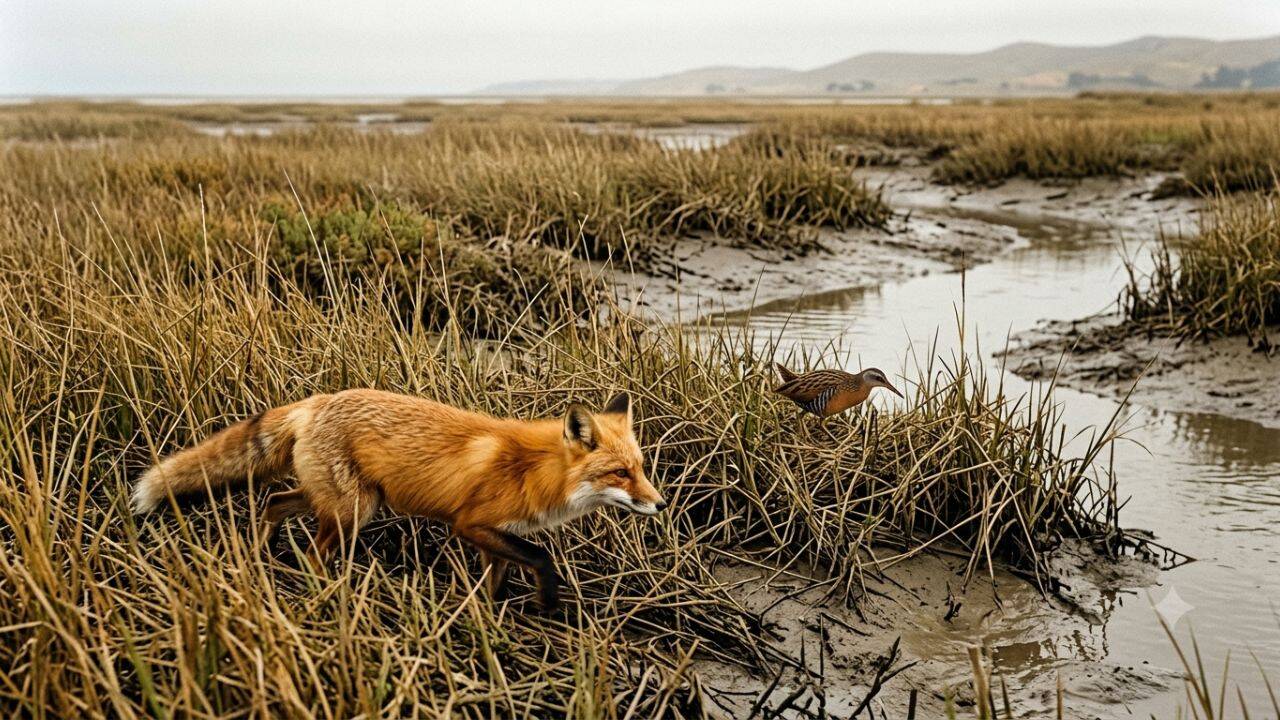
In the late 1800s, European red foxes (Vulpes vulpes) were brought to California for fur farming and sport hunting, setting off a slow-motion ecological collision that nearly drove the light-footed Ridgway's rail into extinction. By the close of the twentieth century, intensive predation at the Seal Beach National Wildlife Refuge plummeted local rail populations down to a precarious five breeding pairs. This historical oversight highlights how nineteenth-century commercial whims continue to dictate modern wildlife survival equations.
History often repeats itself as tragedy wrapped in an economic justification. During the late Victorian era, homesteaders and entrepreneurs saw California's diverse lowlands as a blank ledger waiting to be monetized. Fur farms sprouted across agricultural belts, while sport hunters demanded familiar game species from back East and Europe. No one paused to consider evolutionary isolation. Native California marsh species had developed over millennia without facing the cunning, highly adaptable hunting pressure of a placental canine predator specialized in ground nests.
The Anatomy of an Invasion
The escape and deliberate release of these animals changed everything. Red foxes did not merely survive in their new western home; they exploded across the Central Valley, the San Francisco Bay region, and eventually down to the coastal estuaries of Southern California. They found an environment fragmented by human development, crisscrossed by dikes, and tightly squeezed between urban sprawl and the ocean.
Consider a hypothetical example to understand the mechanism. A single pair of red foxes dropped near a fragmented wetland can exploit linear dry-land corridors, bypassing natural water barriers that would otherwise keep predators out. They do not hunt randomly. They systematically patrol the ecotone where land meets water.
The light-footed Ridgway's rail builds its nest precariously low, woven into the dense stems of cordgrass and pickleweed. These nests sit just inches above the tidal line. When a red fox walks through the marsh at low tide, the nests are entirely exposed to an opportunistic predator that treats ground-nesting birds as an effortless calorie source. Within seven years of the foxes establishing residency at Seal Beach, the local bird population was effectively erased down to those infamous five pairs.
The Complex Mechanics of Modern Control
Wildlife management rarely offers clean lines. When federal and state biologists finally recognized that non-native red foxes were pushing the rails over the edge, direct intervention became mandatory. Trapping and removal programs were initiated across critical coastal refuges.
Yet removing an invasive species from a heavily altered landscape triggers unexpected ecological shifts. As predator removal programs cleared out the red foxes, a secondary mammalian carnivore began to reclaim territory: the coyote. Conventional wisdom once painted all predators with the same broad brush. Ecologists discovered something fascinating instead. Coyotes actively suppress red fox populations through territorial dominance and direct competition.
Where coyotes returned to the edges of the managed marshes, red fox numbers stayed lower naturally. Managing a marsh is not about creating a sterile garden. It involves engineering a functional predator hierarchy where native apex carnivores inadvertently protect endangered ground-nesting prey by keeping hyper-adapted invasive mesopredators at bay.
The Persistent Shadow of Habitat Loss
Predator control solved an acute emergency, but it did not cure the patient. Today, the light-footed Ridgway's rail remains heavily endangered, hovering at hundreds of breeding pairs scattered across a fractured archipelago of surviving wetlands.
Climate change introduces an unyielding pressure that nineteenth-century fur farmers could never have envisioned. Sea level rise steadily drowns the high-marsh zones where rails seek refuge during extreme king tides. When rising water forces the birds out of the cordgrass, they lose the critical cover that protects them from avian raptors and remaining mammalian threats. Captive breeding programs release hundreds of birds back into the wild, yet every released rail enters a tightening bottleneck where habitat acreage shrinks year by year while human infrastructure holds the boundaries firm.
The ghost of nineteenth-century fur farming walks the dikes of every Southern California estuary. Protecting a rare marsh bird requires fighting not just current threats, but the enduring momentum of historical mistakes inscribed into the landscape.