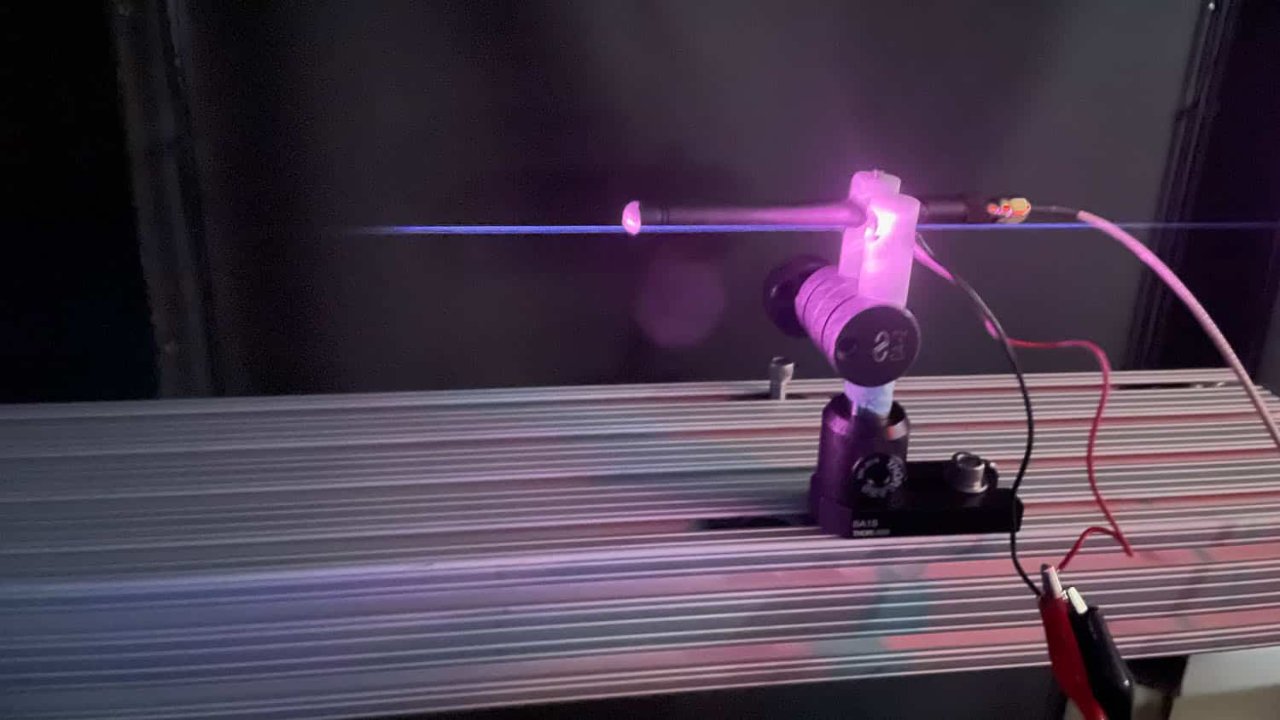
Headlines love a shiny multiplier. "2.5 times better reception" sounds like a magic trick. It isn't.
When coverage around a research breakthrough—like North Carolina State University's work on laser antennas boosting reception by 2.5x—reduces a complex optical-RF bridge to a single headline number, it trains engineers, executives, and investors to ask the wrong question. They ask how much louder the signal gets. They should be asking what problem actually limits high-frequency wireless and optical links in the first place.
Reception gain is not free. Every boost in received power or signal-to-noise ratio in an experimental or specialized link comes attached to trade-offs in beam alignment, optical power budget, atmospheric sensitivity, hardware complexity, and bandwidth. Treating a 2.5x improvement as a universal upgrade to wireless reception is lazy consensus dressed up as engineering news.
The Lazy Consensus Around "Better Reception"
In mainstream tech reporting, "better reception" gets treated like turning up the volume on a car stereo. More signal equals clearer audio, longer range, fewer dropped calls. Simple. Wrong.
At radio frequencies, a classic dipole or patch antenna interacts with electromagnetic waves whose wavelengths are centimeters or meters long. Pointing accuracy is forgiving. Diffraction helps signals bend around obstacles. Moving a receiver a few inches rarely kills the link completely.
Optical and laser-assisted antenna systems live in a completely different physical regime. Light wavelengths sit in the hundreds of nanometers to a few microns—thousands of times shorter than standard RF waves. A laser antenna or optical-to-RF conversion scheme does not behave like a giant metal rod magically pulling extra radio waves out of thin air. Instead, it relies on light, photonics, or optically modulated interactions to sense, convert, or route signals across bands that conventional electronics struggle to handle cleanly.
When a lab reports a 2.5x reception boost, the lazy reading assumes your phone, router, or base station will suddenly pull bars in a concrete basement. In reality, lab multipliers are measured under specific configurations, frequencies, carrier schemes, or noise floors. A 2.5x gain in a controlled optical-RF setup can be genuine, clever physics—and still be useless inside a pocket device running on a 3-watt thermal envelope.
I have watched hardware teams chase headline spec improvements for eighteen months only to discover their link budget collapsed the moment rain hit the radome or thermal drift shifted a laser wavelength by a fraction of a nanometer. A number on a benchmark sheet does not care about your product roadmap.
Defining Terms Before Anyone Gets Burned
Half the confusion around laser antennas comes from sloppy vocabulary. People mash together three distinct concepts and pretend they mean the same thing:
- Conventional RF antennas: Conductive structures tuned to resonant frequencies that radiate and capture electromagnetic waves directly.
- Free-space optical (FSO) transceivers: Point-to-point laser transmitters and receivers that send data via modulated light beams rather than radio waves.
- Laser antennas and opto-electronic/photonic RF front ends: Systems that use lasers, optical cavities, plasmonic or dielectric structures, or laser-driven carriers to detect, shape, or bridge high-frequency signals and optical waves.
Why does the distinction matter? Because physics sets different bottlenecks for each.
In classical electromagnetism—governed by Maxwell's equations and foundational antenna theory associated with figures like Heinrich Hertz and Sergei Schelkunoff—antenna gain and effective aperture are tightly bound to wavelength and physical geometry. You cannot cheat fundamental wave physics with marketing copy. If you shrink an antenna far below a wavelength, radiation resistance drops and losses climb unless you change the physical mechanism or operating band.
Bringing lasers into the picture changes the mechanism. Optical systems offer massive carrier frequencies and wide potential bandwidths, along with immunity to standard RF interference inside the optical path. Yet light brings its own brutal tax: tight angular tolerances, line-of-sight constraints, scattering in fog or dust, and laser eye-safety limits once power rises.
If you hear "2.5x reception" and picture a sleek, omnidirectional indoor gadget, you are confusing an RF antenna mental model with a photonics reality.
Are Laser Antennas Going to Replace Wi-Fi and 5G?
No. Anyone telling you laser antennas are about to replace Wi-Fi and 5G is selling fairy dust.
Wi-Fi and cellular networks win because they are messy, resilient, non-line-of-sight workhorses. Signals bounce off drywall, bend around corners, and stay connected while a person walks down a hallway or rides a train. A tight laser beam does not care about your convenience; if a delivery truck parks between the transmitter and receiver, or a hand blocks the aperture, optical link margin can vanish in milliseconds.
Where high-frequency and optical-assisted links actually make sense is in high-capacity backhaul, defense and aerospace links, specialized sensing, data center interconnects, and congested spectrum bands where point-to-point throughput and interference resistance outweigh mobility. Even there, adoption depends on cost, alignment automation, and reliability over years of continuous operation—not a single lab multiplier.
So when people ask whether a 2.5x reception boost means faster home internet tomorrow, the honest answer is no. Home internet bottlenecks are far more often tied to fiber/cable backhaul, ISP routing, congestion, and router placement than a 2.5x tweak to reception physics.
Imagine a Scenario Where Signal Gain Backfires
Imagine a scenario where a company builds a high-frequency wireless link for rooftop-to-rooftop industrial telemetry. A new laser-assisted reception method delivers a clean 2.5x improvement in signal strength under clear skies. The engineering team celebrates and cuts link margin to save hardware cost. Three months later, coastal fog and summer heat shimmer roll in. Signal fading spikes sharply, alignment drifts slightly on a sun-warmed mount, and the link drops packets during peak shift hours. A 2.5x boost under ideal conditions did nothing to rescue a system engineered without environmental margin.
That is the trap of celebrating peak multipliers instead of worst-case availability. In real deployments, availability at the 99.9% or 99.99% mark beats a shiny average gain every single time.
What People Usually Ask (And Where the Premise Breaks)
"Does a 2.5x reception boost mean 2.5x the range?"
Almost never in a simple linear way. In free space, signal power falls off with the square of distance (the inverse-square law), and in real environments multipath fading, absorption, and clutter distort that curve further. Increasing received signal strength or SNR by 2.5x can extend range or improve bit-error rate in a given regime, but range depends on propagation loss, noise floor, receiver sensitivity, and modulation coding—not a single multiplier applied blindly across every terrain.
"Why use lasers for antennas instead of sticking to radio waves?"
Because RF spectrum gets crowded, electronics face speed and noise limits as frequencies climb into millimeter-wave and terahertz territory, and optical frequencies offer vast bandwidth potential alongside distinct interaction physics. Radio waves aren't going anywhere—low-band and mid-band RF remain unbeatable for coverage and penetration. Lasers enter when you need what RF struggles to deliver cheaply or cleanly at extreme frequencies or tight spatial profiles.
"Is a 2.5x boost enough to make commercial products viable?"
Not by itself. A 2.5x lab result is a data point, not a bill of materials. Commercial viability requires manufacturable tolerances, stable operation across temperature swings, acceptable power draw, regulatory compliance, and clear economic value over existing alternatives. Many breakthroughs stay in journals because the surrounding system—lasers, modulators, alignment stages, packaging—costs too much or breaks too easily in the field.
The Nuance Behind the Multiplier
Here is what the competitor framing misses: a 2.5x reception boost is interesting not because it crowns a "winner" over traditional antennas, but because it highlights how cross-domain engineering between optics and high-frequency electronics can squeeze performance out of difficult regimes.
In real systems design, reception is only one link in a chain:
- Transmitter output and stability
- Channel propagation and atmospheric/physical obstructions
- Front-end capture, conversion, and noise figure
- Signal processing, error correction, and system latency
Improving one stage by 2.5x helps only if it isn't bottlenecked somewhere else. If your bottleneck is alignment jitter, optical loss, or digital processing limits, boosting one reception metric can yield diminishing returns at the system level.
Where My Contrarian Stance Can Hurt You
Being skeptical of headline multipliers has its own blind spot. Dismissing every lab gain as "not ready for prime time" is a great way to miss an inflection point.
History is full of technologies that looked clunky, narrow, or over-engineered in early demonstrations before becoming foundational in niche or high-value markets. If you write off laser and photonic-assisted RF work entirely because it won't replace home Wi-Fi tomorrow, you can get blindsided when optical-electronic integration matures in high-frequency communications, sensing, or specialized infrastructure.
The trick is refusing both extremes: don't swallow hype whole, and don't sneer at real physics just because it has rough edges.
Actionable Moves for Builders and Buyers
If you are evaluating laser antennas, optical-RF links, or high-frequency reception claims for a real project, stop reading press releases and run these checks instead:
- Demand the exact baseline and conditions. Ask what "2.5x" is measured against—signal power, SNR, sensitivity, bit rate—and under what wavelength, frequency, distance, and alignment state.
- Audit the full power and thermal budget. Include the laser source, drivers, cooling, and conversion stages, not just the receiving element itself.
- Test against the worst day, not the best day. Model fog, misalignment, vibration, temperature shifts, and obstructions before claiming a link is reliable.
- Compare total system cost against boring alternatives. Sometimes better antenna placement, cleaner filtering, forward error correction, or a proven RF band beats exotic hardware on cost and uptime.
- Invest in fundamentals that transfer. Whether a link uses copper, silicon, RF, or light, solid grounding in electromagnetics, noise analysis, and link budgets will save you every time.
Chase system reliability, not headline multipliers.