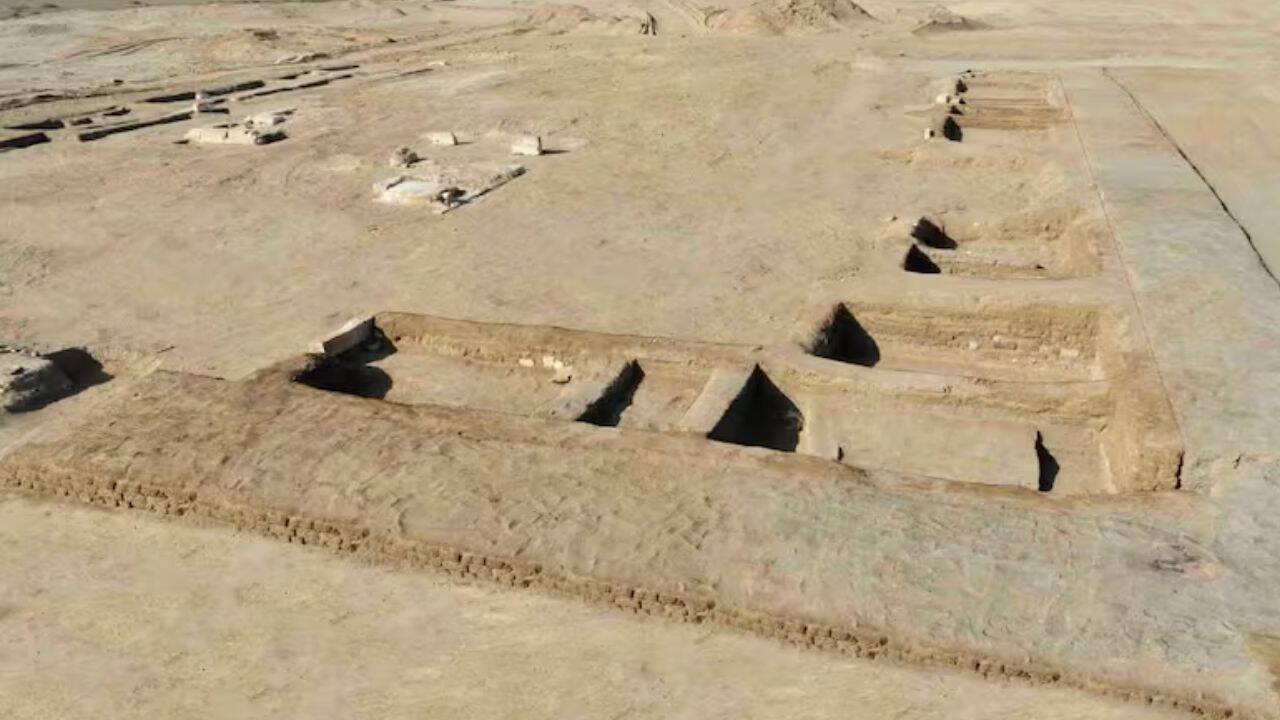
For nearly 140 years, historians have argued over the exact whereabouts of Masn. This ancient settlement guarded Egypt's eastern frontier, yet its physical coordinates remained a frustrating ghost in the archaeological record. That uncertainty might finally be over. An Egyptian archaeological team working at Tell Abu Seify in Qantara East just uncovered a massive, broken sandstone lintel bearing the royal titles of Ramses II. Carved into its three sides is a direct reference to a statue of Horus, describing the deity as the Lord of the City of Masn.
If you track ancient military logistics, you know how vital border posts were for the pharaohs. Tell Abu Seify sits directly along the route of the Ancient Horus Military Road. This strategic corridor connected the Nile Valley to the Sinai Peninsula and ancient Canaan. Finding an explicit text naming Masn right here gives researchers the strongest physical anchor yet. It cuts through decades of academic guesswork.
Behind the Dig at Tell Abu Seify
Archaeology rarely yields clean answers right away. When researchers first started digging deep layers at Tell Abu Seify in the Ismailia governorate, they misidentified several major structural elements. A massive mudbrick wall containing gateways and interior chambers was initially thought to be the core temple building itself.
Recent excavation work completely shifted that interpretation. Experts now recognize that this massive fortification formed the outer perimeter enclosing a sprawling temple precinct. Inside this boundary, the team mapped out two distinct stone-paved roads leading toward the sacred center. The older path dates back to the Ptolemaic Period, while a narrower Roman road sits directly on top of it.
You can literally read the architectural timeline as you move through the layers. Storage rooms line the northern side of the complex, while larger service rooms sit to the south. These utility spaces feed into what remains of the inner sanctuary.
Surviving War Quarries and Roman Barracks
Ancient sites rarely stayed sacred forever. By the third century AD, parts of this sprawling religious complex underwent a massive functional shift, converted directly into Roman military barracks. Soldiers needed fortified positions along the frontier, and recycling an older temple precinct made tactical sense.
Things got even worse for the ancient builders during the Late Roman Period. The sanctuary did not fall to an invading army or a sudden natural disaster. Instead, people cannibalized it for raw materials. Workers built large circular lime kilns right over the corners of the sanctuary, burning limestone blocks down to produce plaster and building mortar.
Despite centuries of stone-quarrying and reuse, the site still holds incredible artifacts. Alongside the Ramses II lintel, recent digs yielded a 2,500-year-old statue fragment of a military official holding a shrine, a basalt royal torso, and several falcon statues carved from limestone and basalt.
What Comes Next for the Search
Egyptian antiquities officials urge caution. While the Ramses II inscription provides a major breakthrough, researchers want more definitive proof before declaring the debate officially settled. Skeptics note that ancient stone blocks frequently moved over short distances during antiquity, meaning the lintel could theoretically have been transported from nearby sites like Tell Hebua.
Even with those academic caveats, the discovery breathes new life into the study of Egypt's eastern border defenses. As teams continue their field seasons along the Suez Canal zone, every newly unearthed fragment helps map out the real geography of the pharaohs.
Keep an eye on upcoming excavation reports from the Supreme Council of Antiquities. The sands of Qantara East still have plenty of secrets left to surrender.


