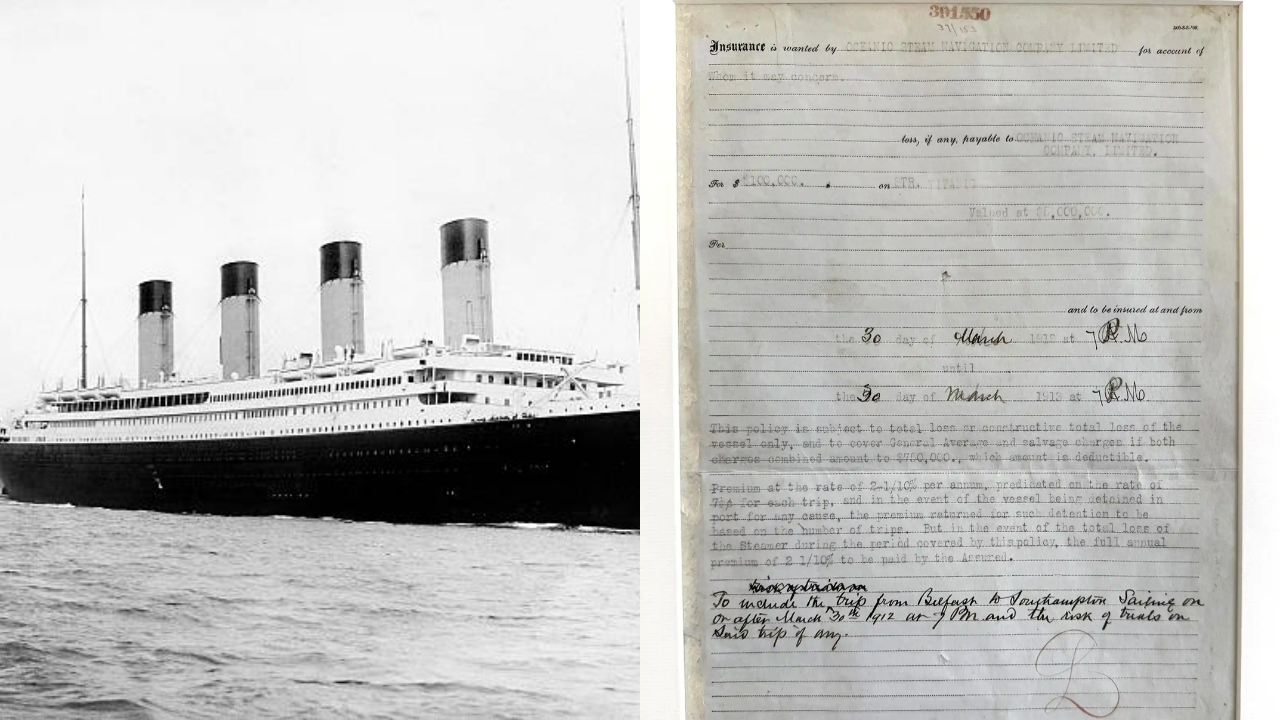
Within thirty days of the RMS Titanic sinking into the North Atlantic in April 1912, its owners collected a $5 million insurance payout, and more than a century later, an original cargo insurance certificate tied to that disaster has resurfaced with an estimated auction value of $67,000. That single piece of parchment does more than just mark a historic maritime tragedy. It exposes the brutal financial reality behind early twentieth-century shipping monopolies, the deliberate under-insurance of the world's largest vessel, and the frantic cash-flow mechanics that kept an international conglomerate from collapsing overnight.
Most coverage of Titanic memorabilia focuses on the romanticized tragedy of the passengers or the sheer novelty of a surviving piece of paper. Look closer at the ledger books, however, and a very different story emerges. The swift settlement of the Titanic insurance claim was not a gesture of corporate generosity from London underwriters. It was an existential necessity for J.P. Morgan’s International Mercantile Marine Co., the sprawling shipping trust that owned the White Star Line.
The Architecture of a Deliberate Under-Insurance
To understand why a $5 million payout happened so fast, you have to look at the math that preceded the maiden voyage. The RMS Titanic cost roughly $7.5 million to build in 1912—an astronomical sum equivalent to well over $200 million today. Yet when brokers at Willis, Faber & Co. approached the London insurance market to underwrite the hull and machinery, they only insured the vessel for £1 million, which translated to roughly $5 million at the prevailing exchange rate.
Why leave $2.5 million on the table? Because the global insurance market simply could not absorb the full risk of a single vessel that massive.
Marine underwriters in 1912 operated on strict capacity limits. Concentrating $7.5 million on one hull violated every rule of risk dispersion. To get the policy written at all, White Star Line agreed to self-insure the remaining $2.5 million through its own internal reserve funds. Furthermore, the policy carried a £150,000 deductible, meaning the owners absorbed the first chunk of any partial damage. This structure kept premiums manageable—around 15 shillings per £100 insured—while satisfying the minimum liquidity requirements demanded by the trust's bondholders.
The vessel was widely touted in the press as practically unsinkable, a reputation fueled by its sixteen watertight compartments. Underwriters bought into that engineering confidence. They priced the risk assuming a total loss was virtually impossible, treating the policy as easy premium income on a flagship route.
Thirty Days to Liquidity
When the ship struck an iceberg on April 14 and sank in the early hours of April 15, the financial shockwaves hit London and New York before the Carpathia even docked with the survivors. For International Mercantile Marine (IMM), the loss of the Titanic was a catastrophic blow to an already over-leveraged balance sheet. J.P. Morgan had assembled IMM a decade earlier by buying up competing transatlantic lines at inflated prices, saddling the conglomerate with massive debt obligations.
IMM needed cash immediately. Not in six months. Not after a prolonged maritime inquiry. Right away.
In modern corporate litigation, a disaster of this magnitude triggers years of forensic battles over negligence, seaworthiness, and crew competence. Had the underwriters at Lloyd’s of London and the major marine insurance companies chosen to contest the claim—arguing, perhaps, that Captain Edward Smith maintained excessive speed in a known ice field—the payout could have been tied up in British courts for a decade.
They did not contest a single penny.
The London insurance market understood that its entire global credibility rested on the speed of its settlement. If the world's premier maritime insurers hesitated to pay out on the most famous shipwreck in history, international trade would freeze. Within thirty days of the sinking, the syndicates liquidated reserves and transferred the full $5 million to the White Star Line's parent organization. It remains one of the fastest major catastrophe settlements in financial history, a stark contrast to the sluggish, bureaucratic claims processes that define modern corporate risk management.
The Cargo Certificate and the Secondary Market
While the $5 million hull policy kept the shipping giant afloat, a parallel web of smaller policies covered everything else inside the ship's hold. This brings us to the resurfaced document valued at $67,000. Unlike the master hull policy held by the ship's owners, cargo and specie certificates were issued to individual merchants, banks, and wealthy passengers shipping high-value goods across the Atlantic.
The Titanic was not just a floating palace; it was a high-speed freight carrier moving luxury commodities, securities, and mail. The cargo manifest included everything from cases of dragon’s blood resin and ostrich feathers to Renault automobiles and crates of fine wine. Each shipment required its own specific marine insurance certificate to protect the consignee against the perils of the sea.
These documents were printed on heavy, watermarked paper, signed by underwriting agents, and stamped with official seals. When the ship went down, claimants had to physically surrender their original certificates to collect their payouts, which is why surviving examples are exceptionally rare. The few that remain today typically survived because the shipper either held duplicate copies for accounting purposes or settled the claim through alternative commercial channels before the physical paperwork could be canceled and destroyed.
| Financial Metric | 1912 Value (USD) | Modern Context / Significance |
|---|---|---|
| Total Construction Cost | $7.5 Million | Built by Harland and Wolff in Belfast on a cost-plus basis. |
| Hull Insurance Payout | $5.0 Million | Settled in full within 30 days by London syndicates. |
| Uninsured Owner Loss | $2.5 Million | Absorbed directly by White Star Line's internal reserves. |
| Passenger & Cargo Claims | $16.8 Million | Original total filed in U.S. courts by victims and merchants. |
| Final Liability Settlement | $664,000 | Capped under the 1851 U.S. Limitation of Liability Act. |
The Brutal Math of Human Liability
The contrast between how the financial system treated property versus how it treated human life in 1912 exposes the harsh realities of early industrial capitalism. While the corporate owners received their $5 million within a month, the families of the 1,500 people who died were forced into a grueling legal war that dragged on for four years.
Survivors and grieving relatives initially filed claims totaling more than $16 million in New York courts. White Star Line responded by invoking the U.S. Limitation of Liability Act of 1851, a maritime law originally designed to protect American merchant shipping from ruinous lawsuits. Under this statute, a shipowner’s liability following a disaster was strictly capped at the post-accident value of the vessel plus any pending freight charges collected for the voyage.
Because the Titanic was sitting at the bottom of the ocean, its post-accident value was zero.
The only recoverable assets left for the victims' families were the surviving lifeboats—valued at roughly $5,000—and the passenger fares already paid for the trip, which totaled around $91,000. After years of legal maneuvering, the U.S. Supreme Court upheld the shipping line's right to limit its liability. In 1916, White Star Line agreed to an out-of-court settlement of just $664,000 to be divided among hundreds of claimants. A third-class passenger's life was routinely valued at less than a crate of insured luxury goods sitting in the cargo hold.
Why Historic Financial Artifacts Command Premium Prices
The $67,000 valuation on the resurfaced insurance certificate reflects a distinct shift in the high-end collectibles market. For decades, Titanic auctions were dominated by physical relics recovered from the debris field or personal items carried off the ship in lifeboats—pocket watches, menus, and boarding passes. Those artifacts carry immediate emotional weight, tying directly to the human drama of the sinking.
Institutional collectors and wealthy investors, however, increasingly prize documentary evidence of the financial and legal machinery behind major historical events. A cargo insurance certificate is a tangible artifact of global capitalism at its zenith. It represents the exact intersection of Gilded Age ambition, British underwriting dominance, and maritime law.
Valuation experts assess these documents based on three strict criteria:
- Direct Voyage Attribution: The certificate must explicitly name the RMS Titanic and correspond to the April 1912 sailing, rather than serving as a generic open-cover policy for the White Star Line.
- Signatory Provenance: Authentic signatures from recognized Lloyd's syndicates or major marine insurers like the British and Foreign Marine Insurance Company significantly elevate the price.
- Physical Condition: Paper surviving from early twentieth-century commercial archives is notoriously acidic and brittle; intact edges, legible stamps, and unfaded ink separate museum-grade pieces from standard ephemera.
The Structural Aftermath in London and New York
The $5 million payout did not save International Mercantile Marine. Burdened by excessive debt and disrupted by the outbreak of World War I two years later, J.P. Morgan’s shipping trust defaulted on its bond interest and entered receivership in 1915. The swift insurance settlement merely bought the conglomerate three more years of operational life.
In London, however, the payout cemented the absolute supremacy of the British insurance market. By absorbing one of the largest single-vessel losses in history without flinching, Lloyd’s syndicates proved that their capital reserves were deeper and more reliable than those of any competitor in New York, Hamburg, or Paris. Over the next several decades, global shipping lines willingly paid higher premiums to insure their fleets in London precisely because they knew the claims would be honored when disaster struck.
The disaster also forced an immediate overhaul of maritime underwriting standards. Insurers stopped taking shipbuilders' claims of unsinkability at face value. Policies written after 1912 introduced strict stipulations regarding lifeboat capacity, continuous wireless watch schedules, and seasonal route adjustments in the North Atlantic. Risk was no longer priced on prestige; it was priced on verifiable safety protocols.
When that $67,000 insurance certificate crosses the auction block, the winning bidder will not simply be buying a souvenir from a famous shipwreck. They will be acquiring the receipt for a $5 million financial lifeline that proved capital markets could price, absorb, and liquidate a historic catastrophe in thirty days flat.