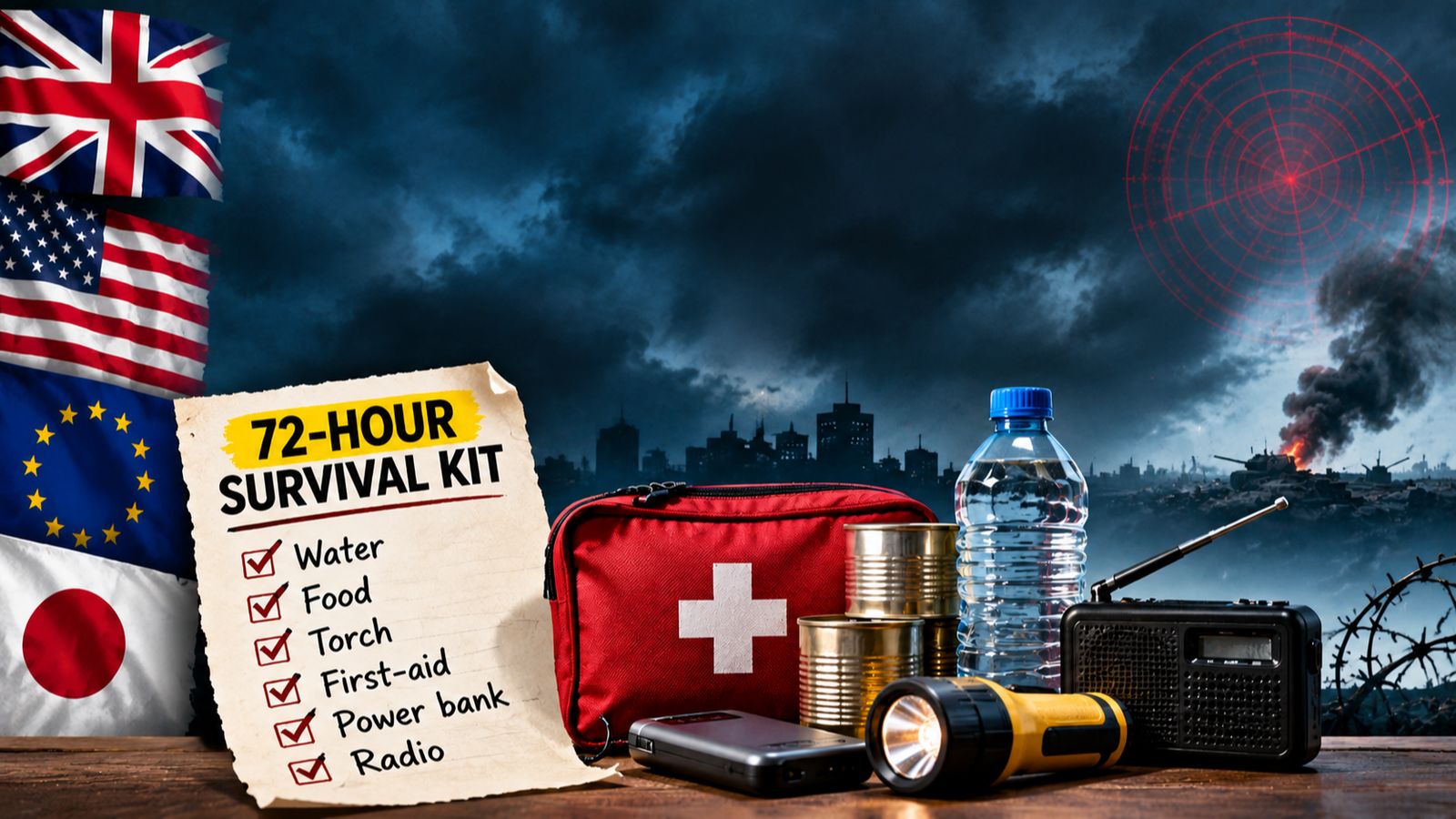
National governments do not issue 72-hour household preparedness mandates out of paternalistic concern; they issue them to solve a mathematical bottleneck in civil logistics. When a systemic shock strikes—whether a geomagnetic storm, a cyberattack on regional power substations, a pandemic supply freeze, or a seismic event—state emergency response capacity hits an immediate ceiling. The 72-hour threshold represents the precise operational window required for centralized authorities to transition from passive monitoring to active mobilization, clear primary arterial routes, and establish staging areas for mass distribution. Without decentralized household resilience during those first three days, first responders are forced to divert scarce bandwidth from critical infrastructure triage to basic life-support rescue for healthy citizens who simply ran out of water and calories.
The Anatomy of the 72-Hour Mobilization Gap
To understand why civil defense agencies across Europe, North America, and East Asia converge on the exact figure of three days, one must examine the mechanics of large-scale emergency logistics. Modern municipal infrastructure operates on just-in-time delivery principles with minimal buffer capacity. When a cascading failure interrupts the electrical grid or transportation networks, the state cannot instantly materialize resources at the point of need.
The mobilization gap breaks down into three sequential operational phases that consume the first 72 hours:
- Situational Assessment and Damage Triage (Hours 0–18): Immediately following a major disruption, command centers operate in an information vacuum. Telemetry fails, cellular networks congest or lose battery backup power, and physical access is blocked by debris or traffic gridlock. Emergency management agencies must deploy reconnaissance units, assess structural integrity across bridges and hospitals, and determine the geographic perimeter of the crisis before committing heavy logistics assets.
- Asset Mobilization and Corridor Clearance (Hours 18–48): Once priorities are mapped, reserve personnel must be activated, heavy equipment fueled, and military or municipal engineering corps deployed to clear primary transport arteries. Supply convoys cannot move until roadways are passable and staging hubs—such as regional airports, rail terminals, or stadiums—are secured and powered by auxiliary generators.
- Last-Mile Distribution Setup (Hours 48–72): Moving bulk pallets of water, rations, and diesel from national strategic reserves to regional hubs is a solved engineering problem. Breaking those pallets down into individual units and distributing them safely to millions of dispersed households is an exponential complexity problem. Setting up points of distribution (PODs), establishing crowd control, and initiating ration allocation routinely takes until the end of the third day.
If the civilian population lacks a 72-hour buffer, the entire sequence collapses. Citizens without water or essential medications begin flooding emergency dispatch lines within 12 hours and overwhelming hospital emergency departments within 24 hours. This creates a secondary crisis where rescue units must abandon grid restoration to conduct welfare checks and deliver basic sustenance.
The Fragility of Just-in-Time Urban Systems
The shift toward aggressive government preparedness campaigns—most notably in Nordic countries like Sweden and Finland, alongside updated civil defense directives from the European Union and FEMA—reflects a structural change in the threat environment. During the late twentieth century, civil defense focused on localized natural disasters where neighboring regions remained intact and could rapidly surge aid into the affected zone.
Contemporary risk modeling accounts for synchronous, wide-area disruptions. Hybrid warfare, coordinated cyberattacks against industrial control systems, extreme weather events spanning entire continental grids, and fragile globalized supply chains mean that neighboring municipalities may be simultaneously incapacitated. When mutual aid agreements fail because every jurisdiction is experiencing the same deficit, local self-reliance shifts from a lifestyle choice to a foundational requirement of national security.
Urban density amplifies this vulnerability through four tightly coupled dependencies:
- Water Pressurization: Municipal water systems rely on electric pumps to maintain positive pressure in water mains. Within hours of a wide-area blackout, water towers drain, pressure drops to zero, and groundwater contaminants can infiltrate pipes through microscopic cracks. Even when tap water remains available, it rapidly becomes non-potable without boiling or chemical treatment.
- Retail Inventory Velocity: Major grocery chains utilize automated inventory algorithms that hold roughly 48 to 72 hours of high-turnover perishables on store shelves. Electronic point-of-sale terminals, automated warehouse picking systems, and refrigerated trucking all depend on continuous grid power and telecommunications. Once panic buying begins, shelves strip bare in less than four hours.
- Pharmaceutical Supply Chains: Hospitals and retail pharmacies maintain lean inventories of critical maintenance drugs such as insulin, antihypertensives, and anticoagulants. Cold-chain failures during power outages render temperature-sensitive biologics useless within a single day.
- Telecommunications Collapse: Cell towers are typically equipped with battery backups rated for four to eight hours, with only primary hub sites supported by diesel generators. Once commercial power fails, mobile data degrades within hours, followed by total voice network loss, severing the public's ability to receive official emergency broadcasts.
The Economics of Decentralized Risk Transfer
From a public policy perspective, the 72-hour mandate is an exercise in decentralized risk transfer. Maintaining centralized strategic reserves capable of feeding, watering, and sheltering an entire national population from Hour 1 of a crisis is economically prohibitive. Warehousing perishable goods at national scale incurs massive recurring costs for climate control, stock rotation, spoilage write-offs, and dedicated distribution fleets that sit idle during normal operations.
By pushing the first 72 hours of inventory onto individual households, governments achieve a distributed storage network with zero municipal overhead. Citizens manage their own stock rotation through normal pantry consumption, absorb the storage footprint within existing residential square footage, and eliminate the last-mile delivery bottleneck during the most chaotic phase of an emergency.
This strategy relies on a clear division of labor between the citizen and the state:
- Household Domain (Hours 0–72): Hydration, caloric maintenance, thermal regulation, basic first aid, sanitation containment, and passive information reception via battery-powered or crank radio.
- State Domain (Hours 72+): Restoration of high-voltage transmission lines, repair of municipal water treatment plants, deployment of bulk fuel reserves, establishment of field hospitals, and sustained food distribution until commercial supply chains reboot.
Engineering a Functional 72-Hour Buffer
Effective household preparedness fails when treated as a shopping list of survivalist gadgets rather than an engineering problem built around human physiological limits. A functional 72-hour baseline requires addressing five non-negotiable operational categories, prioritized strictly by time-to-failure in the human body.
1. Hydration Architecture
Dehydration degrades cognitive function within 24 hours and becomes life-threatening within 72 hours. The standard baseline is three to four liters of potable water per person per day—two liters for direct consumption and one to two liters for basic hygiene and food preparation. A household of four requires a minimum of 36 to 48 liters of stored water. Relying on tap filling after an alert is issued is a high-risk failure mode, as municipal pressure drops precipitously during peak simultaneous draw. Storage must consist of sealed commercial containers or food-grade high-density polyethylene (HDPE) drums treated with stabilization drops, supplemented by a mechanical hollow-fiber membrane filter capable of removing bacteria and protozoa from compromised water sources.
2. Caloric Density Without Infrastructure
Food storage for a 72-hour window must assume zero access to electricity, natural gas, or running water for dishwashing. Calories should require zero cooking and minimal water to digest. High-sodium processed foods accelerate dehydration and increase water consumption requirements. Optimal inventories combine shelf-stable lipids, proteins, and complex carbohydrates: nut butters, canned fish or poultry, vacuum-sealed whole-grain crackers, dried fruits, and ready-to-eat military or humanitarian rations. For households with infants or medical dietary restrictions, specialized formula and therapeutic foods must be isolated from general pantry stock to prevent accidental depletion.
3. Thermal Regulation and Shelter Integrity
Loss of HVAC systems during winter cold snaps or extreme summer heatwaves turns residential structures into thermal traps within 12 to 24 hours. Modern glass-and-drywall construction loses heat rapidly once furnace blowers lose power. A 72-hour thermal plan requires passive insulation strategies: consolidating household members into a single interior room, sealing window drafts with heavy plastic sheeting and tape, and maintaining sub-zero-rated sleeping bags or wool blankets for each occupant. Indoor combustion heaters—even those marketed as indoor-safe—introduce lethal carbon monoxide and fire risks when deployed by fatigued occupants in sealed rooms; passive insulation is vastly superior to unvented combustion.
4. Off-Grid Information and Power Continuity
In an information vacuum, rumor drives irrational behavior, including premature evacuation into gridlocked or hazardous zones. Smartphones are poor emergency communication tools due to high power draw and reliance on vulnerable cellular infrastructure. A dedicated battery-powered AM/FM/shortwave radio with spare lithium primary batteries (which offer a ten-year shelf life and resist cold-weather voltage drop) provides one-way access to civil defense broadcasts. Power banks rated at 20,000 mAh or higher should be maintained at an 80 percent charge state solely to keep essential personal devices operational in airplane mode for offline medical records, maps, and flashlight utility.
5. Medical Continuity and Sanitation Containment
Emergency medical services will not respond to minor lacerations, sprains, or chronic medication lapses during a Level 1 grid event. Households require a 14-day buffer of all prescription medications—negotiated through early refill authorizations—alongside trauma basics: hemostatic gauze, compression bandages, antiseptic wipes, and oral rehydration salts. Sanitation is the most frequently overlooked failure point; when municipal water fails, toilets cease to flush after a single tank cycle. Without a containment protocol—heavy-duty contractor bags lining a standard toilet bowl, paired with absorbent cat litter or sawdust and dedicated hand sanitizer—human waste rapidly triggers secondary outbreaks of gastrointestinal illness inside the shelter space.
Operational Limitations of the 72-Hour Doctrine
While the 72-hour framework solves the initial mobilization bottleneck for acute, localized emergencies, it suffers from severe structural limitations when applied to modern systemic threats.
First, the 72-hour timeline is increasingly obsolete for grid-down scenarios. High-voltage transformers, substation switchgear, and submarine fiber-optic cables cannot be repaired or replaced within three days. A sophisticated cyberattack on power generation infrastructure or a severe geomagnetic storm would likely result in multi-week outages. Treating 72 hours as a finish line rather than a minimum baseline leaves households exposed at Hour 73, precisely when civil unrest and supply depletion peak. Forward-leaning civil defense agencies in Scandinavia and the Baltic states have quietly begun shifting their internal planning assumptions toward seven-to-fourteen-day self-sufficiency windows, even while keeping public messaging anchored at 72 hours to prevent psychological overwhelm and non-compliance.
Second, the doctrine assumes residential shelter-in-place viability. For renters in high-rise urban apartments, a loss of power eliminates elevator access, electric water pumps above the sixth floor, and natural ventilation. In dense urban cores during summer heatwaves, high-rise apartments become uninhabitable within 36 hours, forcing mass spontaneous evacuations that invalidate shelter-in-place assumptions.
Third, socioeconomic friction limits universal adoption. Expecting low-income households living paycheck-to-paycheck to maintain an unconsumed reserve of food, water, medical supplies, and backup power ignores liquidity constraints and cramped living conditions. Without targeted state subsidies or municipal neighborhood micro-hubs to backstop vulnerable populations, decentralized preparedness creates a tiered survival outcome where affluent neighborhoods stabilize while dense, lower-income districts collapse onto emergency services immediately.
Strategic Execution for Institutional and Household Resilience
Treating the 72-hour mandate as an exercise in consumer hoarding misses its strategic purpose. The objective is not to isolate a household from society indefinitely, but to buy the state's logistical apparatus 72 hours of unencumbered operational space to restore baseline utilities.
For individual households and organizational leaders managing distributed workforces, the optimal execution path is phased hardening rather than bulk acquisition:
- Audit Critical Dependencies First: Map every household or operational dependency on continuous grid power and municipal water—specifically refrigeration for biologics, electrically powered medical devices, and residential water pumping mechanisms.
- Establish a Rolling 7-Day Pantry Baseline: Abandon dedicated "emergency food buckets" in favor of expanding normal, shelf-stable pantry inventory by seven days using a strict First-In, First-Out (FIFO) rotation. This eliminates spoilage costs and ensures caloric familiarity during high-stress events.
- Decouple Communications from Cellular Networks: Standardize on offline-capable local information storage, physical copies of critical identification and medical records, and dedicated low-frequency radio receivers before investing in high-capacity battery generators.
- Extend the Buffer to 14 Days for Medical and Water Filtration Assets: While bulk water storage beyond 72 hours becomes spatially impractical for urban apartments, upgrading from stored bottled water to high-capacity gravity filtration systems extends hydration endurance from three days to several months at minimal marginal cost.