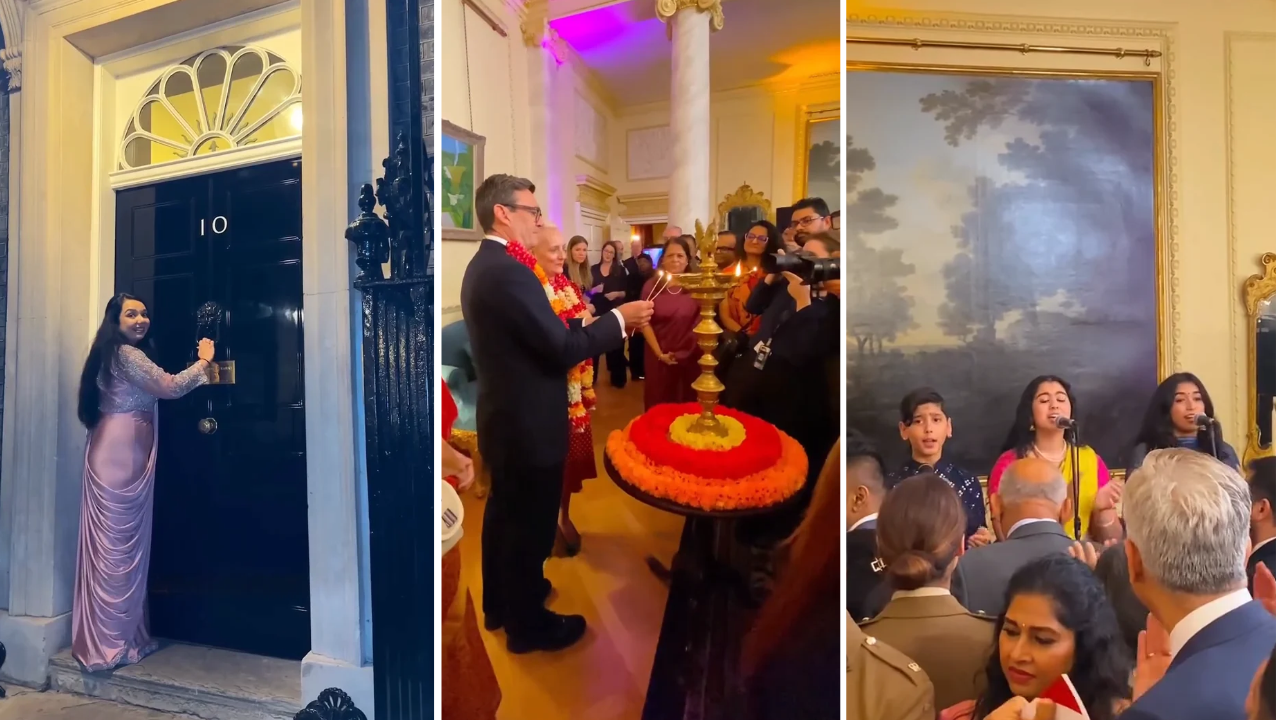
Most political receptions at 10 Downing Street are stiff affairs filled with lukewarm wine and rehearsed talking points. Diwali changes the room entirely.
When a guest recently pulled back the curtain on the UK Prime Minister's Diwali celebration, the details that went viral weren't about backroom policy deals or diplomatic handshakes. People cared about the sound of Bhagavad Gita verses echoing through the historic state rooms, the strictly vegetarian menu, and the fact that traditional Indian snacks replaced the usual British canapés. If you found value in this piece, you might want to read: this related article.
It's easy to dismiss these events as standard political photo ops. Every Prime Minister since Gordon Brown has hosted some version of a Diwali gathering behind that famous black door. Yet the cultural shift inside Number 10 over the past few years tells a much bigger story about British politics, diaspora influence, and what happens when religious authenticity meets the rigid machinery of the British state.
What Guests Actually Experience Inside Number 10
If you've never been to a Downing Street cultural reception, you probably picture a massive banquet hall. Reality is much tighter. The state rooms at 10 Downing Street are historic, ornate, and surprisingly compact once you pack a couple hundred community leaders, charity workers, business owners, and politicians inside. For another perspective on this development, see the latest update from Associated Press.
Security starts long before you see the famous black door. Guests clear airport-style screening at the entrance to Downing Street off Whitehall, hand over phones or follow strict photography rules depending on the specific event protocol, and walk up the famous yellow staircase lined with portraits of past Prime Ministers.
By the time you reach the Pillared Room or the Terracotta Room, the atmosphere shifts from cold Westminster bureaucracy to something closer to a community hall in Leicester or Wembley.
The Sound of Sanskrit in Westminster
The detail that caught the most attention from attendees wasn't the decor—it was the audio. Having sacred Hindu prayers and Bhagavad Gita verses chanted aloud inside the official residence of the British Prime Minister carries real weight for British Hindus, Sikhs, and Jains.
For decades, minority faith events in government buildings were treated like polite cultural exhibitions. You'd get a quick welcome speech, maybe a classical dance performance in the corner, and everyone went home. Bringing actual liturgical chanting—invoking peace, wisdom, and duty—into the center of British political power changes the dynamic from observation to participation.
When Rishi Sunak became Britain's first British Asian and Hindu Prime Minister in 2022, lighting diyas on the doorstep of Number 10 became a global image. Under subsequent leadership, including Keir Starmer's administration, the pressure to maintain that level of authentic cultural respect hasn't gone away. Nobody wants to be the Prime Minister who watered down Diwali back to generic finger food and a rushed speech.
Strictly Vegetarian Catering and Traditional Mithai
Food is always the quickest way to tell whether a government event actually consulted the community it's celebrating or just hired a standard Westminster catering contractor.
At a genuine Diwali reception at Downing Street, the catering rules are strict. Meat and alcohol—usually staples at Westminster receptions—are completely off the table out of respect for Hindu and Jain dietary traditions during auspicious festivals.
Instead, the silver trays circulating the state rooms carry classic Indian vegetarian street food and sweets:
- Samosas and kachoris served hot with tamarind and mint chutneys
- Dhokla and paneer skewers that hold up well in a standing-room crowd
- Traditional mithai including kaju katli, laddoos, and barfi arranged alongside mango lassi or masala chai
Anyone who has organized large-scale South Asian events in London knows how hard it is to get high-end Westminster kitchens to execute proper spices without dulling them down for a British palate. When guests specifically praise the vegetarian snacks on social media, it means the kitchen actually brought in specialist Indian caterers rather than letting standard civil service chefs improvise.
Why Downing Street Diwali Receptions Keep Making Headlines
Every October or November, social media lights up with videos from inside Number 10. Part of that comes down to simple curiosity. Most British taxpayers will never step foot past the wrought-iron gates of Downing Street, so any unfiltered smartphone footage showing what the carpets, chandeliers, and reception rooms look like during a live party gets instant traction.
There's also a deeper political reality driving the coverage. British Indians represent one of the largest, wealthiest, and most politically active demographic groups in the United Kingdom. According to the 2021 England and Wales Census, over 1.8 million people identify as Indian, making up more than 3% of the population—and their voter turnout consistently outpaces national averages.
Beyond Symbolic Politics
Politicians know that showing up for Diwali isn't optional anymore. Both the Conservative Party and the Labour Party spend months competing for the trust of British Hindu, Sikh, and Jain voters.
At the same time, hosting a lavish party doesn't automatically buy goodwill. British Asian voters have become far more cynical about surface-level pandering. Putting a garland around a politician's neck or handing out boxes of sweets won't erase frustrations over visa rules, healthcare waiting lists, small business taxes, or community safety.
What makes these inside accounts resonate with everyday people isn't the political speeches. Nobody remembers what the Prime Minister said at the podium three days later. People remember seeing elderly community volunteers from local temples standing in the exact same room where Winston Churchill and Margaret Thatcher once held cabinet meetings. They remember seeing bright lehengas, sherwanis, and bindis filling a space built during the height of the British Empire.
The Unspoken Rules of Attending a Number 10 Reception
When a guest shares their experience online, they're usually navigating a tight set of unwritten rules. Downing Street receptions operate under strict etiquette, even when the dress code swaps black-tie tuxedos for silk sarees and kurtas.
First, photography is tightly controlled. While the Prime Minister's official photographers capture staged portraits for press releases, guests are often restricted from filming inside certain rooms for security reasons. Whenever a guest does get permission to share a clip of the chanting or the food spread, it offers a rare, unvarnished look that official government press releases completely miss.
Second, the guest list is heavily vetted. Getting an invitation requires nomination through government departments, community organizations, or local MPs. The room usually mixes high-profile figures—like British Asian actors, athletes, and FTSE 100 executives—with grassroots charity founders who run food banks in Birmingham or youth clubs in Manchester.
How British Celebrations of Diwali Have Evolved
Compare today's Downing Street Diwali party to how the festival was treated in Britain thirty years ago, and the contrast is staggering.
In the 1980s and 1990s, major Diwali celebrations were largely confined to community centers, temples, and high streets in cities like Leicester—home to one of the largest Diwali light switch-ons outside India—or Southall in West London. National recognition from the government barely existed.
Tony Blair hosted the first official Downing Street Diwali event in the early 2000s, opening the door to formal state recognition. Since then, the celebration has expanded far beyond Number 10:
- Trafalgar Square now hosts an annual free Diwali festival drawing tens of thousands of Londoners of every background.
- The House of Commons and House of Lords hold separate cross-party Diwali receptions organized by parliamentary groups.
- Major British museums, universities, and corporate headquarters treat Diwali alongside Christmas and Eid as a standard fixture on the annual calendar.
Yet Downing Street remains the symbolic centerpiece. Seeing the Prime Minister's residence illuminated with diyas and rangoli designs sends an unmistakable message about who belongs at the table in modern Britain.
What Attendees and Observers Should Keep in Mind
If you're following the viral clips or hoping to attend a community or civic Diwali reception yourself, look past the spectacle and pay attention to the details that actually matter.
Watch who gets invited to speak and perform. Events that feature local temple priests, youth musicians, and grassroots charity leaders reflect genuine engagement with the community. Events stacked exclusively with wealthy political donors and celebrities are just standard fundraising mixers wearing festive clothes.
Notice whether the cultural elements are treated with real respect. Proper vegetarian catering, accurate pronunciation of prayers, and space for traditional rituals like lighting the lamp show that organizers did their homework.
For British South Asians watching from home, these glimpses inside Number 10 aren't about worshipping politicians. They're a reminder of how far immigrant families have come—from arriving in Britain with a few pounds in their pockets in the 1960s and 1970s to hearing the Bhagavad Gita chanted inside the country's highest seat of power. Keep holding leaders accountable on actual policy, enjoy the viral clips of samosas in the state rooms, and never let symbolic gestures replace real political substance.