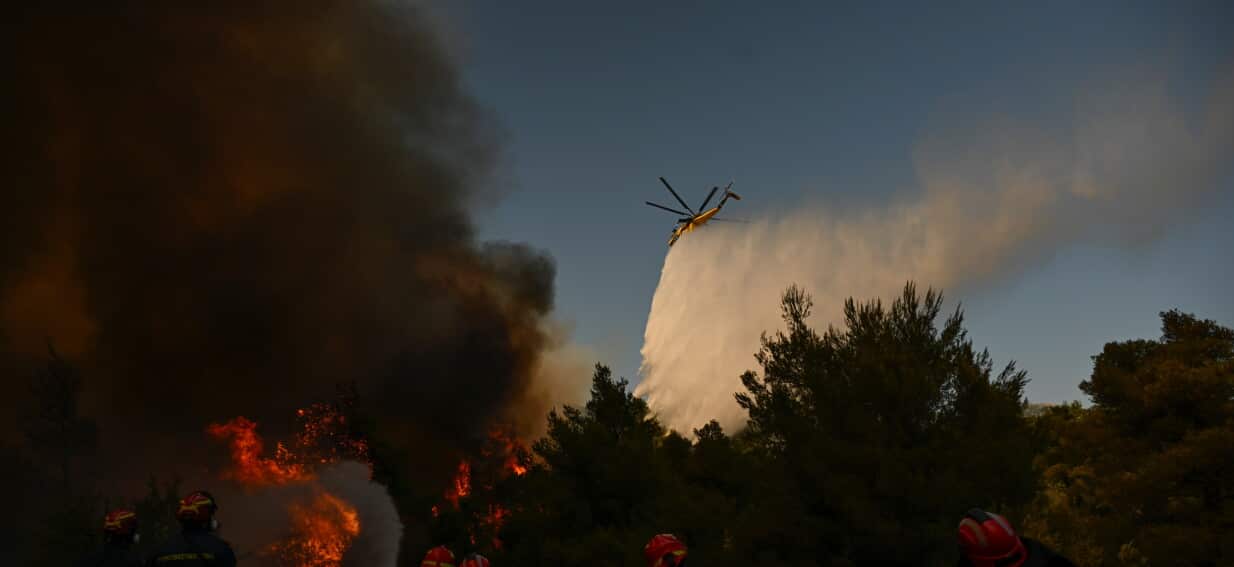
The mid-air collision of two heavy utility helicopters during active wildfire suppression west of Athens exposes the structural limits of aerial firefighting coordination under high-stress atmospheric conditions. When two aircraft operated by Australian contractor McDermott Aviation collided near Psatha, resulting in the deaths of a Danish pilot and a Greek fire service liaison officer, the incident shifted attention from political crisis management to the rigorous mechanics of multi-agency aerial asset deployment.
Aerial firefighting operations in Southern Europe rely on high-density scheduling where multiple heavy-lift assets share constrained airspace. Understanding how this tragedy occurred requires analyzing the operational variables that govern low-altitude flight paths during high-intensity wildfire suppression.
The Operational Density Variable
Wildfire suppression airspaces are compressed volumetric zones. Unlike commercial aviation, which relies on structured air corridors and predictable air traffic control separation, wildfire environments feature fluid, dynamically shifting focal points.
- Spatial Compression: Multiple aircraft must converge on identical drops zones, often restricted by mountainous topography such as the terrain near Porto Germeno and the Gulf of Corinth.
- Visibility Degradation: Atmospheric particulate density, smoke plumes, and localized thermal updrafts reduce visual range. Pilots must execute precision low-altitude maneuvers under degraded visual flight rules.
- Temporal Urgency: The time window between ignition spread and containment is narrow. Operational pressure encourages high frequency drop cycles, which increases intersection risks at staging nodes.
When rotorcraft from international providers integrate into local civil protection frameworks, communication channels must bridge linguistic and operational variations. The presence of cross-national crews—such as Danish pilots and Greek coordinators sharing a single cockpit—introduces a command-and-control variable that requires strict procedural standardization to eliminate cognitive friction during high-workload phases.
Atmospheric Stressors and Environmental Force Multipliers
The operational theatre in Attica during the August 2026 incidents was defined by compounded meteorological strain. Extreme temperatures, prolonged drought periods, and high-velocity winds create volatile aerodynamic conditions that directly alter aircraft performance profiles.
Heavy-lift helicopters operating at maximum gross weight margins experience degraded performance envelopes when ambient air temperatures spike. Rotor efficiency drops, density altitude increases, and localized wind shear generated by firefronts creates unpredictable turbulence. Under Beaufort scale force winds, which have characterized recent Mediterranean wildfire seasons, aircraft stabilization requires continuous pilot correction.
This creates a functional bottleneck. The mechanical strain on the airframe matches the cognitive load on the flight crew. As wind speed forces erratic fire behavior, tactical drop paths must change dynamically, increasing the probability of cross-path trajectory conflicts between assets managed by different response vectors.
Risk Distribution in Cross-Border Fleet Leasing
Contracted aerial firefighting introduces distinct administrative and operational dynamics. Private operators deploy heavy assets—such as the Bell platform series utilized in Greece—across multi-year international leasing agreements.
- Asset Allocation vs. Familiarization: Operators move fleets between hemispheres to match seasonal fire peaks, transitioning crews from Australian or American fire environments into European regional architectures.
- Command Integration: While private operators retain maintenance and aircraft airworthiness responsibilities, operational tactical tasking falls to local civil protection authorities and national fire services.
- The Protocol Gap: Investigating bodies typically partition causation across three vectors: technical failure, environmental interference, and human error. In complex aerial collisions, the primary failure mode is rarely a single mechanical breakdown; rather, it is a cascading breakdown in situational awareness caused by overlapping operational vectors.
Strategic Infrastructure Adjustments
To mitigate structural risks in multi-agency aerial firefighting, operational frameworks require strict spatial-temporal deconfliction protocols. Standardizing collision avoidance technology tailored for low-altitude rotorcraft operations, enforcing mandatory horizontal and vertical separation buffers during water-scooping and drop cycles, and establishing unified tactical radio protocols for international flight crews represent the foundational steps required to secure high-density airspaces against future catastrophic failures.
Two people killed as helicopters collide in Greece
This video coverage provides an initial visual breakdown of the geographic region and the operational parameters surrounding the multi-aircraft collision west of Athens.
http://googleusercontent.com/youtube_content/1