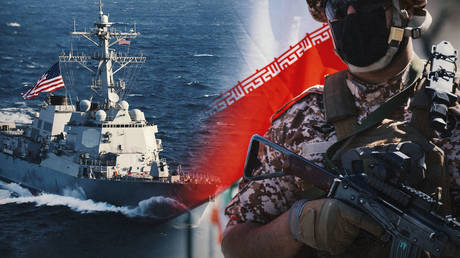
The headlines are screaming about a "call to arms." They want you to believe that the U.S. requesting allied warships in the Persian Gulf is a show of strength, a coalition of the willing standing tall against Iranian provocation. It’s a comforting narrative. It’s also a total fantasy.
When a superpower asks its friends to help police a puddle, it isn't leading. It’s hemorrhaging.
The standard media take on the Trump administration’s request for a multinational maritime security force is framed as a strategic pivot to protect global oil flow. They treat it like a neighborhood watch program. They’re missing the structural decay. This isn't about "freedom of navigation." This is about the brutal reality that the U.S. Navy can no longer afford to be the world’s unpaid security guard, and more importantly, the world knows it.
The Myth of the "Shared Burden"
Mainstream analysts love the phrase "burden sharing." It sounds equitable. In reality, it’s a confession of overextension. For seventy years, the U.S. dollar's dominance has been backed by a simple, unspoken deal: we secure the oceans, you trade in our currency.
By demanding allies send their own hulls into the Strait of Hormuz, the U.S. is unilaterally ripping up that contract. If London, Tokyo, and Berlin have to provide their own kinetic protection, the fundamental value proposition of the American-led order evaporates. Why hold Greenbacks if the Seventh Fleet won't show up unless you bring your own escort?
I’ve spent years watching policy "experts" mistake activity for achievement. Sending a British Type 45 destroyer or a French frigate into the Gulf doesn't change the tactical math against Iran’s asymmetric swarm tactics. It just increases the number of high-value targets.
Why the Strait of Hormuz is a Tactical Graveyard
The "lazy consensus" suggests that more ships equals more safety. This ignores the physics of the geography. The Strait of Hormuz is a 21-mile-wide choke point. In modern naval warfare, putting a multi-billion dollar Aegis destroyer in those waters is like driving a Ferrari through a minefield and calling it "patrolling."
Iran doesn't need a blue-water navy to win. They have:
- Shore-based anti-ship cruise missiles (ASCMs) tucked into the limestone cliffs of the Zagros Mountains.
- Thousands of fast-attack craft that cost less than the paint on a U.S. hull.
- Smart mines that can be deployed by civilian dhows.
When we invite allies into this environment, we aren't creating a "shield." We are creating a diplomatic hostage situation. One lucky hit on a Japanese tanker or a German corvette forces a choice: total regional war or a humiliating retreat. The "coalition" is actually a liability multiplier.
The $100 Billion Distraction
Everyone is asking, "Will the allies join?" The real question is: "Why are we still obsessed with 20th-century power projection?"
While the U.S. begs for help guarding oil tankers, the real war for energy dominance is happening in the Permian Basin and in the laboratory. The U.S. is now a net exporter of petroleum. The oil flowing through Hormuz isn't even primarily destined for American shores—it's heading to China and India.
The U.S. is effectively subsidizing the energy security of its primary economic rivals using the lives of its sailors and the tax dollars of its citizens. Asking for "allied warships" is a desperate attempt to maintain a legacy system that no longer serves the national interest.
The Financial Contagion No One Talks About
Let’s talk about insurance. War risk premiums for tankers in the Gulf haven't just risen; they've mutated. When the U.S. calls for a "coalition," the Lloyds of London underwriters don't see "safety." They see "escalation."
Every time a politician talks about "retaliation" or "escorts," the cost of doing business spikes. This isn't just a tax on oil; it’s a tax on the entire global supply chain. The "security" we are providing is actually the very thing destabilizing the market.
Imagine a scenario where the U.S. simply stopped. Imagine if we said, "The Strait is an international waterway; if China wants their oil, China can escort it." The geopolitical shock would be cataclysmic, but it would finally align responsibility with consumption.
The Death of the "Supercarrier" Era
The push for allied support reveals a terrifying truth that the Pentagon refuses to admit: the U.S. Navy is too small for its mission. We are down to roughly 290 deployable ships. To maintain a constant presence in the Gulf, the South China Sea, and the North Atlantic, we are running our crews into the ground.
Asking for allies isn't a diplomatic choice. It’s a maintenance crisis.
We’ve spent decades building "exquisite" platforms—ships so expensive we can’t afford to lose a single one. This makes us risk-averse. A commander who loses a $13 billion Ford-class carrier loses the war, the era, and the empire. Iran knows this. They don't have to sink us; they just have to make us too afraid to move.
The Actionable Reality
If you are waiting for a "return to stability" in the Middle East, you are betting on a ghost. The era of the U.S. as the global maritime hegemon ended the moment we asked for help.
For investors and industry leaders, the play isn't to watch the ship counts. It's to decouple from the geography.
- Infrastructure over Intervention: The real winners are the pipelines that bypass the Strait (like the East-West Pipeline in Saudi Arabia or the Habshan–Fujairah line).
- Asymmetric Hedging: Stop looking at the price of Brent; look at the cost of maritime insurance and the shift toward localized energy production.
- The Drone Pivot: Naval power is moving toward low-cost, expendable autonomous systems. If your "security force" doesn't look like a swarm of cheap sub-surface drones, it’s just a target.
The "coalition" isn't a sign of a healthy alliance. It’s the final gasp of a 1945 strategy in a 2026 world. We are watching the auctioning off of the American peace.
Stop asking if the allies will show up. Start asking what happens when the U.S. finally admits it's time to go home.
The warships are coming, but the era of the safe harbor is gone.