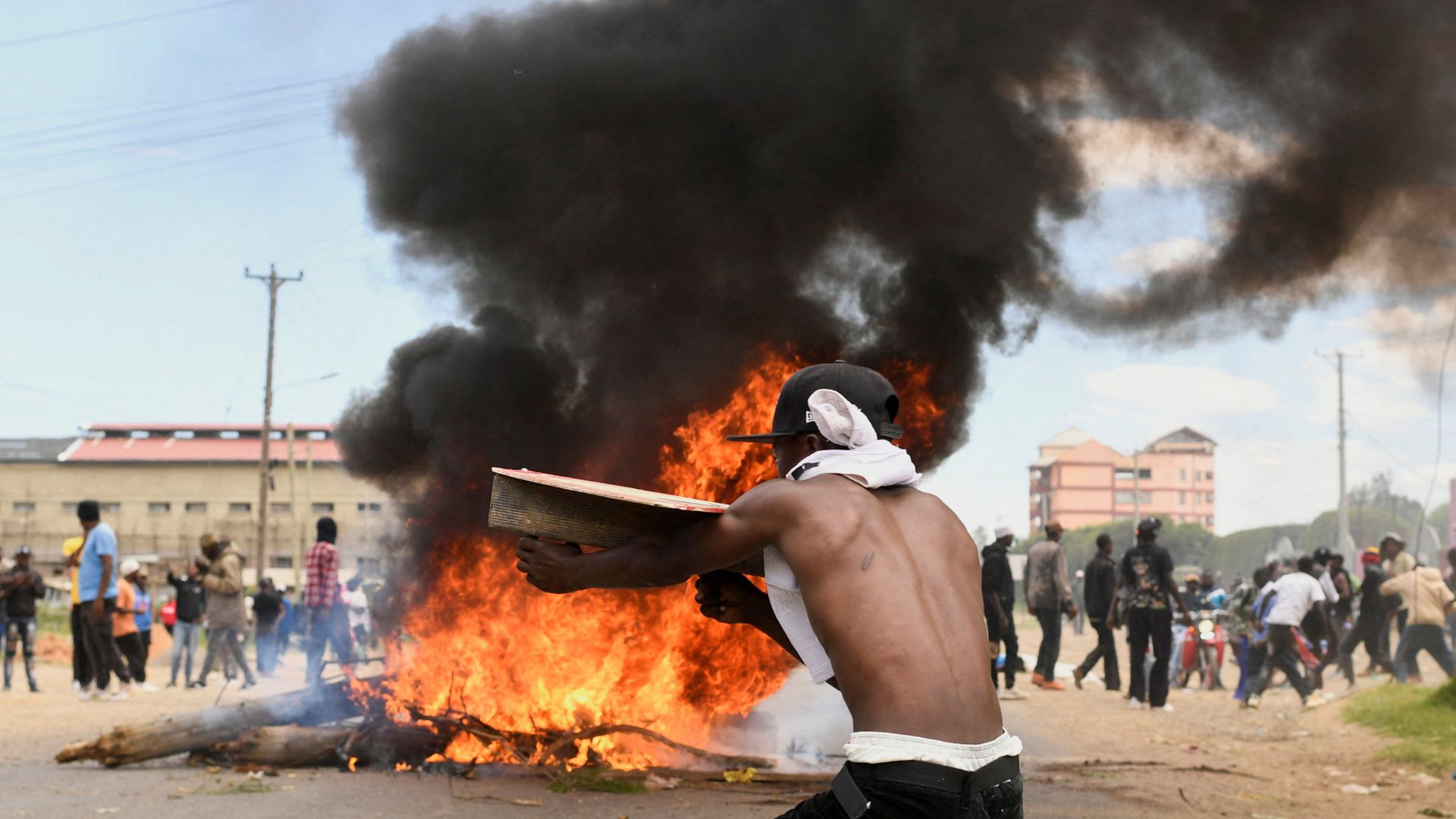
The tension in Nanyuki had been building for days before the streets finally erupted. On Monday, hundreds of young Kenyans marched toward the gates of Laikipia Air Base. They burned tires, threw up roadblocks, and chanted against a plan hatched thousands of miles away in Washington. By Tuesday morning, two of those demonstrators were dead, shot during clashes with security forces who used tear gas and live ammunition to push crowds back from the military installation.
This isn't just a local skirmish over a construction site. It's a geopolitical flashpoint. The protests target a planned 50-bed U.S. military quarantine facility designed to house American citizens exposed to the Bundibugyo strain of Ebola currently tearing through the eastern Democratic Republic of Congo and parts of Uganda.
Kenyans are angry, and it's easy to see why. The underlying issue feels painfully lopsided. Washington has made it clear that it won't allow potentially infected Americans back onto U.S. soil, yet it expects Kenya to shoulder the biological risk instead. Local doctors, activists, and residents are calling it what it looks like, an exercise in medical colonialism.
The Outsourcing of Biological Risk
The current Ebola outbreak in Central Africa is severe. Since it was declared on May 15, the virus has racked up over 900 suspected cases and more than 220 deaths. Health experts on the ground openly admit the true numbers are likely much higher due to weeks of undetected spread.
In response, the Trump administration took a hardline stance. During a recent cabinet meeting, the message was blunt, the U.S. will not permit any Ebola cases to cross its borders. This is a massive shift from the 2014-2016 West Africa outbreak when infected American aid workers were flown to specialized biocontainment units in Atlanta and Nebraska. This time, Washington is outsourcing its isolation strategy.
The plan sounds clinical on paper. The U.S. Public Health Service would staff a temporary facility inside Kenya's Laikipia Air Base. It would hold asymptomatic Americans who had been exposed to the virus while working in neighboring conflict zones. If they stay healthy through the incubation period, they go home. If they show symptoms, the U.S. promises to fly them to other countries like Germany or the Czech Republic, which have already accepted a handful of patients.
But out here in the real world, viruses don't respect chain-of-command protocols.
Nanyuki is a bustling market town of 70,000 people sitting right on the equator. It serves as a major agricultural hub and hosts a permanent British Army training unit. The local economy relies on heavy daily interaction. Hundreds of local Kenyans walk onto that air force base every single day for work. They clean the facilities, supply the food, cook the meals, and maintain the infrastructure.
If the virus breaches the perimeter of that base, it doesn't stay behind military wire. It walks right out the front gate into the markets, the public minibuses, and the crowded neighborhoods of Laikipia County.
A Legal Roadblock and High Altitude Defiance
While anger boiled over in the streets, a parallel battle played out in Kenya's judicial system. The Law Society of Kenya alongside the Katiba Institute, a prominent legal advocacy group, filed a constitutional challenge against the project. They raised a simple argument, the deal bypassed public participation, threatened national sovereignty, and put an already fragile domestic healthcare system at catastrophic risk.
The courts agreed. Last week, a High Court judge issued a temporary order halting all operations linked to the facility. On Tuesday, High Court Judge Patricia Nyaundi extended that block for another three weeks. She didn't stop there. Nyaundi ordered the Kenyan government to hand over all secret agreements, operational protocols, and pacts signed with Washington within seven days. The next formal hearing is set for June 23.
But there's a glaring disconnect between court orders and military reality. Local diplomatic sources and U.S. officials confirmed that even after the first court injunction landed, heavy American military cargo planes kept landing at Laikipia Air Base. They kept offloading equipment. They kept flying in personnel.
To the average Kenyan watching these planes descend, it looked like a total disregard for local law. It gave the distinct impression that agreements made between heads of state mattered more than the rulings of Kenya's highest judges.
The Political Backlash and Elite Disconnect
Kenyan President William Ruto finds himself cornered, caught between an angry electorate and a powerful Western ally. Speaking during a media roundtable in Wajir, Ruto tried to de-escalate the crisis by reframing the narrative. He argued the facility isn't an exclusive American isolation camp but rather a joint initiative designed to upgrade Kenya's overall bio-defense and emergency preparedness.
Ruto revealed that the arrangement came out of a direct personal request from U.S. President Donald Trump, pointing to decades of bilateral health cooperation. To sweeten the deal, Washington pledged $13.5 million toward Kenya's domestic Ebola preparedness.
The political defense isn't going down well. Local leaders have broken ranks with the national government. Laikipia Governor Joshua Irungu came out publicly against the camp, echoing his constituents' fears about local workers tracking the virus home.
The anger among medical professionals is even sharper. Dr. Davji Atellah, leader of the Kenya Medical Practitioners, Pharmacists and Dentists Union, released a scathing statement warning that the union would not tolerate Kenya being used as a containment colony. His logic is unassailable, if this virus is considered too dangerous to enter the United States, a superpower with the most well-funded medical infrastructure on earth, it's far too dangerous to be dumped into Kenya.
Real Consequences of Epidemic Panic
The fear driving the Nanyuki protests isn't irrational paranoia. It's grounded in the lived experience of recent history. Residents still remember the economic devastation of the Covid-19 lockdowns. For small-scale traders, market vendors, and motorcycle taxi riders, a localized outbreak doesn't just mean a health crisis. It means the return of police-enforced curfews, travel bans, and the sudden collapse of their livelihoods.
When your survival depends on daily cash-in-hand transactions, you can't afford a quarantine zone in your backyard.
This crisis highlights a structural flaw in global health security. When wealthy nations manage pandemics by exporting risk to developing countries, they don't solve the problem. They just move the friction points. The immediate fallout in Nanyuki proves that public health policy cannot be dictated from behind closed doors without domestic oversight.
If you're watching how international health partnerships evolve, expect deeper scrutiny moving forward. True biosecurity requires transparency, local consent, and mutual risk-sharing. For now, the construction in Nanyuki is stalled by a court order, the local population remains on high alert, and the families of two protestors are left mourning the cost of a global policy shift they never asked for.