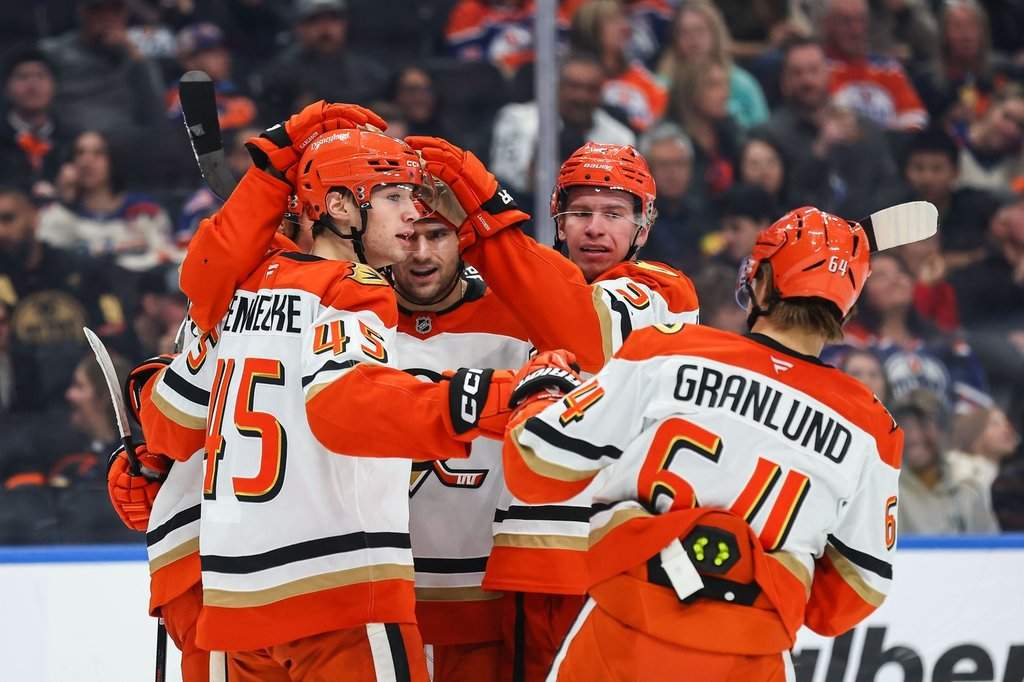
The Anaheim Ducks did not beat the Edmonton Oilers by accident, and they certainly did not do it by playing safe hockey. Anaheim skated into a matchup against one of the Western Conference’s premier offensive juggernauts and beat them at their own track-meet game, maintaining a torrid scoring pace that left Edmonton’s defensive structure in tatters. While surface-level box scores frame the night as another wild, high-event shootout, the underlying reality is far more revealing. The Ducks systematically exploited Edmonton’s chronic neutral-zone gaps and transition weaknesses, proving that Anaheim’s youthful offensive surge is backed by tactical substance rather than mere shooting-percentage luck.
For years, the narrative surrounding the Anaheim Ducks centered on patience. Front-office executives preached development while fans endured lottery finishes and lopsided losses. That grace period is over. When a rebuilding roster consistently hangs crooked numbers on perennial postseason contenders, the league has to recalibrate its scouting report. Against the Oilers, Anaheim demonstrated that speed without structure is just cardio, whereas speed paired with disciplined puck support turns every defensive zone exit into a three-on-two rush.
Why Anaheim’s Offensive Surge Is Not a Fluke
Skeptics love to point at high-scoring stretches and yell regression. In modern hockey analytics, a sudden spike in goals per game is usually dismissed as an unsustainable run of puck luck, bouncy rebounds, and backup goaltenders having bad nights. That dismissal misses what is actually happening on the ice when the Ducks possess the puck in the offensive zone.
Anaheim is no longer settling for low-danger perimeter shots from the half-wall. Watch their entry patterns against Edmonton. Instead of dumping the puck into the corner and praying a forechecker wins a fifty-fifty board battle against heavier defensemen, the Ducks are using middle-lane speed to push opposing defenders back onto their heels. Once the blue line is gained, the puck carrier immediately looks for the trailer entering the high slot.
It is a simple geometric problem. When defensemen retreat to protect against speed down the wings, the middle of the ice opens up like a highway. Anaheim’s young forwards have developed the poise to delay for a split second at the top of the circle, waiting for Edmonton’s backcheckers to overcommit before sliding passes into the soft areas between the hash marks.
- High-danger shot volume has replaced perimeter dumping as the primary offensive identity.
- East-west puck movement forces opposing goaltenders to move laterally before releasing shots.
- Aggressive defenseman activation keeps the puck alive at the blue line, turning potential clears into extended zone time.
Consider a standard sequence in the second period. Rather than firing a routine wrist shot into the goalie’s chest to force a whistle, an Anaheim winger curls back toward the blue line, absorbs contact, and hits the weak-side defenseman pinching down from the point. That single pass forces three defenders to pivot simultaneously. By the time the shot actually leaves the stick, the screening forward has already established position in front of the crease. You do not need shooting luck when the goaltender cannot see the puck until it is behind him.
The Structural Rot Inside Edmonton’s Defensive Zone
To understand how the Ducks kept their scoring pace humming, you have to look closely at what Edmonton gave away. The Oilers have spent half a decade trying to build a championship-caliber defensive environment around generational offensive superstars. Nights like this expose just how fragile that foundation remains when the puck drops against a fearless, fast-skating opponent.
Edmonton’s primary flaw is not a lack of effort. It is a chronic disconnect between their forwards and their defensemen during transitions. When the Oilers turn the puck over inside the offensive blue line, their forwards frequently get caught cheating toward the neutral zone, anticipating a quick counterattack that never materializes. That leaves their defensive pairs stranded on an island against wave after wave of oncoming attackers.
Breakdown at the Blue Line
Gap control is the lifeblood of modern NHL defense. If a defenseman allows an attacker to cross the blue line with full speed and possession, the defensive zone coverage is already compromised. Against Anaheim, Edmonton’s defenders repeatedly backed into their own goaltender, surrendering the top of the circles without forcing a single dump-in.
Why does this happen to veteran blueliners? Fear of getting burned wide. Anaheim’s top-six forwards possess the kind of straight-line acceleration that punishes any defenseman caught flat-footed at the red line. By giving up the entry to protect against the breakaway, Edmonton’s defense effectively traded a low-percentage rush chance for forty seconds of sustained cycle pressure.
Goaltending Left Out to Dry
Whenever the Oilers surrender four, five, or six goals, the local sports talk radio circuits immediately demand a new goaltender. It is the oldest, laziest scapegoat in hockey. While Edmonton’s netminders rarely steal games when the structure collapses around them, blaming the crease for this loss ignores the sheer volume of cross-seam passes allowed right through the royal road—the imaginary line connecting the two faceoff dots through the center of the slot.
A hypothetical scenario illustrates the impossibility of the task. Imagine a goaltender tracking a puck carrier moving down the left wing. The goalie sets his angle, squares his shoulders to the shooter, and prepares for a shot from a sharp angle. At the last millisecond, the shooter fires a hard pass across the crease to a teammate stationed at the back door. Even the most athletic netminder in the world cannot push off, slide six feet laterally, and seal the far post before a one-timer hits the back of the net. Edmonton allowed that exact play to unfold repeatedly because their weak-side wingers failed to track back into the house.
Tactical Adjustments That Tilted the Ice
Coaching matches in the NHL often come down to who blinks first when the game turns chaotic. When the goals started piling up early, the conventional wisdom suggested Anaheim should lock down the neutral zone, deploy a conservative one-two-two trap, and protect their lead by suffocating the clock.
They refused to do it.
Keeping the foot on the gas against a team featuring elite offensive talent feels reckless on paper. Give high-end scorers extra possessions, and they will eventually make you pay on the power play or off the rush. Yet Anaheim’s bench boss recognized a fundamental truth about Edmonton’s roster construction: the Oilers are built to play from ahead, not to grind through a disciplined comeback when they are forced to expend energy in their own end.
By maintaining an aggressive two-man forecheck even while holding a multi-goal cushion, the Ducks forced Edmonton’s defensemen to make hurried, low-percentage breakout passes under heavy physical duress. Instead of allowing the Oilers to gather speed through the neutral zone with clean tape-to-tape passes, Anaheim turned every Edmonton breakout into a frantic scramble along the glass.
- First forechecker angles the puck carrier away from the middle of the ice, eliminating the easy center-lane outlet.
- Second forechecker anticipates the rim around the boards and seals the strong-side half-wall before the winger can chip it out.
- Weak-side defenseman pinches down the wall only when the puck is bobbling, ensuring no odd-man rush develops behind him.
This relentless pressure disrupted Edmonton’s rhythm entirely. You could see the frustration mounting on the Oilers' bench as shift after shift ended with iced pucks, exhausted defenders, and faceoffs deep in their own territory. You cannot score from two hundred feet away from the opposing net.
The Shift in Pacific Division Dynamics
For the past several seasons, the hierarchy in the Pacific Division was set in stone. Edmonton sat near the top alongside a couple of seasoned heavyweights, while Anaheim occupied the basement, serving as an automatic two points on the schedule for teams chasing home-ice advantage in the playoffs.
That dynamic is fracturing in real time. The Ducks are no longer just a fun, plucky young team that plays hard for forty minutes before running out of gas in the third period. They are dictating pace against playoff-bound opponents and winning games in hostile environments.
For Edmonton, the implications are far more sobering. Losing a random regular-season game in November or December does not ruin a season, nor does it erase the undeniable firepower sitting at the top of their lineup. However, losing in this specific fashion—getting out-skated, out-structured, and out-scored by a younger, hungrier roster—highlights vulnerabilities that general managers cannot easily fix at the trade deadline. You cannot acquire team-wide defensive commitment in a one-for-one swap for a third-round draft pick.
What Scouting Reports Must Now Account For
Opposing coaches preparing for Anaheim can no longer treat them as a one-line threat. The scoring depth displayed against the Oilers proved that shutting down the Ducks' top center does not stop the bleeding. Secondary lines are winning their matchups, driving possession, and capitalizing on power-play opportunities with crisp, decisive puck movement.
Teams that try to trade chances with Anaheim right now are walking into a buzzsaw. The Ducks thrive in chaos because their young legs recover faster on the backcheck and their forwards attack the net with zero hesitation. To beat them, opponents have to slow the game down to a crawl, clog the neutral zone, and force Anaheim’s young skill players to win battles in the dirty areas along the boards—precisely the kind of gritty, low-event hockey Edmonton proved utterly incapable of playing.
The Myth of Outscoring Your Mistakes
Every high-scoring team eventually falls in love with its own offense. It is an intoxicating trap. When the puck is going in the net four or five times a night, defensive lapses feel trivial, almost forgivable. Why worry about a missed backcheck or a sloppy turnover at the blue line when your top line can go down the ice thirty seconds later and get the goal back?
Edmonton has lived inside that illusion for years, relying on transcendent individual brilliance to paper over systemic defensive flaws. Against Anaheim, the bill finally came due. When the Ducks matched Edmonton’s firepower shift for shift while playing with significantly better structure without the puck, the Oilers had no secondary gear to shift into.
Meanwhile, Anaheim has to guard against the exact same hubris. Riding a torrid scoring pace builds immense confidence in a young locker room, turning hesitant prospects into assertive NHL regulars. Yet sustainable winning requires understanding why the goals are coming. The Ducks did not beat the Oilers because they played pond hockey; they beat them because they outworked Edmonton in the trenches, won the neutral-zone battles, and attacked the slot with ruthless efficiency.
If Anaheim keeps treating defensive structure as the engine that drives their transition offense rather than an afterthought, this scoring surge will be remembered as the exact moment the Pacific Division’s balance of power tilted permanently.