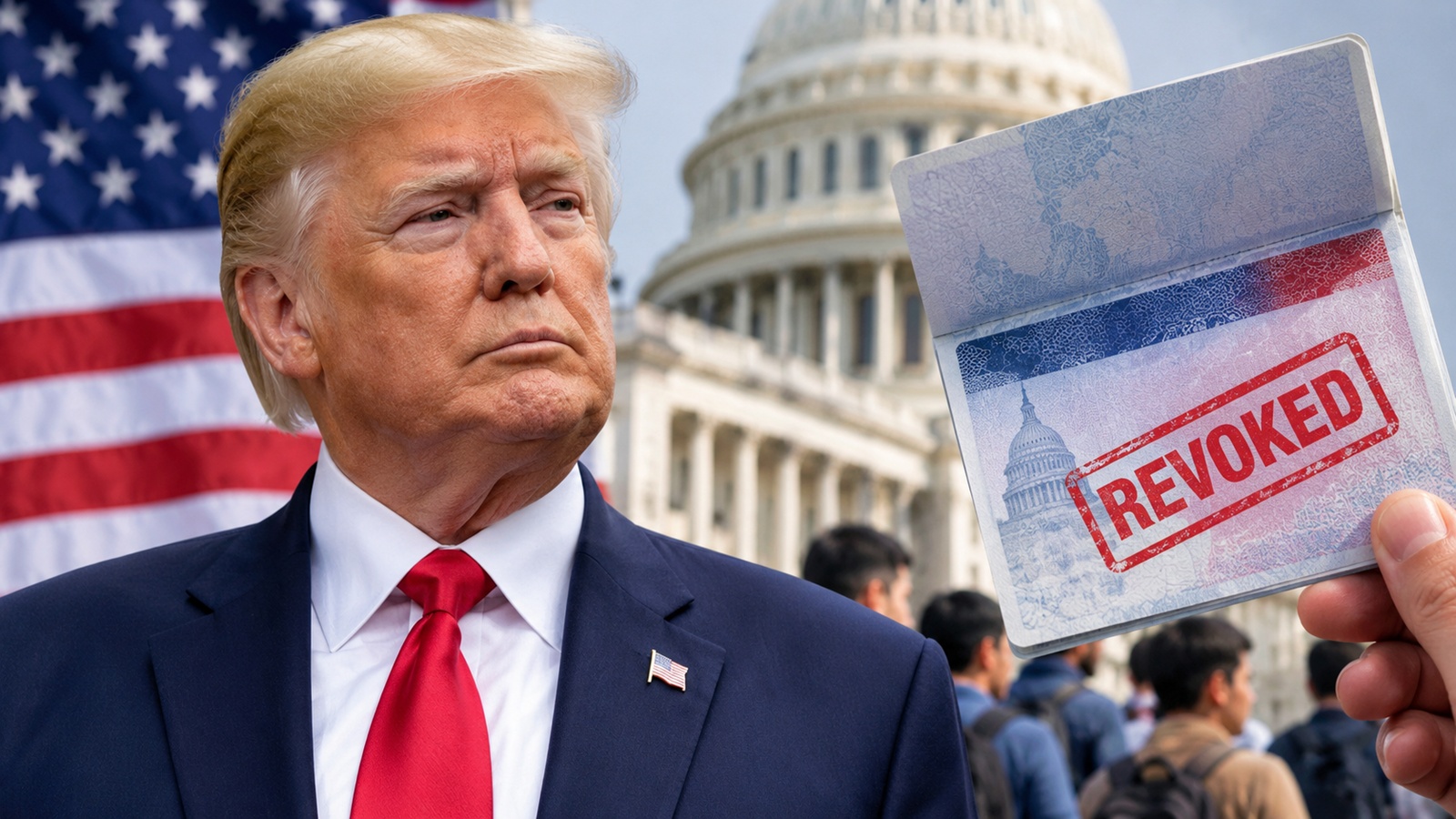
The revocation of 300,000 United States visas under the Trump administration is not an isolated administrative spike; it represents a structural shift from reactive border enforcement to continuous, automated status auditing. For Indian students and skilled workers—who represent the largest cohorts within the F-1 academic and H-1B specialty occupation pipelines—the primary operational risk has moved from the consular interview booth to post-arrival digital surveillance. Surviving this environment requires abandoning passive compliance in favor of active, continuous risk management across academic, employment, and digital domains.
Standard reporting on mass visa revocations treats the aggregate number as a monolithic event, failing to separate consular cancellations from domestic status terminations. This conflation creates panic without providing an actionable defense. To protect residency and work authorization, Indian nationals must understand the exact legal mechanisms driving these revocations, the difference between visa validity and lawful status, and the specific friction points where Indian applicants face disproportionate exposure.
The Mechanics of Prudential Revocation
The foundational error in most analyses of US immigration enforcement is treating a visa revocation and a deportation order as synonymous. They are distinct legal instruments governed by different executive departments, and confusing them leads to fatal procedural mistakes.
A visa foil stamped inside a passport is solely an entry document issued by the Department of State (DOS). Its purpose ends the moment a Customs and Border Protection (CBP) officer admits the traveler at a port of entry. Once inside the United States, a foreign national’s right to remain is governed by their immigration status, documented on Form I-94 and overseen by the Department of Homeland Security (DHS) and U.S. Citizenship and Immigration Services (USCIS).
Under Section 221(i) of the Immigration and Nationality Act (INA), the Secretary of State holds broad, discretionary authority to revoke a visa at any time. The administration has operationalized this authority through a mechanism known as prudential revocation. Unlike traditional revocations, which required a formal finding of ineligibility after a hearing or investigation, prudential revocation allows consular officers to cancel a visa based merely on a suspicion or an unresolved data flag that might render the individual inadmissible.
The mechanics of this system rely on automated interagency data sharing:
- Continuous Vetting Triggers: Biometric and biographic data from visa holders are continuously cross-referenced against law enforcement databases, including the National Crime Information Center (NCIC) and DHS screening systems.
- The Arrest-to-Revocation Pipeline: An arrest—not a conviction—for a minor infraction such as a Driving Under the Influence (DUI) charge, a domestic dispute, or a misdemeanor shoplifting allegation immediately transmits a fingerprint hit to the DOS. The DOS automatically revokes the physical visa foil without waiting for the judicial outcome.
- The Notification Lag: Notices of prudential revocation are frequently sent to the email address listed on the original DS-160 application form, often years after the initial filing. Many individuals remain unaware their visa has been canceled until they attempt to board a return flight to the United States after international travel.
When a visa is prudentially revoked while the individual is inside the United States, their underlying I-94 status generally remains valid—provided they have not violated the specific terms of their admission. However, the revocation acts as a "soft lock" on international mobility. The moment the individual departs the US, they cannot return without attending a new in-person consular interview, where the burden of proof shifts entirely onto the applicant to overcome the underlying flag.
The Three Pillars of Revocation Exposure for Indian Nationals
Indian nationals do not experience this enforcement wave uniformly. Because Indian applicants dominate specific visa categories—accounting for over 70% of H-1B petitions and a massive plurality of STEM Optional Practical Training (OPT) authorizations—their exposure clusters around three distinct systemic vulnerabilities.
1. The F-1 and OPT Employment Verification Bottleneck
For Indian students, the transition from academic study to practical training represents the highest-risk phase of their stay. Under current enforcement directives, Immigration and Customs Enforcement (ICE) has intensified audits of the Student and Exchange Visitor Information System (SEVIS).
The primary failure point is unreported unemployment and unverified employers. F-1 students on post-completion OPT are strictly limited to 90 days of cumulative unemployment, extended by an additional 60 days for those on the 24-month STEM OPT extension. Automated SEVIS sweeps now cross-reference employer Identification Numbers (EINs) against corporate tax filings and physical office registries.
If an Indian graduate is employed by a consulting firm or staffing agency that fails to maintain verifiable client-site documentation, or if the student delays reporting a change of address or employer within the mandatory 10-day window, SEVIS triggers an automatic termination. Under current policy, a SEVIS termination immediately initiates the accrual of unlawful presence, bypassing the grace periods that previously buffered administrative errors.
2. The H-1B Third-Party Placement and Wage Level Friction
The Indian IT and consulting sector relies heavily on the third-party placement model, wherein an H-1B petitioner places an engineer at an end-client site. The administration’s enforcement framework targets this structure through two mechanisms: unannounced Fraud Detection and National Security (FDNS) site visits and strict scrutiny of the employer-employee relationship.
When an FDNS officer arrives at an end-client worksite and discovers that the H-1B worker has been moved to a different project, works remotely from a different Metropolitan Statistical Area (MSA) without an amended Labor Condition Application (LCA), or performs duties that diverge from the specialty occupation defined in the original petition, USCIS initiates a Notice of Intent to Revoke (NOIR) the underlying Form I-129 petition.
Revocation of the I-129 petition immediately destroys the worker's lawful status. Unlike a DOS visa revocation, which only affects travel, a USCIS petition revocation terminates work authorization and legal presence simultaneously. Because Indian nationals face decades-long backlogs in the EB-2 and EB-3 green card categories, they remain trapped in H-1B status for ten to fifteen years, compounding their exposure to site-visit revocations over multiple renewal cycles.
3. Digital Footprint and Consular Re-Adjudication
The expansion of mandatory social media disclosure on Form DS-160—requiring five years of handles across major platforms—has introduced a subjective screening layer. During consular processing or routine administrative processing (Section 221(g)), automated sentiment analysis and manual reviews scrutinize public posts for inconsistencies with the stated visa purpose.
For students, public posts indicating an intent to work off-campus without authorization, participation in unauthorized political demonstrations that result in campus disciplinary action, or contradictions between a LinkedIn profile and a submitted resume serve as immediate grounds for revocation. A LinkedIn profile listing a "freelance" side project while on F-1 or H-1B status is treated as prima facie evidence of unauthorized employment, triggering both visa cancellation and permanent inadmissibility findings under INA Section 212(a)(6)(C)(i) for willful misrepresentation.
The Cost Function of Non-Compliance
To understand why traditional legal defense strategies are failing, one must examine the asymmetric cost function imposed by current immigration enforcement. In economic terms, the government has lowered its marginal cost of issuing a revocation to near zero through automation, while raising the individual’s cost of remediation to catastrophic levels.
[Automated Flag / Minor Infraction]
       │
       ▼
[DOS Prudential Visa Revocation (INA 221(i))] ──► Travel Lock (Cannot re-enter US)
       │
       ▼ (If accompanied by status violation)
[DHS/SEVIS Termination or I-129 NOIR] ──────────► Immediate Unlawful Presence
       │
       ▼
[3-Year or 10-Year Re-entry Bar (INA 212(a)(9)(B))]
The second limitation of relying on post-revocation legal remedies is the elimination of consular non-reviewability exceptions. Under the doctrine of consular non-reviewability, a consular officer’s decision to revoke or deny a visa cannot be challenged in US federal courts. Once a visa is revoked, the applicant has no judicial right to appeal. Their only recourse is to reapply, pay new filing fees, wait months for an appointment—a severe bottleneck at US consulates in New Delhi, Mumbai, Chennai, Hyderabad, and Kolkata—and attempt to prove a negative to a skeptical adjudicator.
Furthermore, the accrual of unlawful presence carries severe compounding penalties. Accumulating more than 180 days of unlawful presence after a status termination triggers an automatic three-year bar from re-entering the United States upon departure. Accumulating one year or more triggers a ten-year bar. For an Indian national with an approved I-140 immigrant petition, triggering a re-entry bar effectively destroys a decade of career investment and family stability.
Operational Protocol for Status Preservation
Mitigating the risk of mass revocations requires treating immigration compliance with the same rigor as corporate regulatory auditing. Indian students and workers cannot outsource this vigilance entirely to university Designated School Officials (DSOs) or corporate immigration attorneys, both of whom manage high caseloads and operate reactively.
Phase 1: The Digital and Documentary Audit
Before any international travel—and at least once per quarter while inside the United States—individuals must execute a self-audit across all government-facing data points.
- Align Public Profiles with Statutory Filings: Audit LinkedIn, GitHub, personal websites, and public social media accounts. Ensure job titles, employment dates, physical locations, and job descriptions match the exact text of the most recent Form I-129 (for H-1B) or Form I-983 training plan (for STEM OPT). Remove any references to unpaid advisory roles, startup co-founding, or freelance consulting, as US immigration law defines "employment" broadly to include any service performed for expected future benefit or equity, even without immediate cash compensation.
- Verify DS-160 Contact Channels: Confirm that the email address and phone number associated with your SEVIS record and USCIS online account are active and monitored daily. Prudential revocation notices frequently land in spam folders; missing a notice can result in an individual boarding an international flight only to be denied boarding by airline carrier liaison officers, or worse, being placed in expedited removal proceedings at a US port of entry.
- Audit the I-94 Admission Record: After every single entry into the United States, download the electronic Form I-94 from the CBP website immediately. Verify that the class of admission (e.g., F-1, H-1B) and the "Admit Until Date" are accurate. CBP officers frequently make clerical errors, truncating an H-1B validity period to match an expiring passport. Relying on an erroneous I-94 date will cause you to inadvertently overstay your authorized period, triggering automatic visa voidance under INA Section 222(g).
Phase 2: Geographic and Occupational Containment
For H-1B workers, physical location is legally tethered to wage compliance. The Department of Labor’s Prevailing Wage Determination is specific to the geographic area of intended employment.
- Enforce the 50-Mile Rule: Never relocate to a new residential address—even for remote work—outside normal commuting distance (generally defined as a 50-mile radius or within the same Metropolitan Statistical Area) without your employer filing an amended H-1B petition prior to your move. Filing a simple Form AR-11 change of address with USCIS is insufficient for H-1B holders; it satisfies the personal reporting requirement while simultaneously alerting FDNS that you may be working from an unauthorized location.
- Document Third-Party Supervision: If deployed at a client site, maintain a contemporaneous paper trail proving that your petitioning employer—not the end client—retains the right to hire, fire, pay, supervise, and control your daily work. Keep copies of internal performance reviews, timesheets approved by your direct employer, and organizational charts.
Phase 3: Arrest and Law Enforcement Protocol
Because prudential revocations are triggered by arrest records rather than convictions, interactions with law enforcement carry immediate immigration consequences.
- Understand Mandatory Disclosure: If you are arrested or cited for any offense—even if the charges are later dropped, dismissed, or expunged—you must disclose the incident on all future visa and green card applications. Expungement seals a record for domestic employment purposes, but it does not erase the biometric hit from federal FBI and DHS databases. Failing to disclose an expunged arrest is treated as material fraud.
- Coordinate Criminal and Immigration Counsel: Never accept a criminal plea deal—even for a minor misdemeanor or a "diversion" program—without having an experienced immigration attorney review the exact statutory language of the plea. Under the INA, admitting to the essential elements of a crime involving moral turpitude or a controlled substance violation counts as a conviction for immigration purposes, even if state law classifies the outcome as a non-conviction.
Limitations of Defensive Compliance
No compliance framework eliminates sovereign executive discretion. Because Section 221(i) revocations do not require probable cause or judicial oversight, an individual with a spotless legal, academic, and employment record can still face revocation due to a false-positive biometric match, a sweeping national security directive, or a sudden policy shift targeting specific university programs or corporate sponsors.
Furthermore, internal compliance cannot resolve structural bottlenecks created by visa retrogression. An Indian H-1B worker who maintains perfect status is still subject to the 60-day grace period limit if laid off during a corporate restructuring. If a new employer cannot file a cap-exempt H-1B transfer petition within that 60-day window, the worker must depart the United States or file a bridge application to change status to B-2 visitor, introducing complex timing risks.
The Strategic Imperative
The era of treating US visa status as a static asset secured upon entry is over. The 300,000 revocations demonstrate that the US immigration apparatus now operates as a continuous, real-time filtering mechanism designed to penalize minor administrative friction with maximum statutory severity.
Indian students and professionals must immediately transition from a posture of passive reliance on institutional sponsors to active, independent status governance. Cancel non-essential international travel if your visa foil is expired or if you have any unresolved administrative flags, arrest records, or pending status amendments. Standardize your public digital footprint to mirror your statutory filings word-for-word, verify every I-94 entry record within 24 hours of arrival, and maintain a liquid emergency reserve sufficient to fund immediate legal intervention or relocation. In an automated enforcement regime, survival belongs exclusively to those who eliminate ambiguity before an algorithm flags it.


