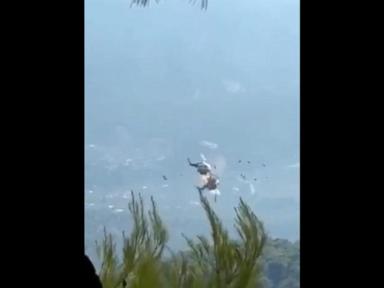
Mid-air collisions in aerial firefighting are not random anomalies. They represent systemic failures at the intersection of human factors, environmental volatility, and operational tempo. When two firefighting helicopters collide during suppression operations, public discourse frequently defaults to labeling the incident as an unfortunate tragedy or an unpredictable hazard of aviation. This framing obscures the structural vulnerabilities inherent in low-altitude, high-stress cooperative flight.
Understanding why these incidents occur requires a systematic deconstruction of the operational environment. Aerial firefighting forces disparate aircraft into congested, turbulent, and smoke-obscured airspaces where traditional air traffic management models break down. By examining the cognitive load of pilots, the limitations of visual flight rules in degraded visual environments, and the systemic pressures driving operational density, we can map the exact mechanical and human vectors that lead to catastrophe.
The Operational Environment and Atmospheric Stressors
Aerial firefighting occurs almost exclusively within the boundary layer of the atmosphere. This zone is characterized by extreme mechanical turbulence, thermal updrafts, downdrafts, and localized wind shear generated by the wildfire itself.
Thermal and Mechanical Turbulence
Wildfires act as massive thermodynamic engines. They consume oxygen and expel intense heat, creating erratic vertical columns of air. Helicopters operating near these fire plumes must contend with rapid density altitude shifts and unpredictable vector changes. When multiple aircraft operate in the same localized column, the wake turbulence generated by a primary lead helicopter creates severe rotational vortices. Lighter tactical transport or observation helicopters caught in these wake zones experience sudden loss of lift or attitude control, forcing corrective pilot inputs that narrow the spatial buffer between aircraft.
Degraded Visual Environments
Smoke, ash, and particulate matter reduce horizontal and vertical visibility drastically. Unlike commercial aviation, which relies on instrument flight rules and radar separation, aerial firefighting is fundamentally a visual flight rules operation. Pilots must maintain separation through out-of-the-cockpit visual acquisition.
When smoke plumes envelop drop zones, visual cues disappear. Pilots lose their horizon, depth perception, and relative motion indicators. Under these conditions, the brain struggles to calculate closing speeds with other moving objects. The absence of automated collision avoidance systems optimized for low-altitude rotorcraft formation leaves visual scanning as the primary defense against mid-air impacts. That defense fails when visibility drops below the reaction threshold required to maneuver a rotorcraft at low airspeeds.
Cognitive Load and Human Factors in High-Tempo Operations
The human element in tactical firefighting aviation operates under extreme psychological and physiological pressure. Decision cycles are compressed into seconds, and the margin for error is effectively zero.
Task Saturation and Attention Tunneling
A firefighting helicopter pilot manages a complex matrix of overlapping priorities simultaneously. They must monitor engine parameters, rotor RPM, fuel state, radio communications with ground incident commanders and other pilots, drop zone hazards like power lines and snags, and the physical release of water or retardant.
During the critical window of a drop run, attention tunneling occurs. The pilot's visual and cognitive focus narrows entirely onto the target zone. Peripheral awareness degrades rapidly. If a second aircraft enters the operational sector from an unexpected vector during this phase of intense concentration, the probability of visual non-detection approaches certainty until it is too late to execute avoidance maneuvers.
Communication Bottlenecks
Coordination in a fire zone relies heavily on multi-agency radio frequencies that are frequently congested. Tactical frequencies handle traffic from fixed-air tankers, lead planes, multiple rotorcraft, and ground personnel.
When channel congestion occurs, critical positional broadcasts are missed or delayed. A pilot executing a maneuver based on stale positional data assumes a spatial separation that no longer exists. This creates a hidden operational hazard where two aircraft converge on the exact same coordinate because both operators believe they have exclusive tactical priority over the drop zone.
The Cost Function of Multi-Agency Coordination
Aerial firefighting rarely involves a single, unified command structure with homogeneous aircraft types. Operations often combine military surplus aircraft, private contractor helicopters, and agency-owned fleets. Each organization brings distinct operational cultures, standard operating procedures, and communication protocols.
Fragmented Command Hierarchies
The integration of air tactical group supervisors with individual ship pilots introduces a layer of command latency. If the air tactical supervisor issues a directive that conflicts with a pilot's immediate local assessment of safety, or if the directive is ambiguous, hesitation ensues.
In low-altitude environments, hesitation translates directly into spatial compression. Without a standardized, globally enforced deconfliction protocol for mixed-fleet rotary operations, agencies rely on ad-hoc coordination methods established at the briefing trailer. These informal protocols degrade rapidly as the fire behavior escalates and operational tempo increases.
Fleet Heterogeneity
Different helicopter models possess vastly different performance envelopes, turning radii, climb rates, and forward speeds. Pairing a heavy lift helicopter with a nimble observation scout in a tight canyon creates an asymmetrical hazard. The heavy ship requires larger maneuvering corridors and possesses slower acceleration profiles, while the scout can pivot rapidly. If tactical assignments do not explicitly account for these performance disparities, faster aircraft easily overrun slower platforms operating within obscured airspace.
Structural Interventions for Spatial Deconfliction
Mitigating the frequency and severity of mid-air collisions requires moving away from reliance on human visual scanning alone. The operational architecture must be re-engineered around technical redundancy and rigid procedural boundaries.
Electronic Conspicuity Mandates
The widespread adoption of Automatic Dependent Surveillance-Broadcast and tactical traffic collision avoidance systems tailored for low-altitude flight is non-negotiable for modern safety margins. Traditional transponders are insufficient in smoky, low-level environments where line-of-sight radar fails. Equipping every suppression aircraft with active, cross-platform positional broadcasting allows cockpit display systems to map relative trajectories independently of visual visibility.
Temporal and Spatial Partitioning
Airspace over a fire must be treated as a dynamic, multi-layered highway system rather than an open zone. Implementing strict altitude blocks and directional ingress-egress corridors eliminates crossing traffic patterns. If aircraft are restricted to specific vertical tiers and predetermined orbital directions based on aircraft class and mission profile, the probability of convergence drops exponentially.
Establish rigid vertical altitude blocks for all incoming and outgoing suppression rotorcraft, enforce mandatory multi-band electronic conspicuity across all private and public contractor fleets, and delegate tactical drop sequencing exclusively to dedicated airborne supervisors to decouple pilot cognitive load from airspace management.