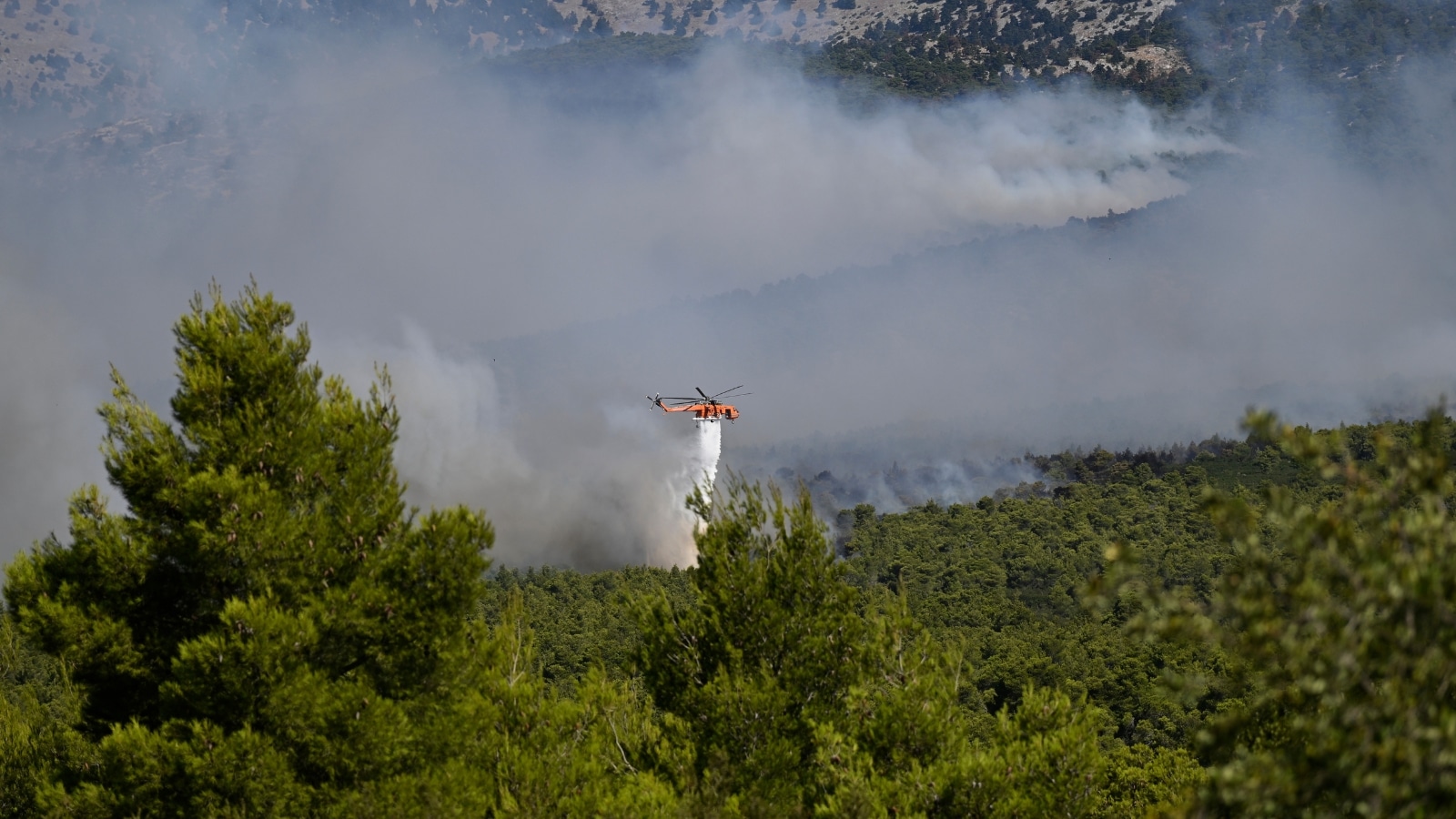
The collision of two leased Bell firefighting helicopters over the Psatha region west of Athens is not an isolated aviation anomaly. It represents the structural breaking point of an overburdened aerial suppression model operating inside severe atmospheric constraints. When gale-force katabatic winds, compressed mountainous topography, and dense concentrations of tactical aircraft converge on a single fire perimeter, the margin for error collapses. Two crew members—one Greek national and one Danish national—lost their lives not merely because of pilot error, but because the operational architecture of modern wildfire management forces high-risk concentration into hyper-restricted airspaces.
The Operational Cost Function of Congested Airspace
To understand why mid-air collisions occur during catastrophic wildfire events, one must examine the operational cost function governing tactical aviation. As ground suppression capabilities saturate during wind-driven crown fires, incident commanders shift the load factor onto aerial assets. This creates an immediate spatial bottleneck.
- The Temporal Compression Variable: Fire spread rates in dry, forested terrain under gale-force gusts leave narrow windows for effective water delivery. Every asset is funneled toward the same restricted drop zones along ridge lines and coastal interfaces.
- The Visibility Degradation Index: Thick smoke plumes, particulate saturation, and thermal updrafts reduce visual flight rules operational horizons to near zero, forcing aircraft into compressed vertical bands.
- The Mixed-Fleet Coordination Friction: Deploying international contractors alongside domestic crews introduces latent communication friction, varying standard operating procedures, and discrepancies in aircraft maneuverability profiles.
When these three variables intersect, the probability of spatial conflict spikes exponentially. The physical reality of operating heavy rotary-wing aircraft in turbulent mountain drafts leaves no room for standard separation buffers.
The Mechanics of Atmospheric Saturation
The wildfire emergency across the European Mediterranean basin exposes a fundamental systemic vulnerability: the reliance on reactive asset concentration rather than preventative management. When nearly 500 firefighters and dozens of aircraft are deployed to a single sector like western Attica, the airspace above the fire front behaves like a saturated highway system during a bottleneck.
Helicopters engaged in bucket operations execute repetitive, high-stress profiles. They transition rapidly from low-speed hovering or water scooping to high-load vertical climbs through shifting thermal columns. In the Psatha incident, video footage analysis indicates a convergence at low altitude where the rotor dynamics of the lower aircraft conflicted with the flight path of the upper unit. This is the direct result of an overcrowded tactical zone where the demand for continuous water drops supersedes optimal spatial separation limits.
[Wind-Driven Fire Spread]
       │
       ▼
[Ground Unit Saturation]
       │
       ▼
[Forced Shift to Aerial Assets] ──► [Spatial Bottleneck Over Drop Zone]
                                          │
                                          ▼
                                   [Mid-Air Collision Risk Spike]
Systemic Flaws in Cross-Border Contractor Models
Greece, like many Mediterranean states, scales its firefighting capacity during dry summer months through commercial leases of foreign aircraft and specialized crews. While this addresses the baseline deficit in permanent state-owned fleets, it introduces severe structural trade-offs:
- Fragmented Command Integration: Contracted pilots from external jurisdictions operate under distinct organizational cultures and may lack deep institutional familiarity with local micro-meteorology, such as the erratic wind behaviors characteristic of the Gulf of Corinth geography.
- Maintenance and Fatigue Variances: High-tempo deployments spanning multiple weeks degrade mechanical tolerances and accelerate crew fatigue, compounding cognitive load during high-threat tactical maneuvers.
- Asset Homogeneity Risk: Relying heavily on specific airframes, such as the Bell platform variants deployed in this operation, concentrates operational vulnerabilities. When an entire class of aircraft is grounded pending investigation, the aggregate suppression capacity of the theater plummets instantly.
Strategic Fleet Re-Engineering
Mitigating future fatalities requires abandoning the doctrine of uncoordinated aerial saturation. Airspace management over active fire zones must transition from decentralized tactical execution to centralized air traffic control models akin to commercial aviation corridors.
Command structures must enforce strict four-dimensional boxing of airspace—allocating precise altitude blocks and temporal windows to individual squads. Furthermore, investment must pivot toward heavy uncrewed aerial systems for nighttime and high-wind reconnaissance, removing human pilots from the most lethal low-altitude environments where visibility is compromised. Until the operational risk model accounts for atmospheric limits rather than political demands for visible suppression, the systemic toll on frontline personnel will remain unacceptably high.