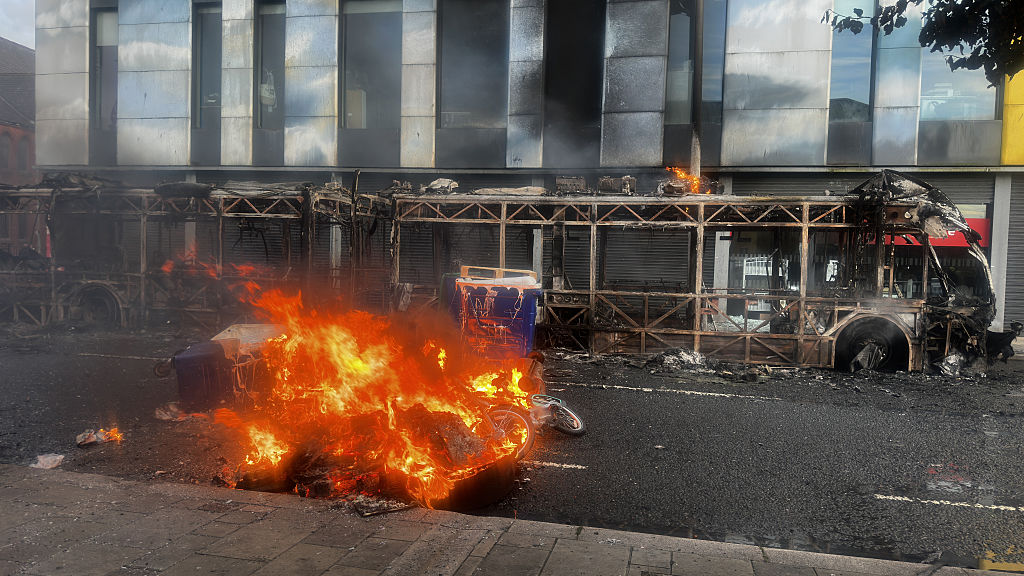
The violent unrest that destabilized Belfast following the June 8, 2026, knife attack on Stephen Ogilvie is not an isolated outburst of communal anger, but a predictable output of algorithmic contagion intersecting with latent socio-political friction. When a graphic video of the North Belfast attack went viral, it triggered a compressed, high-velocity escalation from digital outrage to coordinated street violence. This phenomenon cannot be understood through the lens of spontaneous protest. Instead, it requires a structural examination of how digital infrastructure weaponizes real-world trauma, how bad-faith actors exploit informational asymmetry, and how civil authorities fail to counter rapid-onset kinetic threats.
To deconstruct this crisis, we must isolate the mechanisms that transformed a localized criminal event into a systemic security failure. The escalation sequence operates across three distinct operational layers: the initial kinetic catalyst, the digital distribution architecture, and the asymmetric street-level response.
The Kinetic Catalyst and the Mechanism of Exploitation
The baseline event occurred on Kinnaird Avenue in North Belfast, where Stephen Ogilvie suffered catastrophic injuries to his face, eyes, and back, resulting in the loss of his left eye. The state’s immediate response conformed to standard criminal justice protocols: the Police Service of Northern Ireland (PSNI) declared a critical incident, apprehended the suspect—Hadi Alodid, a 30-year-old Sudanese national holding a five-year visa—and arraigned him on charges of attempted murder and carrying an offensive weapon.
Under normal operational conditions, the state retains a monopoly on the administration of justice. The transition to civil unrest occurs when external actors successfully challenge this monopoly by reframing a isolated criminal act as a systemic existential threat. This reframing relies on a specific conceptual framework: the exploitation of the institutional lag between a crime occurring and the formal dissemination of verified facts.
During this window of informational asymmetry, the state operates under strict sub judice rules and verification protocols, restricting its communication to sparse, formal updates. Conversely, non-state agitators operate with zero verification constraints. They immediately categorize the incident not as a localized dispute or a non-terror-related assault, but as an empirical proof point for broader political narratives regarding immigration policy and state failure. The friction between a slow, methodical state apparatus and a frictionless, rapid digital network creates an informational vacuum that algorithmic systems are structurally optimized to fill with high-arousal, destabilizing content.
The Architecture of Algorithmic Contagion
The rapid mobilization of masked crowds across East and North Belfast on June 9, 2026, was driven by the structural mechanics of modern digital platforms. The escalation curve followed a specific progression:
[Raw Graphic Footage] → [Algorithmic Amplification via Engagement Metrics] → [Geographic Re-targeting by Agitators] → [Kinetic Mobilization]
The primary driver of velocity was the unedited video of the attack itself. On major information networks, content recommendation engines are tuned to maximize user retention and engagement. High-arousal negative emotions—specifically shock, horror, and moral outrage—generate the highest engagement loops. The system treats the graphic depiction of violence as a high-value asset, autonomously accelerating its distribution across user feeds without human intervention.
This structural vulnerability is systematically leveraged by distributed networks of political agitators. High-profile international and domestic figures utilized their massive reach to amplify the footage, stripping away local context and overlaying a highly charged framework of systemic neglect. By explicitly linking the horrific nature of Ogilvie's injuries to the suspect's immigration status, these actors converted visceral human empathy into political grievance.
The critical pivot occurred when global digital reach was converted into hyper-local kinetic action. Through localized Telegram channels, WhatsApp groups, and geofenced social media threads, anonymous coordinators translated generalized online fury into actionable logistics. They designated precise assembly points, timetables, and tactical directives, such as instructions to wear masks and target specific neighborhoods. The digital platform serves as a force multiplier, reducing the transaction costs of organizing a riot from weeks to hours.
Asymmetric Urban Warfare and Strategic Containment Failure
The street-level manifestation of this digital contagion revealed a profound asymmetry between the tactics of rapid-onset rioting and the traditional containment doctrines of the PSNI. The violence on Tuesday night was characterized by decentralized, multi-locus arson attacks and targeted intimidation, rendering standard static barrier policing obsolete.
The cost function of urban rioting is exceptionally low for the perpetrators but unsustainably high for the target community and the state. Masked actors utilized improvised incendiary devices to torch public transport, private vehicles, and residential properties on Lendrick Street and surrounding areas. This forced the displacement of twenty-seven residents, including vulnerable families and an infant, creating an immediate humanitarian and logistical burden on municipal resources.
The strategy behind these actions functions on three levels:
- Socio-Economic Disruption: Forcing city-center businesses to implement early closures on Wednesday, dampening economic output and signaling a failure of state-guaranteed security.
- Tactical Saturation: Striking multiple geographically dispersed targets simultaneously to fragment police response capabilities and exhaust operational reserves.
- Atmospheric Intimidation: Conducting door-to-door targeted intimidation against foreign nationals to enforce a localized form of demographic segregation through violence.
The PSNI’s deployment of 200 additional officers and the execution of targeted arrests represent reactive containment rather than proactive deterrence. Traditional policing models rely on the assumption that crowds are localized and driven by tangible, negotiable demands. When a crowd is instead animated by an abstract, digitally sustained narrative of existential conflict, standard dispersal tactics merely displace the violence to adjacent, less-protected sectors.
The Counter-Narrative Failure and Structural Bottlenecks
The most telling analytical dimension of the Belfast crisis is the total divergence between the desires of the victim's family and the actions of the rioters executing violence in their name. The formal statement issued by Stephen Ogilvie's family was explicit, deliberate, and structurally designed to dismantle the agitators' logic. They explicitly rejected the unrest, defended the economic and social value of migrant communities within the healthcare and hospitality sectors, and requested an immediate halt to speculation.
In a healthy information ecosystem, a clear directive from the primary stakeholder would break the legitimacy of the protest. However, within a hyper-polarized digital ecosystem, the actual victim is rapidly abstracted away. The rioters do not operate as agents of the family; they use the family's tragedy as a disposable vehicle for pre-existing ideological objectives.
This creates a critical bottleneck for state communication strategies. When Prime Minister Keir Starmer and First Minister Michelle O'Neill issue statements branding the rioters as "idiots" and promising "the full force of the law," they are utilizing an outdated institutional broadcast model. This model assumes that top-down moral condemnation carries sufficient authority to alter behavior. It fails to recognize that within the echo chambers driving the unrest, condemnation from state officials is re-interpreted as validation that the state is an adversary to be actively resisted.
Strategic Playbook for State and Security Containment
To prevent future localized incidents from metastasizing into systemic urban crises, state authorities and security architectures must abandon reactive containment paradigms and deploy an integrated, data-driven strategy.
First, the state must establish an Emergency Information Operational Framework. The current policy of near-total informational silence during the first 24 hours of a critical incident must be replaced by a rapid-fact-delivery mechanism. Without compromising judicial integrity, authorities must continuously publish verified baseline data to aggressively compress the window of informational asymmetry that agitators exploit.
Second, civil defense strategies must integrate Real-Time Digital Footprint Analysis. Security services cannot treat online planning and physical rioting as distinct spheres. Pattern recognition algorithms must monitor rapid spikes in localized geolocation tags and graphic content re-sharing. When an inflection point is detected, police assets must be dynamically pre-deployed to high-risk logistics hubs and vulnerable neighborhoods before kinetic assembly occurs, shifting the operational stance from defensive containment to structural deterrence.
Finally, the legal cost function for digital agitation must be dramatically scaled. If international actors and localized networks can coordinate urban destruction with absolute impunity, the state's domestic authority will continue to erode. Statutory frameworks must treat the digital coordination of civil unrest with the same severity as physical participation, imposing severe financial and operational penalties on platforms that fail to suppress the automated amplification of unverified, high-arousal graphic violence during active security crises.