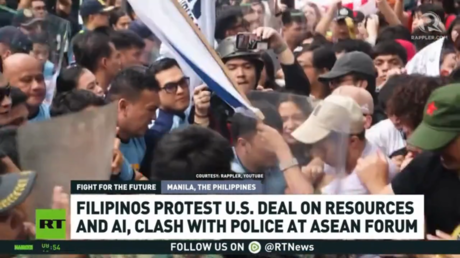
Street clashes between anti-Trump demonstrators and the Philippine National Police near the United States Embassy in Manila represent a predictable intersection of geopolitical signaling, domestic security doctrine, and spatial chokepoints. Standard news coverage frames these events as spontaneous eruptions of anger over American foreign policy or high-profile diplomatic visits. That framing misses the underlying operational mechanics. When leftist coalitions, student unions, and state security forces collide on Roxas Boulevard, both sides are executing rehearsed playbooks designed to maximize political visibility while managing physical escalation thresholds.
To understand why these confrontations recur with mechanical regularity whenever Washington officials or policies enter the Philippine news cycle, one must dissect the structural incentives of the actors involved, the physical geography of Manila’s diplomatic district, and the calibrated escalation ladder of crowd-control operations.
The Geopolitical Trigger Matrix
Demonstrations targeting United States representation in the Philippines rarely stem from a single isolated grievance. Instead, coalition organizers—typically led by umbrella groups such as Bagong Alyansang Makabayan (Bayan)—aggregate multiple policy vectors into a unified protest narrative. The presence or administration of Donald Trump acts as an ideological accelerant, sharpening existing friction points between Washington and progressive Philippine civil society.
The core grievances driving mobilization fall into three distinct operational categories:
- Security Dependency and Force Posture: Protesters target the Visiting Forces Agreement (VFA), the Enhanced Defense Cooperation Agreement (EDCA), and joint military exercises like Balikatan. From the perspective of nationalist and left-leaning groups, expanded U.S. troop rotations and base access erode Philippine sovereignty and entangle the archipelago in great-power competition in the Indo-Pacific.
- Trade Asymmetry and Economic Protectionism: Rhetoric surrounding tariffs, bilateral trade deficits, and labor export vulnerabilities provides an economic baseline for mobilization. Organizers link U.S. executive trade policies directly to domestic inflation and agricultural displacement.
- Executive Alignment and Human Rights: Demonstrators scrutinize the relationship between the White House and Malacañang Palace. When U.S. leadership signals tolerance for hardline domestic security policies or prioritizes strategic basing over governance metrics, activist networks mobilize to challenge both governments simultaneously.
The media reports these events as anti-Trump protests, yet the operational reality is broader. The U.S. president serves as the symbolic focal point for a decades-old critique of post-colonial security architecture.
Spatial Chokepoints and the Geography of Escalation
Physical confrontations between protesters and riot police in Manila are heavily dictated by urban geography. Unlike open public squares that allow crowds to disperse laterally, the approaches to the U.S. Embassy along Roxas Boulevard create natural funnels.
[Assembly Point: Plaza Miranda / Luneta]
       │
       ▼ (March Phase: High Mobility, Low Friction)
[Chokepoint: Kalaw Avenue / Roxas Boulevard Intersection]
       │
       ▼ (Containment Line: Police Phalanx & Barricades)
[Hard Target: U.S. Embassy Perimeter]
This spatial configuration forces a binary outcome once a march reaches the Kalaw Avenue junction:
- Stagnation: Protesters halt at the police line, deliver speeches, burn effigies, and disperse voluntarily after securing media coverage.
- Breach Attempt: Organizers push against the shield wall to advance closer to the embassy gates, triggering immediate physical countermeasures from the Civil Disturbance Management (CDM) units.
Because Roxas Boulevard is a primary north-south arterial route, blocking it imposes an immediate economic and traffic cost on the city. This time-sensitive disruption pressures police commanders to clear the thoroughfare quickly, while giving protesters maximum visual impact against the backdrop of Manila Bay and the embassy compound.
The Escalation Ladder of Crowd Control
Video footage of clashes near the embassy typically captures a compressed thirty-second window of peak kinetic activity—batons striking shields, water cannons firing, or protesters pulling down barricades. Viewing those clips in isolation obscures the four-stage escalation protocol that governs both sides.
Stage 1: Perimeter Hardening and Permit Denial
Under Philippine law, specifically Batas Pambansa Blg. 880 (the Public Assembly Act of 1985), rallies require permits from local government units, though "freedom parks" are exempt. The stretch of Roxas Boulevard directly fronting the U.S. Embassy is not a designated freedom park. Consequently, marches approaching the compound are legally classified as unauthorized assemblies the moment they cross specific intersection thresholds. Police pre-position shipping containers, razor wire, and multi-layered phalanxes of CDM personnel hours before the scheduled assembly.
Stage 2: The Vanguard Push
Protest formations are rarely disorganized mobs. Experienced marshals place seasoned activists—often carrying reinforced wooden placards or bamboo poles—at the front line. As the column reaches the police barricade, the vanguard tests the structural integrity of the shield wall. The objective is rarely to storm the embassy building itself, which is protected by high walls and internal Marine security guards; the objective is to breach the outer perimeter and force the police line backward by ten to twenty meters, creating a visual victory for news cameras.
Stage 3: Kinetic Containment and Dispersal
Philippine National Police doctrine operates under a framework of "maximum tolerance," a statutory requirement under BP 880 mandating restraint until a clear and present danger to public safety or property emerges. Once protesters breach the barricade line or throw projectiles such as paint bombs and water bottles, commanders transition from passive containment to active dispersal.
Tactical responses follow a strict sequence:
- Shield Wall Compression: Front-line officers lock shields and advance in short, rhythmic steps to regain lost ground.
- Acoustic and Hydraulic Deterrence: Fire trucks deployed behind the police line direct high-pressure water streams at the front ranks of the crowd to break formation cohesion without using lethal force.
- Targeted Extraction: Snatch squads move through gaps in the shield wall to detain individuals identified as primary agitators or barricade breachers.
Stage 4: Asymmetrical Media Framing
The final stage occurs after the street clears. Both sides immediately contest the narrative through visual evidence. Activist networks circulate close-up footage of bruised demonstrators, soaked banners, and aggressive baton strikes to illustrate state repression and alignment with foreign interests. Conversely, police spokespersons release wide-angle aerial or body-camera footage showing demonstrators initiating contact, dismantling public barriers, and obstructing emergency traffic lanes.
Strategic Limits of the Confrontation Model
While both protesters and security forces execute their roles with practiced efficiency, the current confrontation model exhibits diminishing strategic returns for every participant.
For protest coalitions, the reliance on predictable clashes at the U.S. Embassy creates a ceiling on public sympathy. Commuters stranded by Roxas Boulevard closures often view the disruptions through the lens of daily economic friction rather than geopolitical principle. Furthermore, repeating the same tactical sequence—marching to Kalaw Avenue, pushing the shield wall, and retreating under water cannons—generates visual fatigue among domestic audiences, reducing the shock value that once drove broader political mobilization.
For the Philippine National Police, heavy-handed kinetic dispersals carry severe reputational risks. Even when operating within legal boundaries to protect diplomatic missions under the Vienna Convention on Diplomatic Relations, images of riot police striking unarmed students or older activists hand immediate propaganda victories to anti-government critics. Over-deployment of force validates the exact narrative protesters seek to project: that the state prioritizes foreign diplomatic comfort over domestic civil liberties.
Tactical Shift for Crowd Management and Civic Engagement
Breaking this repetitive cycle requires structural adjustments in how diplomatic protests are managed and executed in Metro Manila.
Security planners must decouple traffic disruption from diplomatic protection. Instead of establishing rigid, zero-buffer barricades at narrow intersections like Kalaw Avenue—where physical compression inevitably sparks shield-wall collisions—municipal authorities and police commanders should designate controlled staging zones along wider segments of the Roxas Boulevard service road or adjacent park perimeters. Providing a fixed, legally sanctioned line of sight to the embassy compound satisfies the demonstrators' core requirement for symbolic proximity while preserving the main arterial lanes for civilian transit.
Simultaneously, protest organizers aiming to influence bilateral policy rather than merely capture fleeting media footage must shift resources away from low-yield perimeter clashes. Concentrating mobilization efforts on legislative lobbying, economic impact audits of defense agreements, and decentralized regional assemblies imposes sustained political pressure without triggering predictable security bottlenecks. Until either side alters its spatial or tactical doctrine, every major shift in U.S. foreign policy will continue to produce the exact same kinetic choreography on the pavement of Manila.