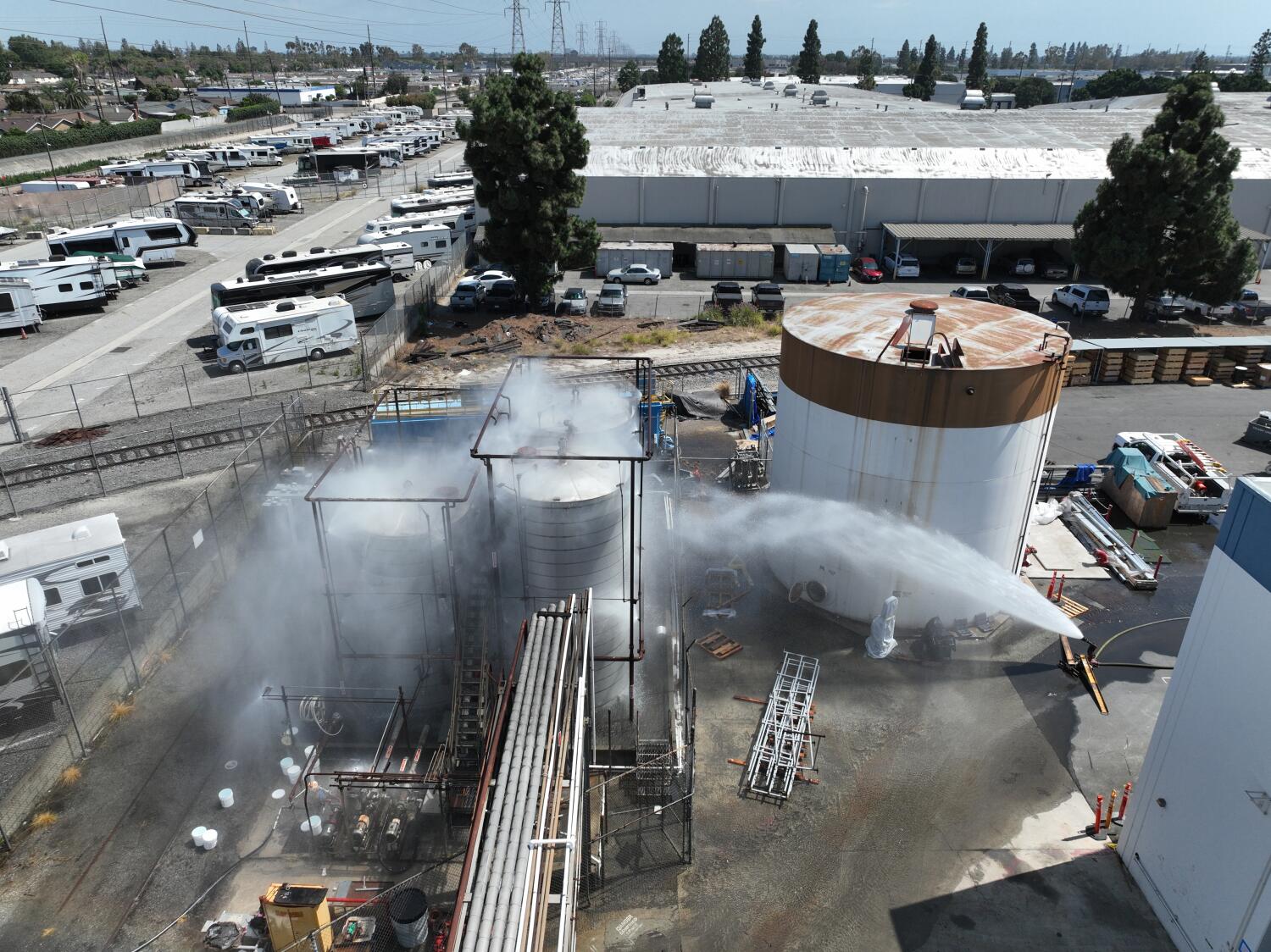
The operational emergency unfolding at the GKN Aerospace facility in Garden Grove, California, highlights the high-consequence risks embedded within dense urban manufacturing corridors. A compromised 34,000-gallon industrial storage tank containing roughly 7,000 gallons of methyl methacrylate (MMA) monomer has lost structural and thermal control. Because a mechanical valve failure has rendered standard closed-loop recovery procedures impossible, the asset is trapped in a binary risk trajectory: it will either breach structurally via mechanical tearing or experience a catastrophic Boiling Liquid Expanding Vapor Explosion (BLEVE). Mitigating this hazard requires a precise engineering understanding of the underlying thermodynamic and chemical feedback loops, coupled with structural risk modeling of urban density.
The Chemistry of Thermal Runaway
The primary hazard is driven by the auto-accelerating polymerization kinetics of methyl methacrylate ($C_5H_8O_2$). In its commercial state, MMA liquid requires active inhibition (typically using hydroquinone or monomethyl ether of hydroquinone) alongside continuous temperature management to prevent spontaneous, exothermic self-reaction.
When the internal cooling infrastructure or chemical stabilization of an MMA asset fails, the system transitions into an unmitigated exothermic reaction state. The chemical mechanism follows a closed feedback loop:
$$\text{Reaction Initiation} \longrightarrow \Delta H_{\text{reaction}} < 0 \longrightarrow \Delta T > 0 \longrightarrow \text{Accelerated Reaction Rate}$$
Because the polymerization reaction is heavily exothermic, the heat generated by early-stage chain propagation raises the temperature of the surrounding bulk liquid. Methyl methacrylate possesses an inherently low boiling point ($101^\circ\text{C}$ or $214^\circ\text{F}$) relative to its polymerization potential. As the internal temperature climbs, the rate of polymerization increases exponentially according to the Arrhenius equation:
$$k = A e^{-\frac{E_a}{RT}}$$
Where:
- $k$ is the reaction rate constant,
- $A$ is the pre-exponential factor,
- $E_a$ is the activation energy,
- $R$ is the universal gas constant,
- $T$ is the absolute temperature.
This exponential surge in reaction velocity yields a corresponding surge in thermal output. When the rate of heat generation ($\dot{Q}{\text{gen}}$) permanently outpaces the rate of ambient or forced heat dissipation ($\dot{Q}{\text{diss}}$), the system reaches the critical inflection point of thermal runaway.
At this juncture, the liquid monomer rapidly vaporizes. Because the tank's pressure-relief valves are either structurally damaged or volumetrically undersized for an unmitigated runaway event, the internal vapor pressure scales exponentially, compromising the structural integrity of the steel pressure vessel.
The Binary Hazard Tree
Emergency commanders face a rigid, bifurcated risk matrix. Because the valve infrastructure is non-operational, the chemical inventory cannot be pumped into secondary containment or neutralized in situ. The industrial asset will inevitably resolve into one of two physical outcomes.
1. Structural Mechanical Failure (The Spill Scenario)
The less destructive outcome occurs if the tank undergoes a localized mechanical failure before reaching peak runaway pressure. Under this mechanism, the increasing internal stress exploits a structural vulnerability—such as a weld line, a weakened seam, or a corrosive defect—causing the hull to split or tear.
This structural breach immediately depressurizes the vessel, preventing a BLEVE. However, it shifts the operational challenge to a large-scale hazardous material containment operation. Approximately 6,000 to 7,000 gallons of liquid MMA would discharge instantly into the facility's localized topography.
The response framework for this scenario requires high-density physical barriers, such as localized sandbagging and synthetic sorbent booms, to prevent the low-viscosity liquid from entering municipal storm drains or local river channels. Because MMA is highly volatile and flammable (flash point of $10^\circ\text{C}$ or $50^\circ\text{F}$), any spilled liquid instantly creates a dense, ground-hugging vapor cloud capable of ignition from low-energy static sources.
2. Boiling Liquid Expanding Vapor Explosion (The BLEVE Scenario)
The high-consequence outcome occurs if the pressure vessel maintains its structural seal until the internal liquid is heated far past its atmospheric boiling point. If a sudden structural rupture occurs under these superheated, hyper-pressurized conditions, the sudden drop to atmospheric pressure causes the remaining liquid inventory to flash into vapor instantly.
This instantaneous phase change expands the chemical volume by orders of magnitude, generating a high-velocity blast overpressure wave. The physical mechanics of this failure mode involve three distinct destructive phenomena:
- Blast Overpressure: The instantaneous expansion of vapor generates a shockwave capable of blowing out reinforced structural walls, shattering industrial glazing up to a mile away, and causing severe pulmonary trauma to unprotected personnel.
- Missile Generation: The structural fragmentation of the 34,000-gallon steel tank creates high-velocity shrapnel. These fragments can travel thousands of feet, breaching nearby industrial assets and storage tanks.
- Thermal Radiation: Because MMA is highly flammable, the simultaneous rupture and atomization of the chemical inventory into an oxygen-rich atmosphere creates a massive fireball. The radiant heat flux from this fireball can ignite secondary structures and induce third-degree burns across a wide radius.
Secondary Cascading Risk: The Domino Effect
The operational footprint in Garden Grove is constrained by its proximity to adjacent industrial storage assets containing supplemental fuels and chemical precursors. A primary explosion or severe thermal radiation flux from the compromised asset would likely trigger a domino effect across neighboring systems.
Industrial infrastructure risk assessment uses a vulnerability threshold based on incident thermal radiation flux ($kW/m^2$) and overpressure ($kPa$). If the primary asset suffers a BLEVE, the adjacent tanks will be subjected to blast waves and intense heat.
| Hazard Mechanism | Vulnerability Threshold | Expected Physical Outcome |
|---|---|---|
| Blast Overpressure | $> 20 \text{ kPa}$ | Minor structural damage to adjacent atmospheric tanks; deformation of piping manifolds. |
| Blast Overpressure | $> 50 \text{ kPa}$ | Total structural collapse of unreinforced storage vessels; catastrophic secondary product release. |
| Thermal Radiation Flux | $> 15 \text{ kW/m}^2$ | Atmospheric venting of adjacent volatile inventories due to tank shell heating; activation of emergency deluges. |
| Thermal Radiation Flux | $> 37.5 \text{ kW/m}^2$ | Rapid structural steel weakening; secondary thermal runaway in adjacent chemical assets within tens of minutes. |
This cascade risk explains why emergency managers must establish an expansive perimeter. A localized failure is structurally bound to scale into a multi-asset industrial fire if the primary energy release breaches neighboring containment structures.
Vapor Cloud Dispersion Dynamics
Should the tank vent volatile gases without immediately exploding, the hazard shifts to large-scale downwind toxic exposure. Methyl methacrylate vapor possesses a molecular weight of $100.12 \text{ g/mol}$, rendering it significantly denser than ambient air (which averages $\approx 29 \text{ g/mol}$).
This negative buoyancy alters the dispersion physics. Rather than rising and dissipating into the upper atmosphere, the toxic plume sinks, hugging the ground and channeling through street canyons, drainage ditches, and low-lying residential topography.
The dispersion behavior is governed by the heavy gas phenomenon, where gravity-driven slumping dominates initial atmospheric mixing. The plume spreads laterally across a wide area, maintaining high concentrations of toxic gas near ground level.
According to the US Environmental Protection Agency and acute exposure guidelines, inhalation of concentrated MMA vapor induces acute respiratory irritation, pulmonary edema, and neurological distress (including severe vertigo and peripheral neuropathy). The plume's movement is determined by local meteorological conditions, specifically wind velocity vectors and atmospheric stability classes.
Because wind direction cannot be engineered or controlled, emergency management must use a 360-degree radial evacuation zone rather than a simple downwind wedge. This precautionary footprint accounts for potential wind shifts and the lateral slumping behavior of heavy chemical vapors.
Urban Density and Evacuation Logistical Friction
The primary reason this industrial incident threatens 40,000 residents across six distinct municipalities (Garden Grove, Cypress, Stanton, Anaheim, Buena Park, and Westminster) is the lack of buffer zones between industrial manufacturing sites and high-density residential areas in North Orange County.
When a high-consequence chemical facility sits next to dense residential zones, evacuation logistics face severe constraints. The timeline required to clear 40,000 citizens from a high-density area often exceeds the time to failure of a compromised industrial asset. This creates a critical operational bottleneck.
[Asset Failure Timeline]       0h --------------------------> Tank Rupture / BLEVE

[Evacuation Timeline]          0h ------> (Notification) ------> (Traffic Saturation) ------> Clear Zone Complete
This bottleneck is worsened by specific operational challenges:
- Traffic Congestion and Bottlenecks: The sudden movement of thousands of vehicles onto localized arterial roads and surface streets quickly exceeds design capacities, causing gridlock within the hazard zone.
- Non-Compliance and Resistance: A significant portion of the population may refuse to comply with mandatory orders due to misjudging the invisible risk of toxic vapor or fearing property theft, forcing public safety personnel to divert resources to door-to-door enforcement.
- Communication Barriers: In multi-ethnic urban centers, distributing real-time, high-stakes technical alerts requires simultaneous, accurate translations across multiple languages to prevent delays in public response.
Tactical Mitigation Framework
With mechanical extraction off the table due to damaged valves, the tactical play relies on keeping the system stable through constant thermodynamic cooling. Emergency hazmat crews use high-volume, unmanned master stream monitors to continuously spray water onto the tank's exterior shell.
This tactic aims to maximize convective heat transfer away from the steel plate, keeping the internal bulk liquid temperature below the critical activation threshold for thermal runaway.
$$\dot{Q}{\text{dissipated}} = h A_s (T{\text{shell}} - T_{\text{water}})$$
Where:
- $h$ is the convective heat transfer coefficient of the water film,
- $A_s$ is the surface area of the tank shell being actively cooled,
- $T_{\text{shell}}$ is the temperature of the tank wall,
- $T_{\text{water}}$ is the temperature of the applied water stream.
This strategy faces strict operational limits. If internal polymerization has advanced too far, the rate of chemical heat generation ($\dot{Q}_{\text{gen}}$) will outpace the maximum thermal energy that can be conducted through the tank's steel walls and carried away by the water film.
Furthermore, continuous water cooling creates a secondary issue: massive volumes of potentially contaminated runoff water. Responders must balance the immediate need for thermal cooling against the need to contain this runoff, ensuring it does not bypass defensive barriers and wash toxic chemical residues into municipal waterways.
Emergency commanders must establish a strict internal temperature threshold. If the chemical core reaches this critical tipping point, all personnel must be pulled back immediately. At that stage, external cooling can no longer prevent an explosion, and the system must be allowed to fail within the evacuated isolation zone.
For a deeper dive into how emergency personnel evaluate chemical hazards and establish boundaries during industrial accidents, watch this technical breakdown of the incident response protocols used by regional hazardous materials teams:
Orange County Hazardous Materials Incident Response Analysis
This video explains the atmospheric monitoring systems and defensive cooling strategies used to manage volatile chemical assets under critical thermal stress.