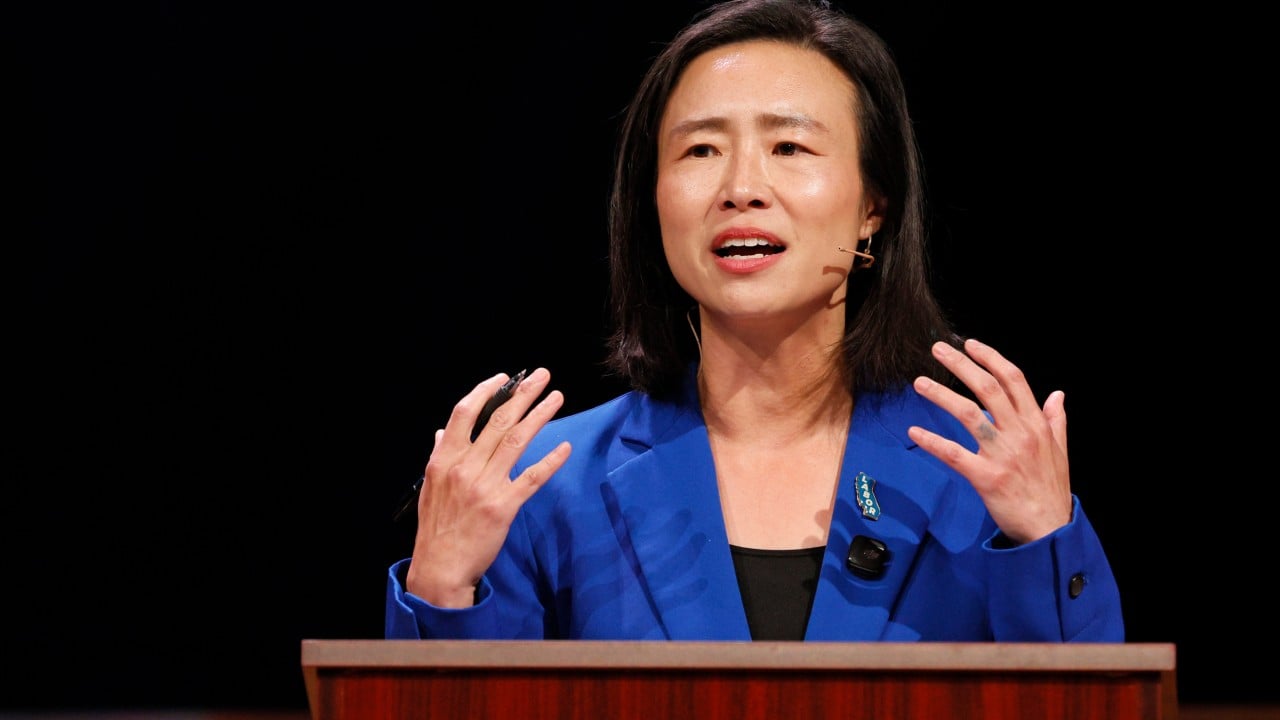
The mechanics of political succession in legacy districts are governed by institutional accumulation, geographic coalition math, and the calculus of voter mobilization. When Speaker Emerita Nancy Pelosi relinquished her seat in California's 11th Congressional District, the structural vacuum triggered a high-stakes contest between San Francisco Supervisor Connie Chan and State Senator Scott Wiener. Examining the outcome of this race requires moving past surface-level narratives of identity politics and foreign policy positioning. The arithmetic of the 2026 contest exposes how institutional backing, turnout gradients, and legislative breadth dictate electoral survival in urban progressive strongholds.
The Foundation of the Contest: The Succession Constraint
To understand Connie Chan’s strategic ceiling, one must analyze the structural properties of California's 11th District. Comprising the entirety of San Francisco, the district operates as a high-density, highly fragmented electorate where general elections often function as intra-party battles between distinct ideological factions of the Democratic Party. Learn more on a related issue: this related article.
Chan, representing the Board of Supervisors for District 1 (encompassing the Richmond and Westside neighborhoods), built her political footprint on localized neighborhood advocacy, municipal tenant protections, and a traditional progressive coalition. Her primary engine relied on working-class immigrant voters, Chinatown constituencies, and organized labor alignments.
Conversely, Scott Wiener’s legislative base as a State Senator spanned a broader geographic and demographic canvas. Wiener’s political brand was forged through statewide housing legislation and high-visibility infrastructure initiatives. The structural divergence between the two candidates created a resource allocation problem: Chan needed to expand past her geographic core into high-turnout, moderate-to-liberal districts where Wiener held structural advantages, whereas Wiener needed only to consolidate the city's center-left and high-propensity voting blocks. Additional reporting by BBC News delves into related views on the subject.
The Mechanics of Coalition Math and Turnout Gradients
Electoral victory in San Francisco is a function of turnout percentage multiplied by geographic concentration. Total voter turnout settled at approximately 66 percent of registered voters. Within this participation rate, the distribution of ballots exposed the limitations of Chan's coalition.
Chan secured victories in specific geographic pockets—predominantly the Westside, lower-income precincts such as the Tenderloin and Bayview, and heavily Chinese-American enclaves including the Sunset and Chinatown. However, these geographic strongholds suffered from lower aggregate baseline turnout compared to the high-propensity voting precincts in districts that favored Wiener, such as District 2 and District 8.
| Strategic Variable | Connie Chan Campaign | Scott Wiener Campaign |
|---|---|---|
| Primary Geographic Base | Western San Francisco, Richmond, Chinatown | Citywide state legislative footprint, Castro, downtown corridors |
| Core Electorate Segment | Working-class renters, progressives, Chinese-American voters | Establishment Democrats, high-density housing advocates, moderate base |
| Primary Institutional Leverage | Municipal labor councils, grassroots neighborhood groups | State legislative record, broad coalition endorsements |
The net vote deficit accrued in Wiener’s high-margin districts (such as Districts 2 and 8) outpaced the margins Chan produced in her core territories. The final tally showed Wiener capturing 53.3 percent (160,400 votes) to Chan's 46.7 percent (140,395 votes), establishing a roughly seven-point margin. This delta demonstrates that a localized progressive municipal machine, even when augmented by high-profile endorsements such as Senator Adam Schiff and foundational labor groups, encounters a hard mathematical ceiling when pitted against a candidate with a decade-long statewide legislative apparatus.
The Divergence in Legislative Portfolios
A critical oversight in journalistic coverage of the race was the reduction of the candidates' appeal to simple ideological labels. In practice, the divergence was operational.
Chan’s municipal record focused heavily on hyper-local governance: opposing state-mandated housing pre-emption bills (such as SB 423), advocating for municipal banking structures, and managing neighborhood-specific zoning controversies. This hyper-local orientation resonates intensely within district-level supervisor races where the electorate is bounded by neighborhood borders, but it presents a positioning challenge in a congressional race requiring a macroeconomic and foreign policy platform.
Wiener capitalized on a portfolio defined by volumetric output at the state level. By championing aggressive housing production laws, public transit funding, and civil rights expansions, Wiener positioned himself as a macro-legislator capable of translating municipal frustrations into state-level statutory frameworks. For median voters fatigued by San Francisco's local governance gridlock, Wiener's statewide scaling offered a more persuasive proxy for federal competence than Chan's defensive, neighborhood-preservation model.
The Geopolitical Subtext and Identity Vectors
Commentators frequently framed the race through the dual lenses of Asian-American political representation and differing rhetoric regarding foreign policy and China. Chan’s candidacy carried immense symbolic weight as a potential historic milestone for Chinese-American representation in federal office from San Francisco.
Yet, identity politics in urban centers operate through complex cross-currents rather than monolithic blocs. While Chan retained deep loyalty among traditional Chinese-American immigrant networks, the broader Asian-American electorate in San Francisco is not ideologically uniform. Generational divides, economic stratification, and divergent priorities regarding public safety and taxation fracture ethnic voting blocs. Wiener successfully peeled off segments of the Asian-American business and professional community by running on pragmatic governance, neutralizing the narrative that the district's Asian vote bank would consolidate automatically behind a candidate sharing their ethnic background.
Furthermore, distinctions in posture toward international affairs—specifically China—highlighted the strategic gap between traditional congressional expectations and municipal advocacy. Pelosi’s legacy was anchored in an assertive, hawkish posture toward Beijing. Chan’s localized focus and comparatively neutral or measured tone on international matters created friction with the institutional foreign policy establishment that historically defines the seat, whereas Wiener’s alignment with mainstream party orthodoxy on national security matters presented fewer friction points for moderate institutional donors.
Strategic Forecast for Urban Progressive Politics
The defeat of Connie Chan signals a structural maturation in how urban progressive candidates must build coalitions for higher office. Relying on neighborhood-level preservation, localized housing skepticism, and base-turnout strategies is insufficient when contesting a consolidated citywide district against a statewide incumbent.
Future progressive challengers in high-density urban cores must decouple their platforms from defensive NIMBY alignments and construct proactive, citywide infrastructure narratives. Without expanding the economic value proposition beyond rent control and neighborhood preservation, progressive municipal leaders will continue to face a structural deficit when scaling their operations to congressional geometries.