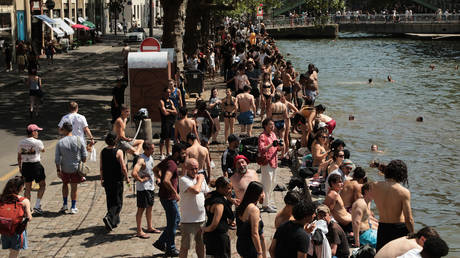
Large-scale atmospheric anomalies are converting seasonal European warming into a structural public health and infrastructure crisis. The recent severe heatwave across Western Europe, which resulted in early casualties in France and widespread regional disruptions, demonstrates that standard municipal emergency protocols are fundamentally under-equipped for contemporary thermal events. Evaluating these phenomena requires moving past sensational media coverage and instead analyzing the specific thermodynamic drivers, physiological vulnerabilities, and structural failures that dictate the true cost of extreme heat.
The Triad of Thermal Risk Generation
The severity of a regional heat event is defined by the intersection of three structural variables: atmospheric pressure mechanics, built-environment heat retention, and localized demographic vulnerabilities. When these variables align, they amplify ambient temperatures well beyond historical baselines.
[Atmospheric High Pressure] + [Low-Albedo Urban Surfaces] + [Unconditioned Infrastructure] = Accelerated Excess Mortality
The primary driver of the current crisis is the establishment of an intense high-pressure system, frequently referred to as a heat dome. This upper-level atmospheric ridge acts as a physical lid, trapping descending air masses. As the air sinks, it undergoes adiabatic compression, structurally increasing its temperature while displacing cloud cover and precipitation.
This continuous solar radiation directly hits low-albedo urban surfaces—such as asphalt, concrete, and traditional roofing materials—converting urban centers into thermal sinks that fail to cool down overnight. In regions where nighttime temperatures remain above 25°C, the human body is deprived of its primary recovery window, accelerating the onset of systemic heat stress.
Physiological Thresholds and the Logistics of Human Survival
Media reports often focus on nominal air temperatures, yet the critical metric for human survivability is the relationship between dry-bulb temperature and relative humidity, which determines the wet-bulb temperature. This threshold measures the lowest temperature to which an object can cool down via evaporation.
- The Evaporative Bottleneck: When the ambient wet-bulb temperature reaches 35°C, the physical gradient required for human sweat to evaporate vanishes. At this threshold, the human body cannot shed metabolic heat, leading to unavoidable hyperthermia regardless of hydration levels.
- The Kinetics of Internal Failure: As core body temperature climbs past 40°C, cellular structures begin to degrade. Proteins denature, cell membranes lose integrity, and a systemic inflammatory response triggers multi-organ failure.
- Secondary Hazards: The surge in drowning incidents during heatwaves is a direct consequence of behavioral risk amplification. As citizens seek unmonitored aquatic cooling zones to bypass the evaporative bottleneck, they encounter thermal shock or strong currents, converting a physiological crisis into an immediate rescue and recovery strain for emergency services.
In southwestern regions like Bordeaux, where temperatures have surpassed 42°C, the lack of widespread residential air conditioning transforms standard housing units into thermal traps. In these unconditioned spaces, elderly demographics and young children face an exponential increase in relative risk due to their less efficient thermoregulatory systems.
Infrastructure Degradation and Supply Chain Bottlenecks
Extreme thermal stress acts as a kinetic force against fixed physical infrastructure. Linear assets and energy distribution grids experience mechanical and operational strain that compromises regional economic stability.
The Thermal Expansion of Fixed Rail Networks
Railway tracks are engineered with pre-stressed steel designed to tolerate a specific localized temperature envelope. When ambient temperatures exceed historical norms by 10°C or more, the internal compressive stress within the steel overcomes the lateral resistance of the ballast. This causes track buckling or sun kinks, forcing transit authorities to proactively cancel or slow rail operations to prevent catastrophic derailments. The resulting logistical logjam halts the movement of freight and labor precisely when supply chains are most fragile.
Grid Instability and Cooling Multipliers
Electrical distribution systems face a dual crisis during severe heat events. First, the physical capacity of transmission lines drops because high ambient temperatures reduce the rate at which lines can shed resistive heat, causing them to sag and lose efficiency. Second, the widespread deployment of mechanical cooling units creates a massive spike in peak electricity demand. When the diminished capacity of the grid meets this heightened demand, the probability of localized transformer failures and cascading blackouts rises exponentially, threatening the power supply of critical medical facilities.
The Limits of Institutional Mitigation
The deployment of red alerts and municipal restrictions highlights a deeper structural bottleneck: public policy remains reactive rather than systemic. Banning outdoor public gatherings, closing thousands of educational facilities, and restricting alcohol consumption to protect emergency response capacity are necessary short-term triage tactics, but they do not address underlying vulnerabilities.
The primary limitation of current municipal frameworks is their reliance on legacy building designs that assume a climate baseline that no longer exists. Retrofitting urban centers requires a massive capital reallocation toward high-albedo coatings, passive architectural cooling, and decentralized green infrastructure. Until these structural changes are implemented, public health authorities will remain trapped in a cycle of crisis management, relying on behavioral mandates to mitigate a challenge rooted in physics and infrastructure architecture.
The immediate operational priority for regional governance must center on the institutionalization of mandatory thermal resilience standards. Municipalities must transition from temporary cooling centers to the permanent enforcement of cool-roof mandates, the mandatory integration of external shading on all new residential developments, and the physical separation of vulnerable populations from unconditioned environments. Failing to execute this structural pivot guarantees that future heat anomalies will continue to yield elevated mortality rates and systemic economic disruption.