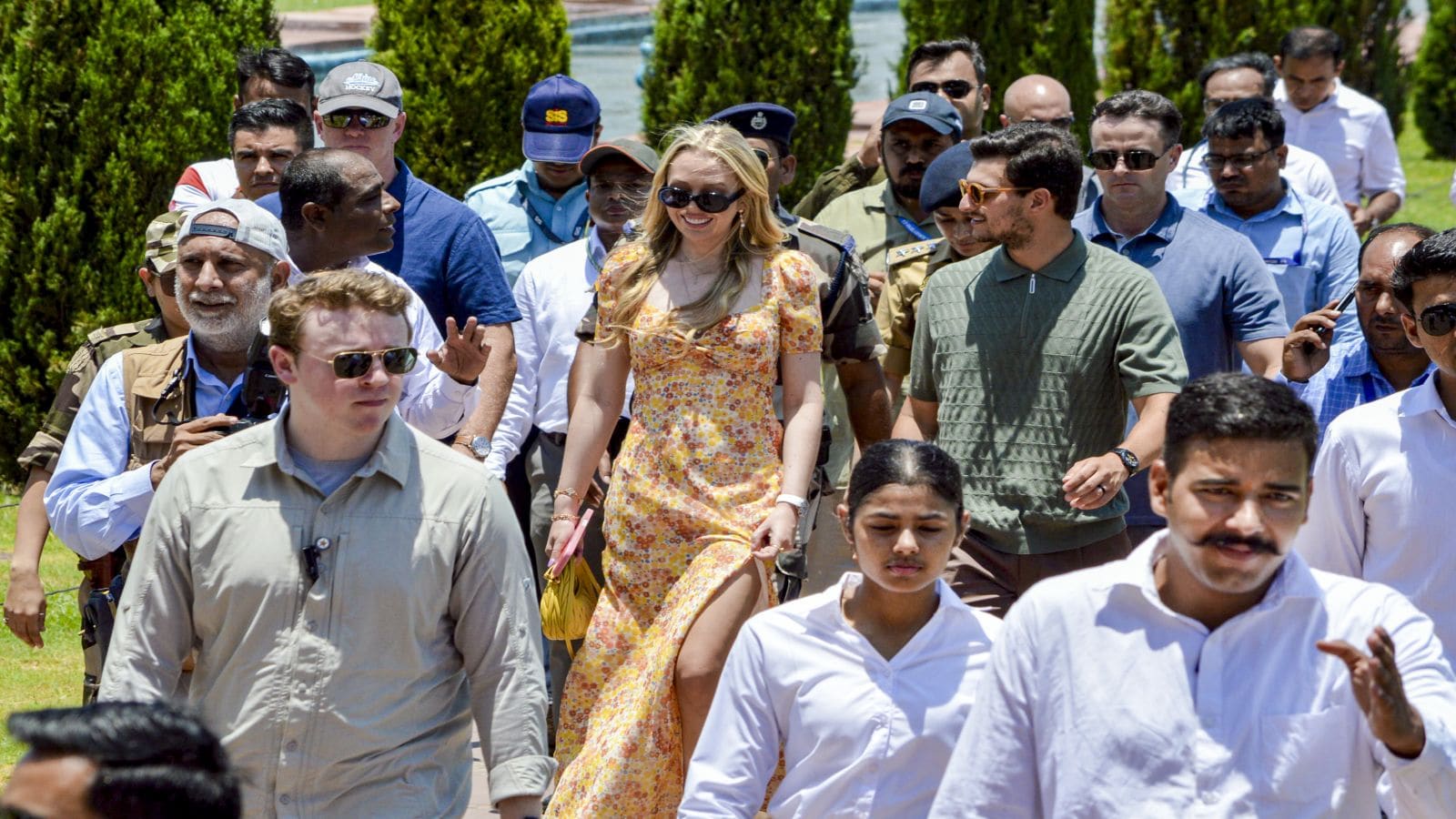
Private international excursions executed by immediate family members of a sitting head of state are never merely recreational; they function as complex exercises in multi-agency logistics, strategic public diplomacy, and bilateral security coordination. The arrival of Tiffany Trump, daughter of US President Donald Trump, along with her husband Michael Boulos and US Ambassador Sergio Gor in India, illustrates the massive operational apparatus required to move high-value individuals across complex foreign geographies.
When a prominent political figure transitions from a densely populated administrative hub like New Delhi to highly exposed historical monuments in Agra and Jaisalmer, the underlying security architecture must adapt dynamically. Standard travel reporting focuses entirely on visual optics and surface-level travel itineraries. A rigorous structural breakdown reveals that these journeys are defined by strict operational constraints, risk-mitigation frameworks, and tactical communication strategies. In other updates, take a look at: Why Ancient Ethiopian Grapevines are a Total Red Herring for Modern Winemaking.
The Security Cost Function of High-Value Movement
The primary constraint of any international VVIP movement is the minimization of exposure risk across varying architectural and urban environments. Moving an individual under US Secret Service protection through India’s cultural infrastructure requires a synchronized, multi-layered security grid. The total operational complexity is a function of three distinct environmental typologies:
1. Modern High-Density Enclosures: Akshardham Temple
The itinerary initiated at the BAPS Swaminarayan Akshardham in New Delhi presents an environment designed for massive public throughput but characterized by highly controlled access points. Security logistics in this quadrant rely on fixed-perimeter isolation. Local police and specialized units establish a cleared corridor, allowing the delegation to interface with the site’s architecture while maintaining a sterile zone that isolates the VVIPs from the general civilian flow. The Points Guy has provided coverage on this fascinating subject in extensive detail.
2. Exposed Monumental Grounds: The Taj Mahal
The transition to Agra’s Taj Mahal shifts the security equation from a controlled enclosure to an expansive, highly exposed open-air layout. The 17th-century monument demands a linear transit strategy. To secure an hour-and-a-half timeline within the complex, security agencies deploy a high-security corridor extending from the military or civil airfield directly to the monument gates. The perimeter risk increases due to clear sightlines, necessitating advanced sweeping teams, local police cordons, and tactical deployment along the entry and exit vectors to counter perimeter vulnerabilities.
3. Living Urban Fortresses: Jaisalmer's Sonar Fort
The final leg into Rajasthan’s desert corridor represents the most complex operational environment. Unlike static monuments, Sonar Fort is a living citadel containing a dense residential population.
[VVIP Security Detail]
       │
       ├─► US Secret Service (Primary Close Protection)
       ├─► Indian Federal Agencies (Intelligence & Liaison)
       └─► Local Rajasthan Police (Perimeter Control & Tactical Routing)
The presence of thousands of permanent residents within the fort walls eliminates the possibility of total environmental sterilization. To mitigate this structural vulnerability, the security apparatus alters its tactical approach:
- Mechanized Internal Transit: The delegation abandoned foot transit in favor of golf carts to maintain continuous forward momentum and reduce the window of stationary exposure.
- Multi-Jurisdictional Command: The security grid combined the US Secret Service for close-in protection, federal Indian intelligence agencies for real-time threat assessment, and local Rajasthan police under the direct supervision of the District Collector and Superintendent of Police for perimeter management.
- Asymmetric Accommodation Isolation: Lodging choice shifts away from urban centers to isolated luxury enclaves along Sam Road, utilizing geographic distance as a natural barrier against tactical vulnerabilities.
Soft Power Geometry and Strategic Optics
While officially designated as a private visit, the presence of a sitting administration's family member accompanied by the active US Ambassador to India, Sergio Gor, converts leisure into an instrument of soft power diplomacy. High-profile international travel operates on an unspoken framework of mutual geopolitical utility.
For the host nation, facilitating a seamless, highly secure tour across three major states (Delhi, Uttar Pradesh, and Rajasthan) serves as an overt demonstration of domestic security capability and administrative competence. Showcasing the capacity to secure an active, populated medieval fort for a high-profile Western delegation signals to the global tourism and investment markets that the state can manage complex infrastructure and law-enforcement operations simultaneously.
Concurrently, the deliberate public documentation of the excursion via digital platforms serves a specific communication function. By broadcasting images of architectural appreciation at culturally significant sites, the delegation generates positive cultural capital. This structural signaling fosters bilateral goodwill outside the friction-filled parameters of formal trade or military negotiations.
The Operational Bottlenecks of Living Heritage
The core structural challenge identified during the Jaisalmer deployment highlights a fundamental friction point in heritage management: the conflict between rigid security protocols and living municipal ecosystems.
When a VVIP delegation enters an active urban ecosystem like Sonar Fort, the host administration faces a binary choice. They must either temporarily paralyze local commerce and resident mobility to guarantee absolute safety, or accept a higher threshold of operational risk to minimize civilian disruption. The data from this deployment indicates a hybrid compromise. The utilization of rapid internal transport platforms and strict time-boxing allowed the delegation to extract cultural value from the historic site without inducing long-term economic or structural friction for the local populace.
Future state-level or private diplomatic visits to living heritage sites must calculate their logistics models using this precise trade-off. The operational blueprint executed across New Delhi, Agra, and Jaisalmer confirms that managing high-profile foreign delegations depends entirely on the host country’s capacity to dynamically scale its security architecture from static, modern complexes to unpredictable, populated historic environments.