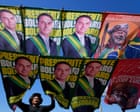
Political dynasties do not survive judicial disqualification by accident; they survive by converting personal charisma into transferable brand equity. When Brazil’s Superior Electoral Court and Supreme Federal Court rendered former President Jair Bolsonaro ineligible and subsequently imprisoned him over the post-2022 coup plot, conventional political analysis treated Bolsonarismo as a decapitated movement. Yet in the 2026 general election cycle, his eldest son, Senator Flávio Bolsonaro, captured 47% of the first-round vote—outpolling incumbent President Luiz Inácio Lula da Silva’s 45% before narrowly losing the October 25 runoff. Simultaneously, the Liberal Party (PL) expanded its footprint to 121 seats in the Chamber of Deputies and 29 seats in the Federal Senate.
Understanding this resurgence requires abandoning narrative journalism in favor of structural political analysis. Standard commentary treats the return of the Bolsonaro surname as a populist anomaly. In reality, it is the predictable output of four interacting mechanisms: brand transference under legal constraint, demographic bloc consolidation, legislative agenda capture, and the structural asymmetry of Brazil’s two-round runoff system. Building on this idea, you can find more in: The Jurisprudence of Gravity: Analyzing the Closure of the Swiss Wingsuit Probes.
The Architecture of Dynastic Brand Transference
In personalist political movements, removing the founder typically triggers fragmentation among ambitious lieutenants. In Brazil’s 2026 cycle, the right-wing ecosystem initially faced this exact coordination problem. With Jair Bolsonaro barred from office until 2030 and incarcerated in 2025, succession fractured across competing nodes: non-family governors with administrative credentials, second son Eduardo Bolsonaro, former First Lady Michelle Bolsonaro, and eldest son Flávio Bolsonaro.
Eliminating competing internal claimants required a ruthless winnowing process driven by both external legal friction and internal family hierarchy: Observers at Al Jazeera have shared their thoughts on this matter.
- Legal Attrition of Secondary Heirs: Eduardo Bolsonaro initially declared his presidential candidacy after his father’s disqualification, positioning himself as the ideological standard-bearer. However, his removal from the Chamber of Deputies and a June 2026 conviction for coercion—stemming from his role in provoking a diplomatic dispute between Brazil and the United States—rendered him ineligible for 12 years. That ruling forced his withdrawal and consolidated the family’s institutional endorsement behind Flávio.
- Institutional vs. Charismatic Legitimacy: Within the family structure, Michelle Bolsonaro commanded higher organic affinity among evangelical and female voters, eventually winning a Federal Senate seat for the Federal District. Yet internal friction between Michelle and her stepsons created a split-ticket dynamic. Jair Bolsonaro’s formal endorsement of Flávio resolved the top-of-ticket ambiguity by prioritizing bloodline continuity and Senate seniority over Michelle’s independent political project.
- Co-optation of Non-Family Rivals: Rather than fracturing the right-wing vote across multiple viable regional executives, former presidential contenders such as Ronaldo Caiado and Romeu Zema ultimately endorsed Flávio. The Bolsonaro surname functioned as an indispensable electoral distribution network; regional governors possessed administrative records, but only the family brand guaranteed immediate access to the core conservative base.
This mechanism exposes a fundamental law of modern populist movements: when voter loyalty is anchored to an anti-establishment identity rather than a policy platform, institutional disqualification of the leader acts as validation rather than deterrence. For core supporters, judicial action against Jair and Eduardo Bolsonaro reinforced the narrative of systemic persecution, allowing Flávio to run not merely as a candidate, but as a proxy vehicle for restorative grievance.
The Three Pillars of Electoral Durability
The resilience of the Bolsonaro coalition in 2026 rested on three measurable structural pillars that insulated the movement from its founder’s absence and the candidate’s own legal vulnerabilities.
Pillar 1: Asymmetric Religious and Regional Polarization
Brazilian presidential elections are governed by rigid geographic and confessional cleavage lines. Datafolha polling during the runoff demonstrated a stark religious inversion: Flávio Bolsonaro commanded a 62% to 29% advantage among evangelical voters, whereas Lula held a 52% to 42% lead among Catholics. Because evangelical demographics represent a rapidly expanding share of the Brazilian electorate, this single bloc provided a high-floor voting machine capable of withstanding negative news cycles. Geographically, this religious alignment reinforced conservative dominance in the South, Southeast, and Center-West, counterbalancing Lula’s structural stronghold in the Northeast.
Pillar 2: Legislative Infrastructure Outpacing Executive Reach
A critical error in media coverage of Brazilian politics is treating the presidency as the sole metric of power. While Flávio Bolsonaro fell short in the second round, the broader Bolsonarista legislative apparatus achieved decisive gains on October 4. The Liberal Party added 22 seats in the Chamber of Deputies to reach 121, and doubled its presence in the Federal Senate by adding 14 seats to reach 29 out of 81.
This legislative expansion alters the governance equation regardless of who occupies the Planalto Palace. By controlling the largest bloc in both chambers alongside allied center-right parties (such as UNIÃO, PSD, Republicanos, and PP), the conservative coalition retains veto power over constitutional amendments, judicial appointments, and budgetary appropriations. Executive defeat did not weaken the movement’s institutional leverage; it entrenched it inside Congress.
Pillar 3: Tactical Ideological Flexibility
Standard commentary often portrays right-wing populism as ideologically rigid. In practice, Flávio Bolsonaro’s campaign demonstrated high tactical elasticity when confronting populist economic measures championed by the incumbent administration. Ahead of the election, Lula pushed a constitutional amendment to abolish Brazil’s six-day workweek (the 6x1 schedule) in favor of a five-day, 40-hour standard. Although the Bolsonaro camp initially dismissed the measure as opportunistic, Flávio reversed course in October and mobilized opposition senators to vote in favor of the amendment. By neutralizing a potent economic wedge issue before the runoff, the campaign prevented Lula from monopolizing working-class labor grievances.
The Cost Function of Inherited Baggage
Every political asset carries an embedded liability structure. Inheriting the Bolsonaro brand granted Flávio immediate name recognition and a 47% first-round ceiling, yet it simultaneously imposed severe constraints on his ability to build a 50%-plus-one runoff coalition. In Brazilian electoral history since 1989, no candidate who finished first in the opening round had ever lost the second round—until Flávio Bolsonaro in October 2026.
Three compounding liabilities explain why his vote share plateaued between October 4 and October 25:
- The Swing-Voter Gender Deficit: Winning a Brazilian runoff requires capturing moderate women and independent voters in major urban centers. Flávio’s public friction with Michelle Bolsonaro alienated segments of the female electorate that she had previously bridged. Furthermore, his selection of Alagoas lawmaker Alfredo Gaspar—a former prosecutor and public security official—as his running mate doubled down on a hardline law-and-order profile rather than broadening demographic appeal after Flávio had previously floated choosing a woman.
- Geopolitical Attribution Costs: External alignment with U.S. right-wing politics proved double-edged. When the United States levied a 25% tariff on Brazilian goods in mid-July 2026, Quaest polling revealed that more Brazilians blamed Flávio Bolsonaro than President Lula for the economic penalty. Voters linked the tariff fallout to the Bolsonaro family’s diplomatic agitation in Washington—the same dynamic that had led to Eduardo Bolsonaro’s conviction.
- Concurrent Criminal Exposure: Unlike an outsider candidate who can campaign purely on anti-corruption rhetoric, Flávio entered the race under active Federal Police scrutiny regarding alleged money laundering involving betting companies (estimated at roughly $905 million) and funds solicited for a biographical film about his father. While core partisans dismissed these probes as judicial lawfare, swing voters treated them as a direct continuation of the governance instability that characterized the 2019–2022 administration.
Runoff Mechanics and the Ceiling Trap
The mathematical divergence between the first round and the runoff illustrates the structural trap of hyper-polarized branding. In a fragmented multi-candidate first round, tactical voting favors the candidate closest to minor right-wing alternatives. Flávio capitalized on this dynamic on October 4, consolidating anti-PT sentiment to finish two percentage points ahead of Lula.
However, a two-person runoff transforms the election from a referendum on the incumbent into a binary risk assessment of the challenger. Lula’s campaign exploited this shift by pairing his incumbency with moderate running mate Geraldo Alckmin, mobilizing ground networks, and leveraging social media creators to drive turnout from 78.92% in the first round to 80.78% in the second. Those additional 1.86 percentage points of turnout broke disproportionately against the Bolsonaro ticket, proving that a high-floor populist brand becomes a low-ceiling liability when rejection rates cannot be diluted across third-party candidates.
Post-Election Fracture and the 2030 Succession Trajectory
The post-runoff trajectory of the Bolsonaro family confirms that dynastic cohesion depends entirely on access to executive power. Within days of the October 25 defeat, the Supreme Federal Court ordered Flávio Bolsonaro to surrender his passport in connection with the betting-company money-laundering investigation. Rather than remaining in Brasília to lead the congressional opposition, Flávio crossed the land border into Argentina and traveled to the United States, declaring himself the leader of Brazil from abroad while appearing at conservative gatherings in Florida.
This departure creates an immediate power vacuum on the Brazilian right and triggers a predictable three-way succession struggle ahead of the 2030 cycle:
- Congressional Institutionalists vs. Exile Populists: With Flávio operating from abroad under judicial scrutiny and Eduardo barred from office until 2038, day-to-day leadership of the 121-member PL bloc in the Chamber and 29-member Senate caucus shifts to domestic legislative operators.
- The Michelle Bolsonaro Independent Axis: Seated in the Federal Senate with intact electoral eligibility and strong backing from evangelical networks, Michelle Bolsonaro possesses the institutional platform and demographic reach that her stepsons lack. Friction between her political operation and Jair Bolsonaro’s sons will intensify as resource allocation for the 2028 municipal elections approaches.
- Executive Governors Reclaiming Center-Right Hegemony: Regional executives who deferred to the Bolsonaro surname in 2026 now possess empirical proof that the family brand cannot clear the 50% runoff threshold.
For political strategists and institutional investors modeling Brazilian risk through 2030, the actionable conclusion is unambiguous: decouple the legislative durability of Bolsonarismo from the declining executive viability of the Bolsonaro family. Brazil’s Congress will remain structurally conservative, forcing the fourth Lula administration into continuous transactional bargaining with a reinforced right-wing legislature. Simultaneously, the right’s presidential nomination in 2030 will migrate away from direct dynastic heirs toward either Michelle Bolsonaro’s independent religious-populist coalition or a pragmatic state governor capable of retaining the evangelical floor without triggering the rejection ceiling that defeated Flávio Bolsonaro.