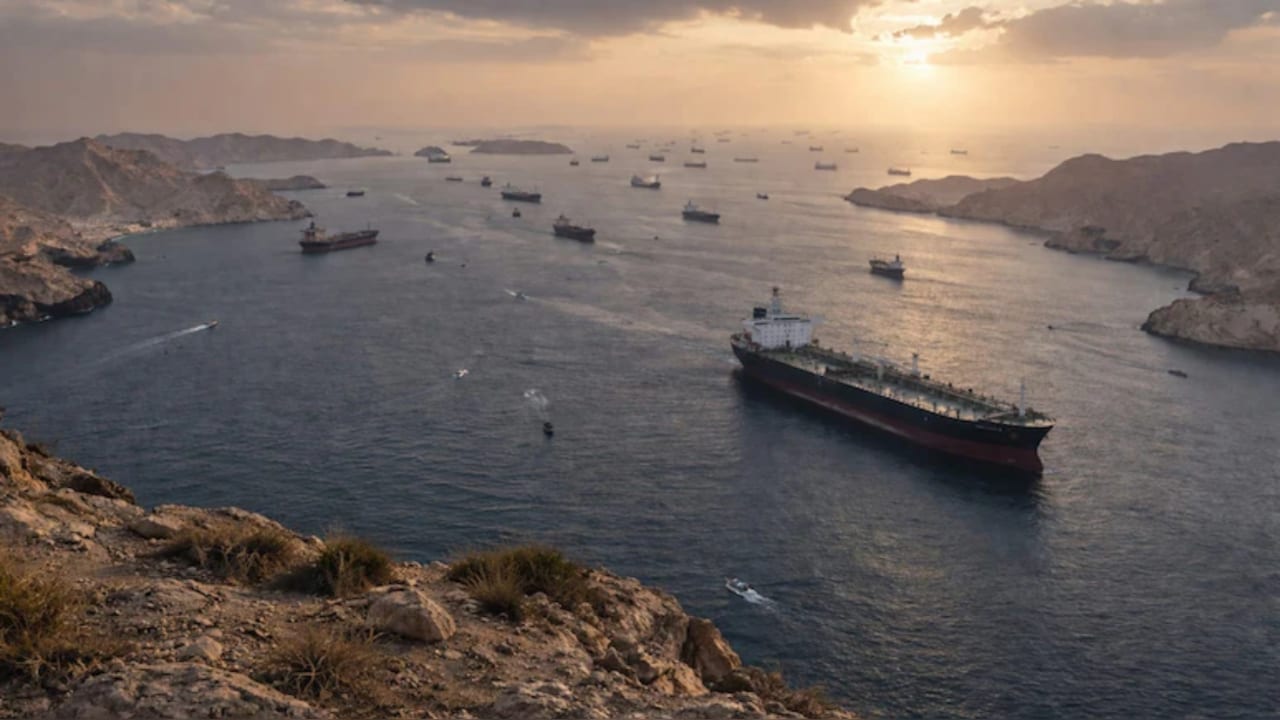
The current military standoff in the Strait of Hormuz is not a localized geopolitical dispute; it is a highly calculated, high-stakes trade war executed through kinetic means. Following the breakdown of a fragile truce and the subsequent re-imposition of a US naval blockade on Iranian ports, Tehran’s declaration of the strait as an inviolable "red line" exposes the underlying strategic calculus of both actors. Behind the public warnings of "existential war" lies a quantifiable matrix of maritime control, asymmetric defense capabilities, and regional infrastructure vulnerabilities.
To evaluate this crisis, we must analyze the operational realities of maritime chokepoints, the cost-imposition strategy employed by Iran, and the economic vulnerabilities of the United States and its regional allies.
The Asymmetric Control Function: Geography vs. Kinetic Power
The conventional military paradigm assumes that regional control is a function of localized physical presence, such as naval assets, coastal fortifications, and nearby islands. This assumption underpins the current US Central Command (CENTCOM) targeting strategy, which focuses on destroying Iranian missile sites, coastal defense systems, and naval bases along the southern coast and strategic islands like Greater Tunb.
However, this strategy overlooks Iran's decentralized defense doctrine. Tehran's operational model does not rely on static coastal infrastructure. Instead, it operates on a highly distributed mobile launch framework.
+--------------------------------------------------------+
|             Iran's Distributed Strike Model            |
+--------------------------------------------------------+
|  [Deep Inland Command] ---> [Mobile Launcher Units]   |
|                                     |                  |
|                                     v                  |
|                      [Strait of Hormuz Chokepoint]     |
+--------------------------------------------------------+
This model is governed by three operational variables:
- Inland Launch Depth: By utilizing long-range anti-ship cruise missiles (ASCMs) and loitering munitions, Iran can project lethal force into the 21-mile-wide Strait of Hormuz from deep within its mountainous interior. This renders localized coastal strikes highly inefficient, as the target coordinates are constantly shifting.
- Asymmetric Maritime Interdiction: The closure of the waterway is achieved not through a conventional naval blockade, but via low-cost high-volume tactics. These include the deployment of smart naval mines, fast-attack craft (FAC) swarms, and drone strikes against commercial shipping, which instantly drives insurance premiums to prohibitive levels.
- The Escort-to-Strike Ratio: For the US and its allies to force open the strait, they must commit a massive ratio of defensive naval assets (destroyers, Aegis cruisers) to escort a single commercial vessel. This diverts critical naval power from other global theaters, creating a highly favorable strategic trade-off for Iran.
The Infrastructure Cost Function: Regional Leverage
Iran's primary strategic leverage lies in its ability to impose severe regional costs. When US military options expand to target critical domestic infrastructure within Iran—such as power plants and bridges—Tehran's counter-strategy shifts from local maritime defense to regional infrastructure destruction.
This regional cost function is defined by two primary escalation pathways:
1. The Regional Infrastructure Equalizer
Iran’s military command has explicitly stated that any strike on its domestic infrastructure will trigger immediate retaliatory strikes on the power grids, desalination plants, and energy export facilities of neighboring Gulf states. Because neighboring economies are highly centralized and rely heavily on vulnerable coastal desalination and gas-to-power infrastructure, the economic damage of such strikes would be highly asymmetric.
2. The Universal Energy Blackout
By claiming that regional energy exports will be "for everyone or for no one," the Islamic Revolutionary Guard Corps (IRGC) targets the global supply chain directly. If the US successfully bypasses the Strait of Hormuz using alternative routes, Iran possesses the missile capabilities to target alternative pipelines and storage terminals across the Arabian Peninsula, effectively nullifying any bypass mechanisms.
Structural Bottlenecks of a US Forced-Open Policy
The US strategy of using precision air strikes and a naval blockade to compel Iran to negotiate faces severe structural limitations. This approach relies on a flawed theory of escalation dominance, assuming that superior kinetic force will force Tehran to accept a highly unfavorable diplomatic status quo.
In practice, this strategy creates a critical bottleneck:
- The Tonnage and Replenishment Limit: Maintaining a continuous naval blockade and conducting sustained aerial strikes requires a constant supply of precision-guided munitions and naval rotations. Over a prolonged period, this depletes key stockpiles and strains naval readiness.
- The Freedom of Navigation Paradox: While the US historically acts as the guarantor of maritime security to protect global trade, proposing unilateral shipping tolls or charging for safe passage fundamentally undermines this principle. Attempting to monetize security operations breaks international maritime law and alienates key allies who rely on unhindered transit.
- The Insurance Trap: Even if the US military successfully destroys 90% of Iran's coastal launch capabilities, the remaining 10% is still enough to damage commercial tankers. Under maritime insurance rules, as long as a threat of dynamic targeting exists, commercial fleets will refuse to transit the strait without astronomical war-risk premiums. This keeps the waterway effectively closed to normal commercial traffic, regardless of US claims of control.
The Strategic Path Forward
To resolve the crisis without triggering a catastrophic regional conflict, the US and its allies must shift their strategy from kinetic escalation to structural deterrence and diplomatic leverage.
The immediate tactical priority must be the establishment of a multilateral maritime transit authority in partnership with regional neutral powers like Oman. Rather than pursuing an aggressive forced-entry campaign, the US should focus on localized defensive escorts while restoring the diplomatic mechanisms established in previous agreements. Restoring compliance with negotiated frameworks on oil export waivers and ship traffic regulations remains the only viable path to permanently lowering the risk premium on global energy transit and reopening the world's most critical maritime chokepoint.