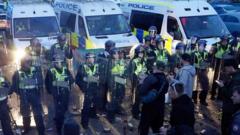
The air in Southampton on a Tuesday night doesn’t usually feel heavy with the scent of burning plastic and raw adrenaline. It usually smells of salt water, diesel from the docks, and the grease of late-night chip shops. But this week, the air changed. It became thick, volatile, and sharp.
To read the official police blotters or the sterile court dispatches, you would think what happened was merely a logistical sequence of events. A court case ended. A crowd gathered. Bricks were thrown. Arrests were made.
But institutions do not understand the anatomy of an explosion. They see the fire, but they rarely look at the oxygen that fed it. They do not see the invisible stakes that pull ordinary, fractured lives out of the quiet safety of their living rooms and drag them into the path of riot shields.
To truly understand why three young men—and several others before them—now sit in dark holding cells awaiting their fate, you have to go back to the image that broke the city's collective dam.
It is an image captured on a body-worn police camera. In it, an 18-year-old university student named Henry Nowak lies on the cold pavement. He has been stabbed multiple times. He is bleeding out. He is whispering, desperately, that he cannot breathe.
And yet, the metal that meets his wrists is not a medical tourniquet. It is a pair of police handcuffs.
His killer, a man named Vickrum Digwa, had spun a frantic, immediate lie to the arriving officers, claiming he was the actual victim of a racially motivated attack. The police believed the liar. They restrained the dying boy. Henry lost consciousness in those cuffs, and he never woke up.
When that video footage was released to the public, following Digwa’s sentencing to life in prison, it didn’t just inform the public. It wounded them. It felt like a betrayal of the basic, unwritten contract between a citizen and the state: when I am dying, you are supposed to save me.
The grief did not stay quiet. It mutated.
Consider Daniel Frost. He is forty-four years old, a father of two, living alone with his dog in Southampton. He lives with the quiet, grinding reality of a severe physical disability, the consequence of a catastrophic fall that left him with a replaced hip and dependent on state support. His life is small, insulated, and largely defined by pain.
But on Tuesday night, Frost wasn't just a vulnerable man in a quiet flat. The ambient fury of the city found him. He walked into the chaos near Portswood Road—the very neighborhood where Henry was killed—and something inside him snapped.
He didn’t just join the crowd; he became an instrument of its rage. He grabbed heavy plastic wheelie bins and hurled them at a wall of protective riot gear. He took a dog lead, wrapped the heavy metal carabiner tightly around his knuckles like a makeshift weapon, and taunted the police to come and take it from him.
The next day, sitting in the sterile dock of a magistrates' court, the adrenaline had completely evaporated. It was replaced by the crushing weight of reality. Through his defense lawyer, Frost spoke of his profound shame, calling his actions one of the single biggest regrets of his life. A judge deemed his behavior far too severe for a simple fine, remanding him in custody to await a higher court's sentence.
He went out seeking justice, or an outlet for anger, and ended up losing his own freedom.
But the fire didn't burn out with the older generation. It consumed the young.
On Friday afternoon, twenty-four-year-old Connor Bishop sat deep in the cells beneath Southampton Magistrates’ Court. When his name was called, he flatly refused to come up to face the room. His lawyer had to enter a guilty plea to violent disorder on his behalf while Bishop remained in the dark below.
CCTV footage had caught Bishop in the thick of the Portswood melee, picking up a heavy, bright orange traffic cone and launching it into the retreating line of police officers. He was part of a pack that hunted the uniform, throwing bins and bottles, fueled by a collective vertigo that makes people believe, if only for an hour, that the rules of society no longer apply.
Further down the coast, at Portsmouth Magistrates’ Court, two more names were added to the ledger: Reece Robinson, twenty-one, and Noah Etherington, a mere eighteen years old. Both pleaded guilty. Both were taken down to the cells, denied bail, their youth abruptly halted by the heavy iron gates of a remand prison.
They are statistics now. Four names among many, facing months or years behind bars.
But look closely at what was actually happening on those streets. Eleven police officers were injured. A police dog was hurt. Bricks shattered windows, and flares scorched the tarmac. The Hampshire Police Federation became so overwhelmed by targeted digital threats and AI-driven doxxing campaigns that they had to completely pull their presence from social media platforms to protect their officers' families. Misidentified officers were forced to flee their own homes in fear for their lives.
This wasn't a protest. It was a fever.
The profound irony of the violence is that it desecrated the very memory it claimed to honor. After the trial concluded, Henry Nowak’s father, Mark, stood before the cameras. His face carried the unimaginable, hollow exhaustion that only a grieving parent possesses. He didn’t call for fire. He didn't ask for retribution.
He begged for the opposite. He explicitly stated that he did not want his son’s tragedy to be used as fuel to inflame division, hatred, or hostility. He wanted Henry’s legacy to be safer streets, not bloodier ones.
Yet, the machinery of public outrage doesn’t listen to grieving fathers. It listens to the loudest voices in the room. Political figures arrived to stand outside the police station, microphones were raised, and digital algorithms did what they do best: they weaponized human sorrow.
The independent watchdog is now investigating the police's actions on that fatal December night. A full jury inquest has been scheduled to determine exactly how much the state’s delay and the mistaken handcuffing contributed to an eighteen-year-old student losing his life.
There will be answers. There will be systemic accountability, delivered in the slow, meticulous, agonizingly quiet rooms of a coroner's court.
But the streets didn't want to wait for the slow turning of the legal wheel. They wanted to scream. And in doing so, they created a secondary tragedy—a wake of shattered shopfronts, injured workers, and young men who ruined their own futures in a single night of blind, unthinking fury.
When the smoke finally cleared from Portswood Road, the local residents didn't wait for the council. They came out onto the pavements with household brooms, dustpans, and garbage bags. They swept away the shattered glass. They uprighted the overturned bins. They cleaned up the wreckage left behind by people who claimed to care about their community but left it scarred.
The true pulse of the city wasn't found in the men throwing traffic cones or the politicians shouting into microphones. It was found in the quiet click of those plastic broom bristles against the asphalt, cleaning up a mess that never should have been made.
How Henry Nowak's arrest ignited violent protests and political debate
This video provides vital context regarding the political fallout and the community tension surrounding the controversial police response that triggered the Southampton unrest.