The air inside the hotel suite is heavy. It smells of expensive hairspray, cooling stage lights, and the metallic tang of pins being driven into fabric.
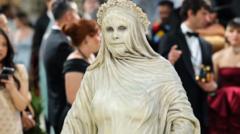
Heidi Klum stands in the center of the room. She is not standing in the way you or I stand. She is holding herself with the precision of a clockmaker. Around her, a dozen people move with frantic, silent urgency. They are ghosts in black, circling a marble statue that breathes. If you enjoyed this article, you should look at: this related article.
This is the ritual before the Met Gala.
We see the red carpet photos. We see the flashbulbs, the frozen smiles, the headlines about who wore what. We see the finished product—the "sculpture" that graces the front pages. But we rarely see the surrender. Because that is what this is. To become a walking piece of art at the world’s most scrutinized party, a human must stop being a person for a few hours. They must become a frame. For another angle on this event, check out the latest update from Variety.
Consider the physics of the transformation.
A gown is rarely just a gown at this level of fashion. It is an engineering challenge. When the concept involves weight, structural integrity, or movement that defies gravity, the garment ceases to be clothing and becomes a mechanical system.
Imagine a young designer, sweating over a laptop screen, calculating the tension required to keep five hundred pounds of hand-beaded lace suspended across the human frame without causing a collapse. That is the hidden tension of the Met. It is not just about aesthetics. It is about the threshold of structural failure.
When Heidi Klum chooses a look—often one that pushes against the boundaries of traditional couture—she is inviting this tension into her home. She is not just putting on a dress. She is agreeing to be the load-bearing component of a kinetic experiment.
Watch the way she moves in the footage.
There is a slight, almost imperceptible hesitation in her gait. You might mistake it for a practiced runway strut. It isn’t. It is the walk of a woman who knows exactly where the center of gravity has been shifted. If she tilts too far, the entire illusion breaks. The sculpture crumbles.
This is the part the public doesn’t see. The reality is far less glamorous than the red carpet suggests. It is physically punishing. It is a game of millimeters. In a hypothetical world where we could X-ray the garment, we would see the intricate harness systems, the hidden support struts, and the way the fabric is anchored to her skeleton.
Why do it?
The easy answer is attention. The cynical answer is brand management. But those are cold, lifeless explanations for a deeply human drive.
There is a specific kind of thrill in becoming something else. Most of us go through life trapped in the same skin, governed by the same daily rhythms, bound by the same physical limitations. We wake up, we work, we age. The Met Gala is one of the few places on earth where the impossible is invited to dinner.
For a few hours, the rules of biology and comfort are suspended. The celebrity becomes a conduit for a designer’s wildest, most impractical dream. They are the brush, the canvas, and the paint, all at once.
I remember watching a costume designer work on a similar project years ago. They were obsessed with the way light hit a specific type of synthetic resin. They didn’t care that the material made the wearer sweat, or that it pinched the skin. To them, the human element was secondary to the composition.
That is the danger zone. That is where the ego of the art crashes into the reality of the human.
Heidi Klum navigates this with a veteran’s eye. She understands that the sculpture only works if she commits to the role completely. If she looks uncomfortable, the magic vanishes. If she shows a flicker of pain, the audience is reminded that she is just a woman in a very heavy, very expensive costume.
She refuses to break.
This takes a specific type of grit. It is not the grit of a soldier or a surgeon; it is the quiet, disciplined endurance of a performer who knows that the audience is waiting for a crack in the façade. She maintains the posture, the gaze, and the rhythm even when the structural weight is pulling at her shoulders, even when the temperature inside the fabric is rising, even when every instinct is screaming for the release of soft cotton.
She is building a monument to the present moment.
Look at the transition from the hotel suite to the steps. She is a woman of flesh and blood when she enters the car. She is an object of myth when she steps out of it. The transformation is complete. The flashbulbs explode, a chaotic swarm of light reflecting off the surfaces of her garment, and in that blinding glare, the humanity disappears.
She is no longer Heidi. She is the sculpture.
There is a tragedy in it, perhaps. We demand that our icons be more than human. We demand they be statues. We demand they be impossible. And when they give us exactly that, we consume them with our cameras and our screens, never thinking about the weight they are carrying behind the velvet rope.
But the night ends. The event is a blur of champagne and social maneuvering. And eventually, the pins are pulled. The structural supports are unfastened. The layers of art are peeled away, leaving nothing but a person, tired and bruised, waiting for the relief of gravity returning to its natural order.
She climbs back into the car, the silence finally returning to the room. The sculpture is gone. The person remains.
She leans back against the leather seat, closes her eyes, and for the first time all night, she stops holding her breath.


:max_bytes(150000):strip_icc()/Whitney-Leavitt-Jen-Affleck-063025-6249409f3e634d3d8889b627b49eb21f.jpg)