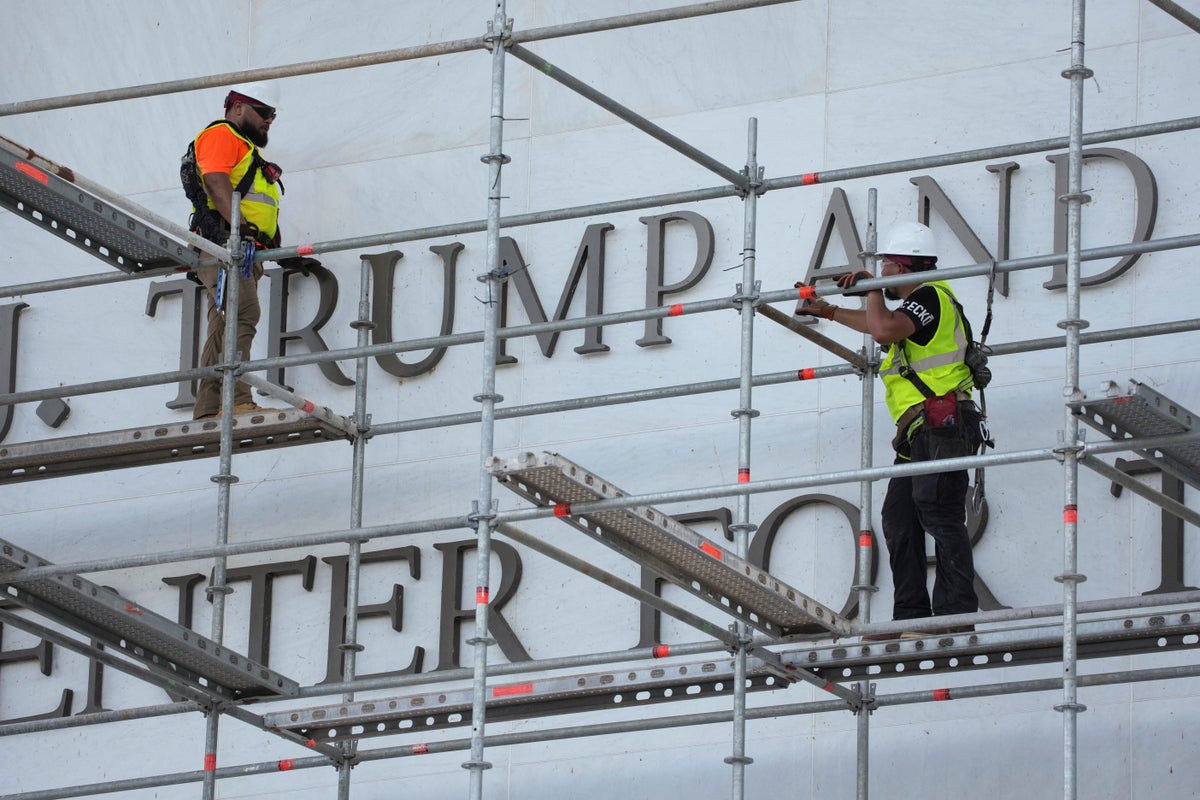
The physical removal of branding from a federal facility is rarely a product of aesthetic preference; it is the lagging indicator of a structural breakdown in institutional governance. When construction crews erected scaffolding to dismantle the facade lettering at the John F. Kennedy Center for the Performing Arts, they were not merely executing a construction order. They were resolving a core tension between executive agency overreach and statutory congressional mandate. The systemic failure of the facility's board of trustees to recognize the limits of corporate-style asset control within a public trust provides a precise case study in administrative law and institutional risk management.
To understand how a presidential administration and a hand-picked board of trustees suffered a definitive legal defeat, one must look past political rhetoric and analyze the three specific legal and operational pillars that governed this dispute: statutory exclusivity, fiduciary deviation, and the mechanics of injunctive relief.
The Principle of Statutory Exclusivity
The fundamental error in the board’s strategy lay in treating a federally designated living memorial as a standard non-profit asset subject to unilateral re-branding. Under the 1964 organic statute establishing the institution, Congress explicitly designated the venue as the sole national monument to President John F. Kennedy within the nation's capital.
When the reconstituted board voted to alter the moniker to "The Donald J. Trump and The John F. Kennedy Memorial Center for the Performing Arts," they operated under the assumption that plenary governance powers granted them naming rights. However, public administrative bodies remain bound by the doctrine of explicit delegation. The legal architecture dictating this constraint can be broken down into two distinct variables:
- The Scope of Delegated Authority: Legislative language that dictates the management of an institution does not inherently include the authority to alter its statutory identity. U.S. District Judge Christopher Cooper’s 94-page opinion underscored that because Congress legislated the name, only an act of Congress possesses the constitutional authority to amend it.
- The Non-Discretionary Nature of Living Memorials: Unlike standard public-private partnerships where naming opportunities are utilized as liquid capital to attract donors, a designated national memorial possesses a fixed statutory definition. The board possessed zero explicit or implied legal authority to dilute or expand that designation.
The board's attempt to pre-emptively manufacture legitimacy by purchasing and preparing physical signage prior to the formal trustee vote demonstrates a tactical focus on operational momentum over legal verification. This created an immediate procedural vulnerability that invited a structural challenge from ex-officio board members, specifically Representative Joyce Beatty, who retained legal standing to protect the integrity of the original congressional charter.
Fiduciary Deviation and Capital Allocation Risks
The secondary vulnerability in the administration's framework was the conflation of capital improvement projects with structural asset transformation. The proposed $257 million "revitalization project" introduced a critical operational bottleneck: a mandated two-year complete shutdown of the venue.
In a commercial context, temporary closures for capital expenditure overhauls are evaluated via standard net present value formulas, balancing short-term revenue losses against long-term operational efficiencies. In a public trust framework, a total operational freeze creates an immediate conflict with the organization’s statutory charter to provide continuous cultural programming.
The economic and operational feedback loops of this decision generated two major points of friction:
[Board Approves Two-Year Shuttering]
                │
                ▼
[Immediate Breach of Statutory Charter] ──► (Triggers Civil Litigation)
                │
                ▼
[Artist Contract Cancellations] ──────────► (Destroys Institutional Goodwill)
The administration’s subsequent litigation against artists who withdrew from scheduled performances—such as jazz musician Chuck Redd—backfired under the District of Columbia’s anti-SLAPP (Strategic Lawsuits Against Public Participation) statutes. The courts recognized that the venue was using punitive breach-of-contract claims to suppress public opposition to an unauthorized institutional restructuring. By failing to establish valid, signed agreements for future cycles before threatening million-dollar damages, the board exposed its legal strategy as an exercise in political retribution rather than a defense of fiscal health.
The Mechanics of Injunctive Relief and Irreparable Harm
The final collapse of the administration’s legal position occurred within the stringent framework governing emergency stays and preliminary injunctions. To halt Judge Cooper’s June 12 deadline, Justice Department lawyers were required to satisfy a rigid four-factor legal test: proving a high likelihood of success on the merits, demonstrating that the institution would suffer irreparable harm absent a stay, showing that the balance of equities favored their position, and proving a stay served the public interest.
The government’s core economic defense centered on capital disruption. Executive Director Matt Floca and Justice Department counsel argued that stripping the name would induce a catastrophic capital flight, rendering operations financially non-viable. They asserted that existing donors who committed capital specifically under the revised name would rescind their funding, forcing immediate capital returns.
This argument failed to satisfy the legal definition of irreparable harm for two fundamental reasons:
- Quantifiable vs. Non-Quantifiable Loss: In federal jurisprudence, economic injury—even substantial financial loss—rarely constitutes irreparable harm because it can be remedied through subsequent financial restructuring, alternative fundraising mechanisms, or damages.
- The Self-Inflicted Injury Doctrine: Courts routinely reject claims of irreparable harm when the alleged injury is the direct consequence of the moving party's own strategic overreach. Because the board altered the branding and accepted donations under a legally contested framework before securing clear statutory clearance, the resulting financial instability was classified as a self-inflicted operational risk.
When the U.S. Court of Appeals for the D.C. Circuit issued its swift, one-page denial of the emergency stay on June 12, it confirmed the lower court’s assessment. The panel, notably featuring a bipartisan mix of appointees with no noted dissents, recognized that allowing an unauthorized name change to persist during a lengthy appeal process would introduce greater systemic confusion than enforcing an immediate return to the status quo.
Operational Playbook for Public Trust Governance
The resolution of this conflict establishes a clear precedent for the execution of capital campaigns and governance changes within federally chartered institutions. Entities operating under congressional mandates must abandon the assumptions of private equity turnarounds and instead implement a strict checklist for risk mitigation:
- Isolate Statutory Charters From Executive Discretion: Any variance in public-facing identity, asset deployment, or multi-year closures must undergo a formal statutory audit prior to board authorization. If the text of the organic act lacks explicit permissive language for branding adjustments, legislative remedy must precede capital allocation.
- Decouple Philanthropy From Institutional Identity: Development officers must structure donor agreements with explicit contingency clauses acknowledging the statutory limitations of the venue. Accepting capital tied to naming rights on a federal living memorial introduces catastrophic balance-sheet risks if those rights are struck down by judicial review.
- Enforce Independent Board Diligence: Board members must reject efforts to push through capital overhauls via truncated or restricted voting processes. The practice of muting dissenting ex-officio trustees during deliberative sessions guarantees procedural defects that invalidate the resulting resolutions under administrative challenge.
The physical removal of the lettering from the facade on June 12 marks the permanent closing of an unconstitutional branding experiment. Moving forward, the institution's leadership must pivot away from aggressive litigation strategies and focus entirely on stabilizing its core donor network under its original, legally immutable name.