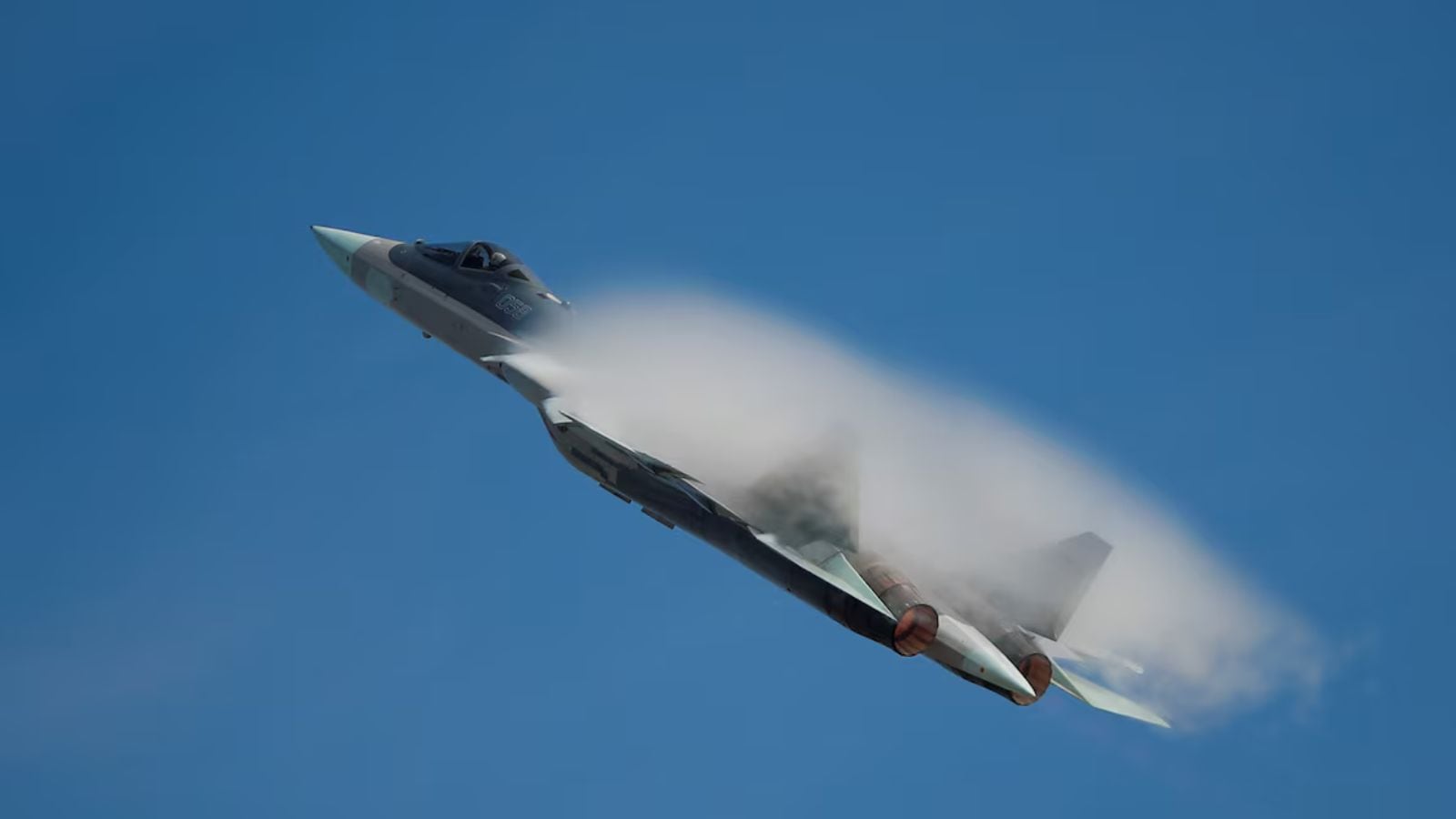
The operational matrix of international defense procurement is dictated by two brutal variables: the immediate squadron deficit and the long-term amortization of technological sovereignty. Russian President Vladimir Putin’s unilateral offer to India for joint production of the Sukhoi Su-57 stealth fighter, accompanied by the assertion of "no restrictions whatsoever" regarding technology transfer, is not a simple bilateral gesture. It is a calculated response to a structural bottleneck.
To evaluate the viability of this offer, the transaction must be stripped of its diplomatic rhetoric and analyzed through a cold, data-driven framework. The core tension lies between India's defense requirements—specifically its shrinking combat squadron strength—and its domestic aerospace objective, the Advanced Multirole Combat Aircraft (AMCA) program. By evaluating the industrial infrastructure, financial trade-offs, and technology transfer mechanics, we can map the exact strategic equilibrium New Delhi must calculate.
The Strategic Deficit: Squaring the Fighter Squadron Gap
The Indian Air Force operates under a persistent structural deficit, facing a sanctioned strength of 42 squadrons while field deployment numbers hover significantly lower. The timeline to bridge this gap via domestic manufacturing introduces a compounding capability risk.
The AMCA Timeline Horizon
India’s domestic fifth-generation fighter, the AMCA, is structurally projected to enter active operational service post-2035. This leaves a minimum nine-year capability vulnerability. Under basic attrition and retirement models for legacy platforms like the MiG-21 and early-generation Jaguars, the gap expands linearly unless balanced by off-the-shelf procurement or licensed assembly.
The Stopgap Volume Requirement
Defense ministry assessments indicate a critical need for an intermediate platform. The procurement of approximately two squadrons—equivalent to 36 Su-57 aircraft—is under active review. The short-term acquisition function acts as an operational bridge, aimed entirely at neutralizing regional stealth deployments until local industrial lines can scale up.
The Industrial Absorption Capacity: Assessing HAL's Infrastructure
The viability of transferring a high-complexity aerospace platform depends on the local manufacturer's ability to absorb, replicate, and scale sophisticated industrial processes without catastrophic capital expenditure.
The 50 Percent Infrastructure Compatibility Benchmark
A joint technical assessment conducted by Russian engineering committees evaluated the existing facilities of state-run Hindustan Aeronautics Limited (HAL). The audit concluded that roughly 50 percent of the current manufacturing infrastructure—primarily facilities utilized for the license-built Su-30MKI at Nashik—can be directly repurposed for the Su-57 workflow.
[HAL Assembly Line Asset Allocation]
├── Repurposed Infrastructure (50%): Tooling, heavy jig structures, baseline sub-assembly bays.
└── Deficit Infrastructure (50%): Radar-absorbent coating facilities, advanced composite curing ovens, specialized clean rooms for AESA radar integration.
The remaining 50 percent represents a capital bottleneck. Transitioning to a fifth-generation manufacturing standard requires clean-room environments for avionics integration, high-temperature autoclaves for advanced carbon composites, and specialized facilities to apply radar-absorbent material (RAM) coatings. The financial quotation for this infrastructure upgrade remains outstanding from the Russian defense export conglomerate, Rosoboronexport, creating a variable cost factor that alters the net present value of the entire program.
The Technology Transfer Function: Code vs. Components
When dealing with stealth aerospace architectures, "technology transfer" is a spectrum ranging from kit assembly to source-code sovereignty. The current proposal represents an unprecedented shift compared to the aborted 2021 Fifth Generation Fighter Aircraft (FGFA) program, which collapsed under the weight of a $30 billion cost projection and highly restricted technology access.
The updated framework shifts from co-development to advanced licensed production, altering three primary technical variables:
- Source-Code Access: Russian authorities have indicated a willingness to grant unprecedented access to the aircraft's source code. Source-code autonomy allows local engineers to integrate domestic weapons payloads and electronic warfare suites without returning the airframe to the original equipment manufacturer (OEM).
- Sensor Customization: The integration of India’s indigenous Virupaksha Active Electronically Scanned Array (AESA) radar into the Su-57 frame serves as a critical test of this modularity. Replacing the standard Russian N036 Byelka radar with a domestic variant reduces long-term component dependency but introduces significant integration risk.
- Propulsion Evolution: Initial batches of the Su-57 would rely on the AL-41F1 engine or the early-stage Izdeliye 30. True technological sovereignty requires the local production of single-crystal turbine blade technology—a milestone that India's domestic Kaveri engine program has spent decades trying to master.
Macro-Economic Realities and the Geopolitical Supply Chain
The economic logic driving this renewed offer stems from structural pressures on Russia's defense industrial complex. Sanctions and prolonged high-intensity combat have restricted Russia's standard export markets, making large-scale, long-term capital infusions from reliable trading partners structurally necessary.
India, concurrently, is managing a complex diversification strategy. While historical data from the Stockholm International Peace Research Institute (SIPRI) identifies Russia as India’s largest arms supplier, New Delhi has methodically lowered its import percentage from Moscow. Supply chain friction caused by international sanctions has delayed component delivery for existing systems, such as the final tranches of the S-400 air defense network.
Investing in a major Russian platform like the Su-57 creates a long-term path dependency. It locks up capital that could otherwise fund western procurement tracks, like the Rafale-M or local AMCA R&D, while exposing New Delhi to secondary sanctions risk.
The Strategic Recommendation
The optimal path for New Delhi is not a binary choice between pure indigenous development and total foreign adoption. Instead, it must be an aggressive, calculated hedging strategy.
India should advance negotiations for the 36 off-the-shelf Su-57 aircraft exclusively under a strict legally binding agreement that guarantees full source-code access and local integration rights for the Virupaksha AESA radar. This addresses the immediate squadron deficit within a 36-month delivery window. Concurrently, HAL should cap its capital investment in Su-57 assembly line conversion at the specified 50 percent threshold, utilizing the platform solely as an industrial training ground to master radar-absorbent material application and composite handling.
All surplus capital and technical insights gained from this industrial exposure must be systematically funneled directly back into accelerating the AMCA timeline. The Su-57 must not become India's permanent fifth-generation solution; it must be used as a high-performance, depreciating asset to buy the time necessary to achieve absolute domestic aerospace autonomy.