Mass athletic victories trigger immediate, large-scale behavioral shifts within a population. While mainstream media frequently covers these events through the lens of emotional narrative—focusing on surface-level sentiment and visual spectacle—the underlying mechanics rely on a predictable framework of social cohesion, economic surges, and psychological decompression.
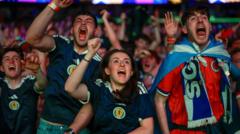
When a national team, such as Scotland’s national football team, secures a high-stakes victory, the resulting public celebration is not an isolated emotional outburst. It is the visible output of a complex socio-behavioral system. Understanding this phenomenon requires breaking it down into three distinct operational vectors: the aggregation of social capital, the localized economic velocity spike, and the structural release of collective anxiety.
The Tri-Partite Framework of Mass Celebration
To systematically evaluate the impact of an international sporting triumph, we must categorize the outcomes into three structural pillars.
                  [International Sporting Victory]
                                 │
         ┌───────────────────────┼───────────────────────┐
         ▼                       ▼                       ▼
  [Pillar 1: Social]     [Pillar 2: Economic]    [Pillar 3: Psych]
  Collective Identity    Demand Compression      Anxiety Release
  & Tribal Cohesion      & Velocity of Money     & Dopaminergic Spike
1. The Cohesion Vector (Social Capital Aggregation)
International football matches function as unique mechanisms for rapid tribal alignment. Under normal conditions, a population is highly fragmented by political, economic, and regional divisions. A major sporting victory operates as a temporary forcing function that overrides these micro-identities, replacing them with a singular macro-identity.
This transformation relies on what sociologists term "reflected glory." When the athletic proxy (the team) achieves a high-value objective, the population absorbs that success into their personal identity matrix. The physical manifestation of this—thousands of individuals gathering in public squares, chanting, and displaying national symbols—is an optimization of social capital. It reduces interpersonal friction across socioeconomic divides, creating a brief window of heightened civic trust.
2. The Transactional Vector (Localized Economic Velocity)
The financial impact of sports fan celebrations is driven by demand compression. Months of latent consumer desire and financial restraint are compressed into a highly volatile 24-to-48-hour window. This causes an acute spike in the velocity of money within specific urban ecosystems.
- Hospitality Saturation: Food, beverage, and nighttime entertainment venues experience utilization rates that frequently exceed standard peak capacities by 200% to 300%.
- Merchandising Surges: The immediate post-match window triggers an impulse-driven demand curve for official apparel and commemorative goods, shifting inventory at rates that defy standard retail depreciation models.
- Micro-Transport Friction: Urban transit networks experience extreme, localized demand shocks. While this increases short-term fare box revenue, it introduces severe operational strain, forcing municipal systems to deploy emergency capacity management strategies.
3. The Psychological Vector (Stress Decompression and Dopaminergic Release)
On an individual level, the celebration is a structural response to prolonged cognitive load. High-stakes international competition subjects fans to sustained periods of acute stress, characterized by elevated cortisol levels and cognitive hyper-focus.
The definitive whistle confirming a victory causes an immediate, systemic shift from anxiety to relief. This transition triggers a massive, collective dopaminergic spike. The public celebration is the behavioral manifestation of this neurochemical reset. By externalizing this internal shift through physical movement, vocalization, and social interaction, individuals regulate their nervous systems after hours of intense psychological tension.
The Cause-and-Effect Chain of Fan Mobilization
The progression from a sporting victory to a full-scale public celebration follows a strict causal chain. Mainstream reporting often conflates these steps, treating the entire event as a single, spontaneous occurrence. In reality, the mobilization is highly structured.
[Sporting Victory Achieved]
        │
        ▼
[Immediate Neurochemical Shift (Cortisol to Dopamine)]
        │
        ▼
[Decentralized Urban Migration (Fans Move to Central Hubs)]
        │
        ▼
[Commercial Hyper-Consumption (Hospitality/Retail Surge)]
        │
        ▼
[Systemic Stabilizer (Temporary Rise in Social Capital)]
This causal model demonstrates that public euphoria is not random. It requires specific infrastructure—namely, centralized public spaces and a responsive hospitality sector—to transition from individual psychological relief into collective economic and social utility.
Operational Bottlenecks and Structural Risks
While the positive externalities of mass celebration are clear, the phenomenon introduces distinct operational liabilities that municipal governments and business owners must mitigate.
The primary bottleneck is infrastructural capacity. Urban centers are designed for predictable, distributed traffic flows. A sudden, uncoordinated influx of thousands of celebratory citizens creates immediate points of failure:
- Logistical Crises: Waste management systems are instantly overwhelmed by the sheer volume of refuse generated in compressed timeframes, leading to secondary cleanup costs that can erode the tax revenue gains of the economic surge.
- Public Safety Strains: Emergency medical services face unique deployment challenges. Navigating highly dense, celebratory crowds to treat acute injuries or alcohol-related incidents requires specialized, pre-staged medical infrastructure.
- Supply Chain Exhaustion: Local hospitality businesses frequently exhaust their liquid inventories within hours, facing stockouts that limit their ability to fully capitalize on the demand surge. This highlights a critical lack of agile supply chain mechanisms in the service sector.
Quantifying the Intangible: The Valuation of Public Sentiment
Societal joy is difficult to model accurately, but its economic proxy can be found in consumer confidence indexes. Historically, prolonged national celebration correlates with short-term increases in discretionary spending that extend beyond the hospitality sector.
When a population experiences a collective lift in sentiment, risk aversion temporarily decreases. This behavioral shift can influence short-term macroeconomic indicators, leading to marginal increases in big-ticket retail purchases, domestic travel bookings, and even productivity spikes in corporate environments in the days immediately following the event. The sense of shared achievement mitigates workplace burnout by providing an external source of validation and community connection.
However, this model has a distinct shelf life. The decay rate of sports-induced euphoria is exceptionally steep. Data suggests that within 72 to 96 hours post-event, neurochemical levels return to baseline, civic friction reappears, and consumer spending patterns normalize. The long-term macroeconomic impact is negligible unless sustained by subsequent victories or leveraged by coordinated national marketing campaigns.
Maximizing the Strategic Value of Civic Euphoria
To convert a transient burst of public celebration into long-term structural value, municipal authorities and commercial entities must move away from reactive management and adopt proactive optimization frameworks.
Municipalities must establish flexible zoning laws that allow public squares to instantly transition into pedestrian-only, commercially active fan zones upon a major victory. This channels crowd velocity into controlled areas, reducing public safety risks while maximizing commercial collection points.
Concurrently, the hospitality sector must implement data-driven inventory buffering, utilizing predictive modeling based on real-time match probabilities to optimize stock levels prior to the match ending.
The final strategic move belongs to civic and cultural organizations: they must immediately capitalize on the heightened social capital window by launching community initiatives, membership drives, and public infrastructure campaigns within the 48-hour peak euphoria window, capturing consumer attention when collective alignment is at its absolute maximum.