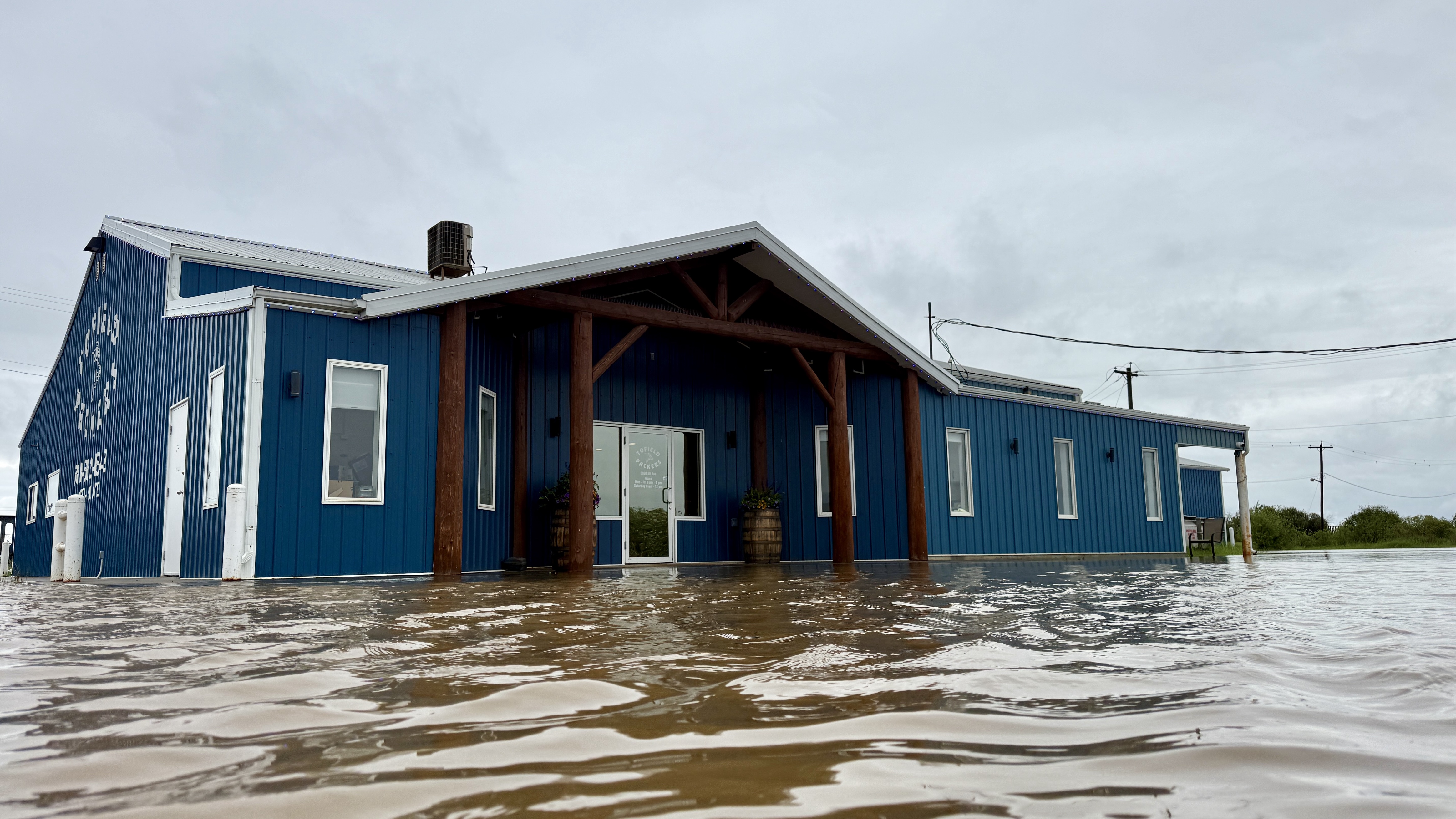
Municipal drainage architecture is fundamentally designed around probabilistic risk modeling, rendering it vulnerable to black swan meteorological events. When a localized atmospheric system dropped over 100 millimeters of precipitation within a 24-hour window across central Alberta—intensifying to 140 millimeters in proximate ecological zones—the infrastructure of rural hubs like Tofield was subjected to a stress test that exposed systemic bottlenecks in rural hydraulic engineering. Standard municipal drainage systems are calibrated to a specific statistical baseline, typically a 1-in-100-year storm event. When actual precipitation volumes outpace these design parameters, municipal networks transition from controlled transport mechanisms into active points of structural failure.
The structural failure observed during localized inundation events isolates two distinct functional bottlenecks: overland flow saturation and wastewater system hydraulic overload. By decoupling these two systems, engineers and public works authorities can isolate why typical emergency mitigations fail when a deluge occurs.
The Dual-System Bottleneck
Urban and rural municipalities rely on two separate networks to process liquid waste and runoff: the stormwater network (surface management) and the sanitary wastewater network (subsurface containment). The critical failure point during extreme precipitation is not merely the volume of water on the streets, but the unintended mechanical coupling of these two distinct networks.
The Stormwater Volumetric Limit
The primary barrier against overland flooding is the stormwater network, which utilizes gravity-fed open ditches, culverts, and dedicated retention ponds. In many rural configurations, the absence of continuous underground concrete storm piping requires surface topography to act as the primary conduit.
When rainfall intensity exceeds the infiltration capacity of surrounding soils—a threshold known as the saturated hydraulic conductivity—the ground ceases to absorb water. The resulting overland sheet flow runs directly into local topography. If the volume of surface water exceeds the maximum volumetric flow rate ($Q$) of local culverts and ditches, defined by Manning’s equation:
$$Q = \frac{1}{n} A R^{2/3} S^{1/2}$$
where $n$ represents the channel roughness coefficient, $A$ is the cross-sectional area, $R$ is the hydraulic radius, and $S$ is the slope, the system reaches physical capacity. Any input volume beyond this mathematical limit converts streets, parking lots, and low-lying commercial zones into temporary retention basins.
Wastewater Hydraulic Overload
The secondary, more critical vulnerability manifests inside the sanitary wastewater system. Unlike the stormwater system, wastewater networks are closed loops designed exclusively to transport predictable indoor flows to treatment facilities. During intense rainfall, this system experiences rapid, parasitic volume increases via two distinct mechanisms:
- Inflow: Direct entry of stormwater into the sanitary system through manhole covers, cross-connections, or submerged cleanouts.
- Infiltration: Groundwater seeping into cracked subsurface sewer pipes, joint failures, or defective lateral lines via the surrounding saturated soil matrix.
This phenomenon, collectively classified as Rainfall-Derived Inflow and Infiltration (RDII), introduces a massive volumetric spike into a system with rigid volumetric limits. Once the inflow volume surpasses the mechanical pumping capacity of lift stations and the peak hydraulic capacity of the treatment infrastructure, internal pressure climbs. The resulting hydraulic head forces untreated wastewater backward through the lowest points of connectivity, generating catastrophic residential and commercial sewer backups.
The Cost Function of Mechanical Interventions
To counteract immediate system failures, municipalities deploy secondary mechanical interventions, primarily high-volume water pumps and vacuum truck fleets. While necessary for crisis containment, these operations are governed by diminishing marginal returns and physical constraints.
The deployment of vacuum trucks introduces a logistical loop limit. A standard industrial vacuum truck possesses a fluid capacity averaging 10,000 to 15,000 liters. When municipal inflows are measured in millions of liters, a fleet of vac trucks functions less as an absolute solution and more as a localized pressure valve. The transit loop—consisting of transit time to the flooded site, extraction duration, transit to a functional discharge point, and offloading—creates a severe operational bottleneck.
Concurrently, heavy mechanical equipment operating on saturated gravel routes accelerates infrastructure degradation. Saturated subgrades lose their bearing capacity, meaning heavy axle loads generate immediate subgrade deformation, deep rutting, and structural failure of the roadway base.
Demand-Side Load Reduction Dynamics
When a municipal infrastructure reaches maximum hydraulic capacity, further system stability depends entirely on demand-side management. Municipal directives urging residents to cease non-essential water usage—such as laundry cycles, dishwashing, and prolonged showers—represent a calculated effort to manipulate the baseline sanitary sewer load.
In a standard municipal configuration under dry conditions, the base sanitary load follows predictable diurnal curves, peaking in the morning and evening. During an active RDII crisis, the available capacity buffer within the wastewater system drops to zero.
[Total Wastewater System Capacity]
=========================================  <-- Critical Overflow Threshold
▲                                       ▲
│                                       │
│ Parasitic Stormwater Inflow           │ Total Hydraulic Load
│ & Infiltration (RDII)                 │ (System Operating at Maximum)
│                                       │
▼                                       ▼
─────────────────────────────────────────  <-- Dynamic Capacity Buffer
▲
│ Domestic Baselines (Showers, Toilets)
▼
=========================================
Every liter of domestic wastewater discharged down a drain during this window directly replaces a liter of capacity that the system requires to process internal hydraulic pressure. If domestic baselines remain unchanged, the system is forced past its critical overflow threshold, resulting in widespread property damage via reverse flow contamination.
Structural Paradigms for Climate Resiliency
Mitigating future systemic failures requires shifting from reactive operational management to structural modification of municipal design principles. Relying on legacy historical baselines ensures regular infrastructure failure as precipitation intensity anomalies increase in frequency.
Municipalities must prioritize the decoupling of surface runoff from sanitary networks through targeted infrastructure investment:
- Engineered Infiltration Barriers: Retrofitting sanitary manholes with watertight inserts and executing targeted lining of aging lateral lines to minimize the baseline RDII coefficient.
- Expanded Dynamic Retention Architecture: Transforming rural drainage channels into engineered bioswales and expanding stormwater retention ponds to deliberately slow down the time-to-peak runoff curve, preventing surface water from pooling in low-lying commercial sectors.
- Decentralized Pumping Grids: Installing permanent, automated bypass pumping infrastructure at known hydraulic low points to systematically redirect overland flow before it impacts critical civic facilities.
The ultimate defense against extreme meteorological events requires re-engineering municipal frameworks to accept, isolate, and channel excess volumes without allowing cross-system contamination. Relying on emergency alerts to manually alter human behavior is an unstable mitigation strategy for a permanent infrastructure deficit.