Subsurface tectonic energy release operates on deterministic physical principles, yet human settlements experience these events through the lens of systemic fragility. When a magnitude 7.7 earthquake struck 68 kilometers north-northwest of Ende in Indonesia's East Nusa Tenggara province at a shallow depth of 10 kilometers, the immediate consequence was not merely a localized tremor, but a systemic failure across physical, logistical, and informational networks. Understanding this event requires stripping away narrative descriptions of panic to analyze the mechanical vectors of destruction: hypocentral depth, spectral acceleration, geotechnical amplification, and logistical friction coefficients.
The event originated within the Flores region of the Indonesian archipelago, a zone defined by active subduction and collision tectonics along the Sunda Arc. Shallow crustal and interface earthquakes of this magnitude release immense seismic energy moments before surface waves arrive. Because the hypocenter was anchored at a shallow depth of 6 miles, high-frequency seismic waves retained their energy density upon reaching the surface, maximizing peak ground acceleration. Buildings lacking ductile framing or reinforced masonry could not dissipate this sudden kinetic input, leading to widespread structural failures across Sikka, Manggarai, and East Manggarai regencies.
The Mechanics of Structural and Geotechnical Failure
Physical destruction during high-magnitude shallow earthquakes follows a strict cost function driven by building typology, soil composition, and secondary mass movements. The destruction observed across Flores Island was governed by two distinct failure mechanisms.
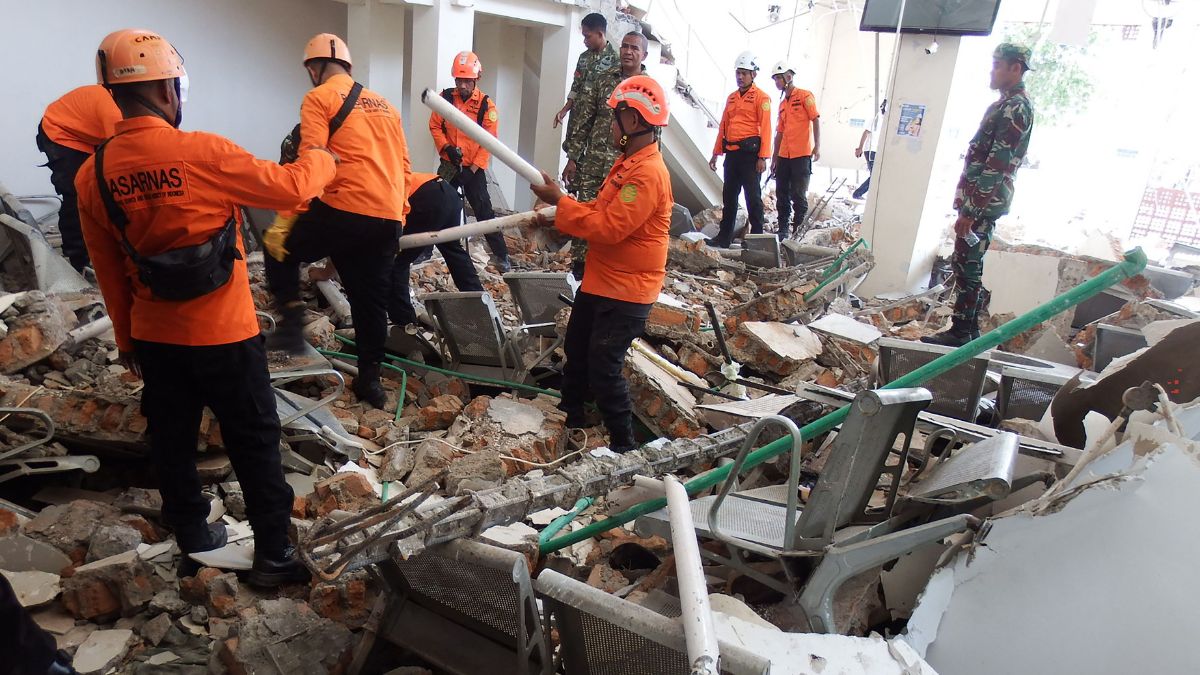
The first mechanism is direct inertial loading on non-engineered structures. Traditional and low-rise masonry buildings in regional regencies frequently lack ring beams, vertical column ties, or adequate roof-to-wall anchorage. When horizontal shear forces exceed the nominal tensile strength of unreinforced brick or concrete block walls, out-of-plane buckling occurs instantly. This explains why public assets such as port terminal waiting rooms in Maumere and assembly hall roofs collapsed under the initial cycles of horizontal shaking. The natural frequency of these rigid structures matched the dominant frequency of the shallow seismic waves, inducing resonance that accelerated structural fatigue and catastrophic collapse.
The second mechanism involves geotechnical instability, specifically seismic-induced slope failure and liquefaction. The mountainous topography of Flores Island, crossed by infrastructure such as the 435-mile Trans-Flores highway, is highly susceptible to gravitational mass wasting when shaken. Seismic body and surface waves act as dynamic alternating stress factors on saturated or fractured slopes, reducing effective shear strength. The resulting landslides severed the primary logistics artery between Labuan Bajo and Larantuka, isolating remote villages and creating an operational bottleneck for emergency response teams.
The Hydrodynamic Response and Tsunami Physics
Early threat assessment for undersea megathrust or large shallow strike-slip earthquakes mandates immediate hydrodynamic modeling. The Indonesian meteorological agency BMKG issued an initial tsunami warning based on the 7.7 magnitude and undersea epicenter, prompting coastal populations in East Nusa Tenggara, West Nusa Tenggara, and South Sulawesi to evacuate to higher ground.
Subsequent sea-level monitoring stations recorded localized tsunami waves reaching heights of up to 5.3 feet in Manggarai and East Manggarai regencies, along with smaller oscillations in Maurole and Bulukumba. These wave heights demonstrate how bathymetry and local coastal geometry amplify tsunami run-up. While a basin-wide catastrophic tsunami was avoided because the fault mechanism did not displace the water column on a trans-oceanic scale, the localized displacement generated significant inundation. In coastal pockets like Ngada village, receding waters left behind heavy sediment loads, stranded fishing boats, and compromised coastal infrastructure, proving that even a moderate localized hydrodynamic pulse carries devastating kinetic potential for low-lying settlements.
Logistical Friction and Information Asymmetry
Emergency response efficiency is bounded by operational capacity, communication uptime, and transport accessibility. In archipelagic disaster zones, the primary constraint is rarely the availability of national assets, but rather the friction of deployment.
Following the seismic event, extensive power outages disabled regional telecommunications grids, creating an informational blackout. Police Chief Rudi Darmoko noted that the lack of power severely delayed damage assessment loops, leaving command centers blind to the true distribution of casualties across remote sub-districts. This information vacuum directly impacts resource allocation, forcing disaster management agencies to operate under high uncertainty.
Geographic fragmentation compounded these delays. East Nusa Tenggara consists of disconnected islands and rugged terrain. While the National Disaster Management Agency deployed three helicopters and a rescue vessel to bypass severed road networks, air and maritime logistics require precise landing zones and harbor infrastructure, both of which suffered localized damage. Furthermore, the absence of heavy mechanical excavation equipment on isolated parts of Flores Island meant that initial search and rescue operations in landslide-buried settlements relied on manual extraction, significantly reducing the probability of survival for trapped victims during the critical golden hours post-impact.
Deploy heavy, modular seismic monitoring arrays and micro-zonation mapping across East Nusa Tenggara to identify high-risk settlement zones prior to the next tectonic cycle. Local municipalities must mandate retrofit guidelines for unreinforced masonry public infrastructure, prioritizing the structural integrity of schools, medical outposts, and transport terminals to eliminate single points of failure in regional life-support networks.