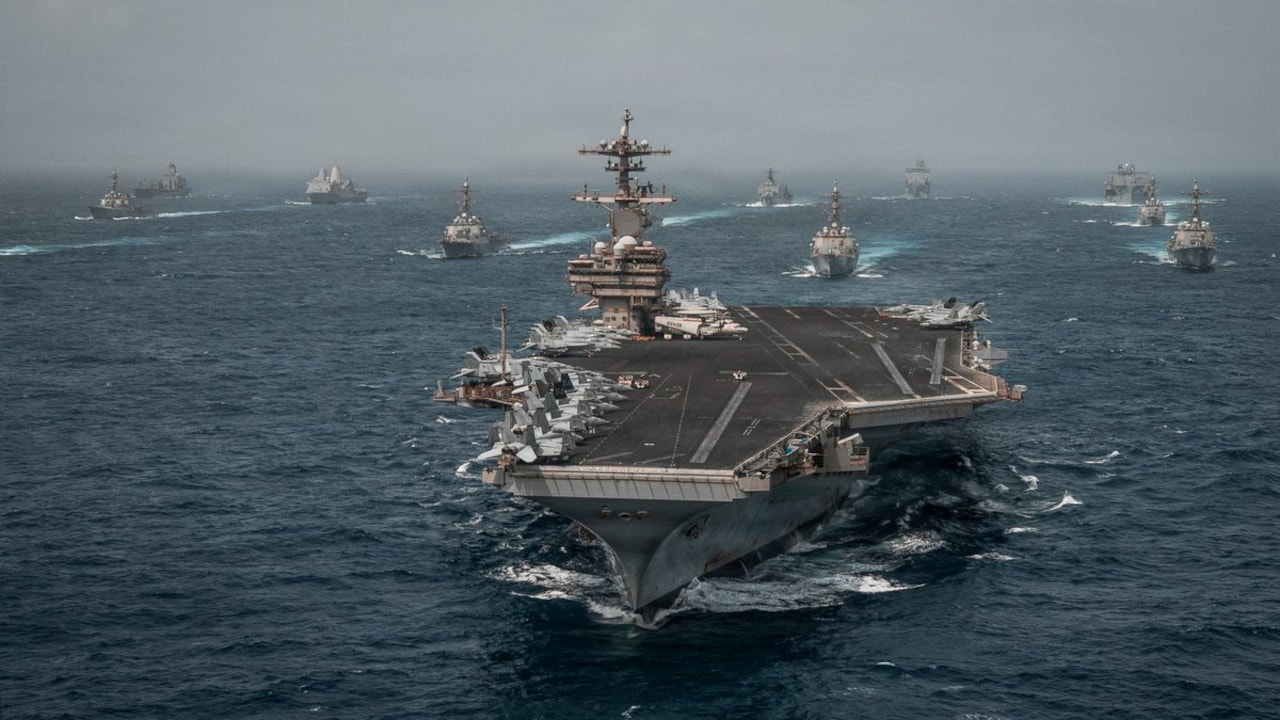
The installation of a massive billboard in Tehran's Islamic Revolution Square depicting United States President Donald Trump in a coffin represents more than a provocation; it is a calculated execution of state-sponsored signaling designed to manage domestic stability and project asymmetrical deterrence during active military friction. This visual campaign occurs against the backdrop of a reimposed United States maritime blockade and tactical strikes on Iranian port infrastructure, serving as a precise instrument of psychological warfare rather than a mere emotional outburst.
Understanding this escalation requires breaking down the strategic utility of state-curated municipal messaging in the Iranian capital into quantifiable strategic drivers.
The Tri-Sector Model of State-Sponsored Messaging
The Iranian regime deploys municipal propaganda through a structured tri-sector framework to achieve distinct geopolitical, domestic, and regional outcomes.
1. The Domestic Audience Cost Function
Authoritarian regimes under external military pressure face severe domestic vulnerabilities. Visual markers like the "We Kill Trump" billboard serve to consolidate the internal political base following the assassination of Supreme Leader Ayatollah Ali Khamenei. By projecting an image of offensive resolve, the state manages the domestic audience cost of military inaction. The primary objective is to reassure loyalists of state capability, thereby preventing internal fragmentation during severe economic blockades.
2. Asymmetric Deterrence and Rhetorical Escalation
Faced with conventional military inferiority against joint United States and Israeli forces, Iran relies on asymmetric deterrence. This strategy relies on creating extreme cognitive uncertainty for adversary decision-makers. Threatening the life of a sitting United States president is a high-threshold rhetorical escalation intended to signal that the regime is willing to bypass traditional diplomatic exit ramps, raising the perceived cost of further military incursions by the coalition.
3. Regional Proxy Alignment
Municipal messaging in major squares like Enghelab and Palestine Square acts as a broadcast signal to regional proxies. By maintaining an aggressive posture toward leadership in Washington and Tel Aviv, the central authority in Tehran signals ongoing commitment to its network of regional aligned actors, preserving the cohesion of its regional alliance architecture even under direct military blockade.
Strategic Mechanisms of the Current Escalation
The timing of this display corresponds directly with real-world kinetic operations. On the southern coast, United States strikes have targeted port facilities, including Bushehr and Bandar Abbas. In response, Tehran has attempted to enforce control over the Strait of Hormuz.
The visual deployment of Trump's image in a coffin is structurally paired with physical monuments, such as a statue of Khamenei’s fist, indicating a coordinated narrative loop:
[Adversary Kinetic Strike]
        │
        ▼
[Economic/Maritime Blockade]
        │
        ▼
[Asymmetrical Narrative Response (Tehran Billboards)]
        │
        ▼
[Domestic Reassurance & Adversary Cognitive Friction]
This cycle functions as a feedback loop. When physical capabilities are constrained by economic isolation and conventional military blockades, the regime substitutes physical military actions with high-impact symbolic escalations to maintain strategic equilibrium.
Constraints and Systemic Risks of Asymmetric Rhetoric
While effective for short-term narrative consolidation, this strategy introduces major structural vulnerabilities.
- The Trap of Escalation Commitments: When a state publicly commits to high-profile retributive acts—such as the assassination of a foreign leader—it creates a commitment trap. Failure to act on these threats can eventually undermine internal credibility, while attempting to execute them risks triggering a full-scale conventional response that the regime cannot sustain.
- Marginal Diminishing Returns of Visual Threat: Repeated visual threats lose psychological efficacy over time. The transition from threatening military personnel to targeting the head of state represents the upper limit of rhetorical escalation, leaving few remaining symbolic options short of direct kinetic operations.
- Economic Bottlenecks: No amount of narrative projection can fully offset the structural degradation caused by a maritime blockade. Symbolic defiance cannot stabilize domestic inflation or supply-chain deficits permanently.
The deployment of high-visibility state threats in central Tehran is a calculated tool of asymmetric defense. It aims to offset physical and economic vulnerabilities by generating cognitive friction for adversaries and reinforcing domestic political cohesion. The ultimate test of this strategy lies in whether symbolic deterrence can successfully delay deeper kinetic confrontations before the economic realities of the blockade force a structural breakdown.
Al Jazeera English provides visual coverage of the newly erected billboard in Tehran's Islamic Revolution Square, showcasing the physical scale of the state propaganda installation.