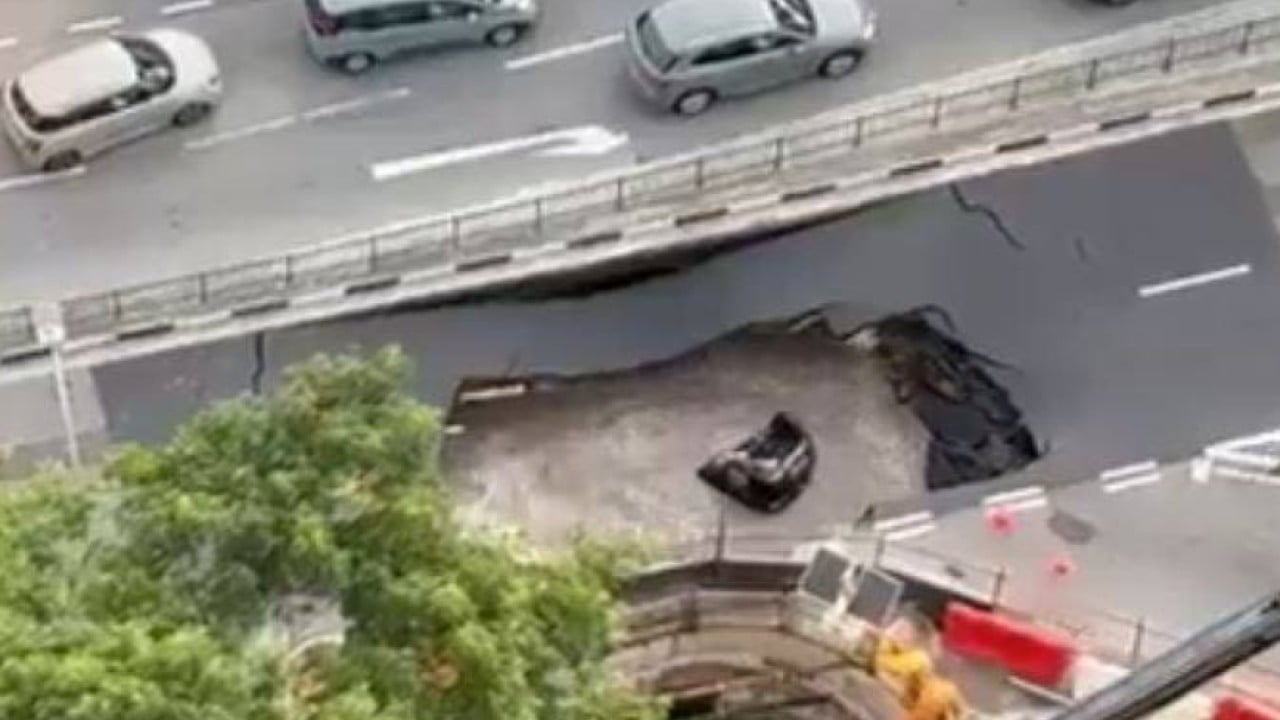
Civil engineering projects executed within hyper-dense urban environments operate under a razor-thin margin of safety. When ground stability fails, resulting in macro-scale subsidence events like sinkholes, the root cause is rarely an isolated technical anomaly. Instead, it is almost universally a systemic failure in the governance of risk, characterized by a breakdown in verification protocols, misaligned subcontractor incentives, and a failure of oversight. The prosecution of a construction firm and its top executive over the Tanjong Katong sinkhole incident provides a stark case study in how operational lapses transform manageable geological risks into existential corporate and legal liabilities.
To evaluate this event with analytical rigor, one must look past the sensationalism of a collapsing roadway and dissect the structural mechanics of regulatory compliance, engineering accountability, and risk mitigation.
The Tripartite Framework of Subsurface Risk Governance
Urban excavation projects rely on a three-pronged defense mechanism to maintain equilibrium between structural loads and soil resistance. A failure in any single pillar destabilizes the entire framework, shifting the project from a state of controlled risk to active crisis.
1. The Geotechnical Baseline and Instrumentation Network
Before a single metric ton of earth is moved, engineers establish a geotechnical baseline report to map soil strata, groundwater levels, and pressure gradients. Because soil is inherently heterogeneous, projects deploy an extensive array of instrumentation, including inclinometers, piezometers, and settlement markers. This network serves as the sensory nervous system of the site. It does not prevent movement; it quantifies it. When data from these sensors breach predetermined trigger levels (Alert, Action, and Alarm phases), operational protocols mandate an immediate halt to excavation and the implementation of remediation measures, such as chemical grouting or structural shoring.
2. The Chain of Statutory Responsibility
Under modern civil engineering regulations—exemplified by Singapore’s Building Control Act—accountability is non-delegable. The framework explicitly segregates roles to prevent conflicts of interest:
- The Qualified Person (QP): An independent professional engineer who designs the temporary earth retaining systems (ERSS) and oversees structural adequacy.
- The Site Supervisor (Resident Engineer/Resident Technical Officer): The boots-on-the-ground auditor responsible for ensuring construction aligns precisely with approved plans.
- The Builder (Main Contractor): The entity charged with physical execution, risk management, and daily operational safety.
The legal charges emerging from the Tanjong Katong incident underscore a critical failure in this chain. When a main contractor or a corporate director fails to supervise works adequately, they effectively sever the feedback loop between the QP’s design assumptions and real-world site conditions.
3. The Operational Verification Protocol
Construction management cannot rely on passive trust. It demands active, documented verification. Every phase of excavation requires a sign-off proving that the installed retaining walls match the design specifications, that the soil stabilization measures have cured to the required compressive strength, and that groundwater drawdown is within safe limits.
The Cost Function of Regulatory Non-Compliance
In highly regulated markets, construction firms frequently miscalculate the financial trade-offs between speed and safety. They view compliance as a linear cost center, failing to recognize that non-compliance carries an exponential risk profile. The total economic and operational impact of an engineering failure can be modeled through a distinct cost function.
Total Cost of Failure = Direct Remediation Costs + Project Delay Penalties + Legal and Punitive Liabilities + Enterprise Value Degradation
Direct Remediation Costs
This involves the immediate capital required to stabilize the site, backfill the void, redirect disrupted utilities, and repair damaged public infrastructure. These costs are rarely covered fully by insurance if systemic negligence is proven.
Project Delay Penalties
In major infrastructure or commercial contracts, Liquidated Ascertained Damages (LAD) accrue on a daily basis. When a regulatory body issues a Stop Work Order (SWO) following a sinkhole, the clock does not stop. The main contractor remains liable for downstream delays affecting subcontractors, clients, and public stakeholders.
Legal and Punitive Liabilities
Statutory fines levied against corporations are only the baseline. The real paradigm shift in regulatory enforcement is the criminalization of executive negligence. Charging individual corporate directors signals that the corporate veil will not protect executives who foster a culture of cutting corners.
Enterprise Value Degradation
For a tier-one construction firm, the true death blow is the loss of pre-qualification status. Governments and major private developers utilize stringent procurement scorecards. A conviction for a major safety lapse slashes a firm's safety rating, effectively barring them from bidding on high-margin public sector tenders for years.
The Mechanics of Soil Destabilization and Retaining Wall Failure
Understanding the legal culpability requires a brief excursion into the physics of deep excavation failure. In the Tanjong Katong region, the geology often features marine clay formations or loose, saturated granular soils.
When a trench or shaft is excavated, the lateral earth pressure exerted by the surrounding soil must be counteracted by an Earth Retaining and Stabilizing System (ERSS), such as sheet piles, soldier piles, or diaphragm walls.
If a builder fails to install the ERSS to the required depth, or omits critical horizontal struts, a localized failure occurs. The weight of the adjacent soil overcomes the shear strength of the earth, causing the retaining wall to deflect inward.
This deflection creates a pressure differential. Saturated soil and groundwater migrate rapidly toward the point of low pressure, washing away fines (small soil particles) behind the wall. As the subsurface material enters the excavation zone, it leaves an empty cavity beneath the surface. The overlying pavement holds temporarily due to bridging action, until the void expands to a critical volume, leading to a sudden, catastrophic collapse of the surface—a sinkhole.
The legal charges of "failing to take necessary measures to ensure the safety of the structure" typically mean that the builder either deviated from the QP's approved design, ignored instrumentation data showing excessive wall deflection, or failed to achieve the necessary structural integrity in the retaining elements.
Operational Safeguards for High-Risk Infrastructure Projects
To insulate an organization from catastrophic structural failures and subsequent regulatory prosecution, project executives must implement a rigorous operational protocol that transcends basic checklist compliance.
Dynamic Threshold Management
Static trigger values are insufficient. If an inclinometer shows a steady, accelerating trend toward an alert level over 72 hours, waiting for it to officially hit the "red line" is a failure of risk management. Project teams must employ velocity-based triggers, where the rate of change in soil movement dictates immediate intervention.
Independent Verification of Subcontractor Deliverables
Main contractors frequently delegate specialized works, like piling or jet grouting, to specialized subcontractors. However, the legal liability remains anchored to the main contractor. Implementing a strict double-sign-off system—where both the subcontractor's engineer and the main contractor's independent quality control manager verify the depth, alignment, and material quality of every structural element—eliminates localized blind spots.
Real-Time Data Centralization
Data siloed in paper logbooks or localized spreadsheets is useless during a fast-evolving subsurface crisis. Modern sites must utilize centralized, cloud-based telemetry platforms where instrumentation data is fed in real-time to the QP, the builder, and the client simultaneously. This transparency ensures that an alarming trend cannot be minimized or ignored by site personnel eager to avoid a project halt.
Strategic Playbook for Executive Risk Mitigation
Corporate directors in the construction sector must treat engineering risk with the same governance rigor applied to financial audits. Relying on vague assurances from project managers creates immediate vulnerability to criminal liability under modern workplace safety and building control legislation.
First, establish an independent Board-Level Safety and Risk Committee that reports directly to the CEO, completely bypassing the project delivery chain. This committee must possess the unchallengeable authority to issue internal Stop Work Orders if safety thresholds are breached, ensuring that schedule pressures never override structural reality.
Second, mandate random, unannounced third-party audits of all active ERSS sites. These audits must focus explicitly on the delta between the designed structural parameters and the actual field deployment, checking for unauthorized modifications or undocumented site adjustments.
Finally, restructure joint venture and subcontracting agreements to include explicit indemnification and default clauses tied to regulatory non-compliance. While you cannot contract out of criminal liability, you can ensure that any subcontractor whose operational deviations trigger a regulatory investigation is contractually obligated to absorb the resultant financial damages, protecting the parent firm's balance sheet from structural contagion.