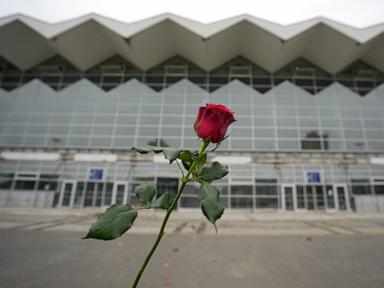
Two years after the November 1, 2024 canopy collapse at the Novi Sad railway station, the event functions less as a discrete infrastructure failure and more as a diagnostic stress test of Serbian institutional governance. Standard media coverage treats the second anniversary as an emotional milestone, focusing on vigils and surface-level political friction. That framing misses the structural mechanics at play. When a state-managed public works project fails catastrophically, the resulting civic mobilization follows a predictable institutional breakdown: opaque procurement degrades physical safety, physical failure shatters perceived state competence, and student-led networks bypass traditional opposition bottlenecks to sustain multi-year political pressure.
To understand why the Novi Sad collapse triggered a durable protest movement rather than a transient outrage cycle, analysts must separate the immediate engineering failure from the governance architecture that enabled it. If you enjoyed this post, you might want to read: this related article.
The Governance Deficit Behind Infrastructure Failure
Public infrastructure failures in developing or transitioning economies rarely stem from isolated engineering errors. They are the downstream output of systemic institutional design. In the case of the Novi Sad station renovation, the core vulnerability lay in the tension between accelerated political timelines and rigorous regulatory oversight.
The Three-Stage Degradation of Oversight
- Procurement Opacity: Large-scale transit infrastructure in Serbia has frequently relied on bilateral intergovernmental agreements rather than open, competitive public tenders. By bypassing standard public procurement laws, state actors reduce administrative friction and accelerate project initiation, but they simultaneously strip away external auditing mechanisms and public visibility into subcontractor qualifications.
- Regulatory Capture and Subcontracting Cascades: When prime contractors operate under political protection or diplomatic insulation, risk is pushed downward through multi-tiered subcontracting chains. Each subcontracting layer extracts margin while diluting direct accountability. Technical inspection bodies, facing institutional pressure to meet political inauguration deadlines, shift from adversarial verification to administrative rubber-stamping.
- Asymmetric Information Release: Following the collapse that killed 15 people in late 2024, the initial state response relied on selective disclosure—claiming specific structural elements had not been part of the recent renovation. In crisis management, this tactic creates a fatal vulnerability. When independent engineers, leaked documentation, or architectural records contradict official narratives, the state loses control of the information environment.
The transition from an infrastructure accident to a political crisis occurs precisely at this third stage. Citizens can process technical failure as tragedy; they process perceived cover-ups as an existential threat to personal safety. For another angle on this event, check out the recent update from NPR.
Why Student Networks Outperformed Traditional Political Opposition
A critical anomaly in post-2024 Serbian politics is the structural durability of the protest movement. Prior mobilization waves in Belgrade and Novi Sad—including the anti-violence protests of 2023 and anti-lithium mining demonstrations—often plateaued due to fragmentation among formal opposition parties. The post-Novi Sad mobilization altered this dynamic by shifting the center of gravity to university faculties.
Traditional opposition parties suffer from three structural liabilities in hybrid regimes:
- Centralized Leadership Vulnerability: Party leaders are easily targeted by state-aligned media ecosystems through coordinated reputational attacks, neutralizing their appeal to undecided demographics.
- Ideological Factionalism: Coalitions spanning pro-European liberals and conservative nationalists struggle to maintain unified messaging beyond broad anti-corruption slogans.
- Resource Asymmetry: Opposition organizations lack the institutional footprint, municipal funding, and media distribution networks required to sustain multi-month mobilization across secondary cities.
Student plenums and university blockades inverted these vulnerabilities. By operating through decentralized, consensus-based assemblies within academic departments, the movement eliminated single points of leadership failure. State media cannot effectively smear a rotating, anonymous administrative structure.
The physical occupation of university buildings solved the logistical problem of sustained mobilization. Campuses provided built-in infrastructure, communication channels, and daily physical proximity, reducing the coordination costs that typically exhaust street-level protest movements after four to six weeks. Instead of relying on sporadic weekend rallies that state institutions could simply wait out, student networks established continuous operational pressure.
The Mechanics of Civic Escalation and State Counter-Measures
Over a 24-month horizon, the interaction between the protest movement and the Serbian state evolved into an attrition cycle governed by competing institutional incentives.
Tactical Shifts in Civic Pressure
The movement avoided maximalist demands for immediate regime change, which often alienate moderate citizens and trigger unified defensive reactions from state security apparatuses. Instead, organizers anchored their platform on narrow, legally verifiable demands:
- Full, unredacted publication of all technical and financial documentation related to the Novi Sad station reconstruction.
- Criminal prosecution of officials and contractors responsible for the structural failure and subsequent administrative negligence.
- Dismissal of charges against detained demonstrators and accountability for physical attacks on protesting students and faculty.
This narrow framing is strategically effective because it forces the state into a binary choice: comply and risk exposing systemic corruption within its patronage networks, or refuse and validate the protesters' core thesis that institutions are compromised.
State Containment Strategies and Their Diminishing Returns
Faced with persistent blockades and mass demonstrations—including major general strike calls and cross-country student marches—state authorities deployed standard containment playbooks:
- Selective Concessions: Releasing partial batches of construction documentation while withholding key financial annexes, aiming to satisfy casual observers while protecting core decision-makers.
- Personnel Sacrifices: Accepting the resignations of ministerial figures or mid-level agency directors to absorb political heat without altering underlying procurement practices.
- Economic and Institutional Friction: Threatening academic funding, withholding professor salaries during blockades, or adjusting academic calendars to break student cohesion.
By the second anniversary, the diminishing returns of these counter-measures became evident. Partial document releases invited crowdsourced forensic auditing by independent architects, lawyers, and civil engineers, keeping the story alive in the news cycle for months. Ministerial resignations failed to demobilize the public because the movement targeted systemic impunity rather than individual personnel.
Geopolitical Insulation and External Constraints
An objective assessment of the Serbian crisis requires accounting for external geopolitical variables. Unlike earlier democratic movements in Eastern Europe, the post-Novi Sad mobilization operated without decisive diplomatic pressure from Western capitals.
European Union institutions and major member states maintained a transactional posture toward Belgrade, prioritizing regional stability in the Western Balkans, alignment on supply chains (such as critical raw materials), and geopolitical balancing against Russian influence. Consequently, external actors issued calibrated statements supporting the rule of law and peaceful assembly without imposing concrete conditionality on accession funds or diplomatic engagement.
For the protest movement, this external neutrality imposed a strict ceiling on international leverage, forcing reliance entirely on domestic civic endurance. For the Serbian government, geopolitical insulation prevented acute external isolation, though it could not resolve the domestic legitimacy deficit created by the collapse.
Strategic Implications for Governance and Civic Actors
Two years after the Novi Sad canopy collapse, the standoff illustrates a fundamental rule of political economy: institutional legitimacy cannot be decoupled indefinitely from basic state competence. Infrastructure projects built to project modernization become liabilities when opaque governance compromises physical safety.
For institutional reformers, international observers, and civic strategists operating in similar governance environments, the two-year trajectory dictates three operational priorities:
- Shift Oversight Upstream to Procurement Architecture: Post-crisis investigations and ministerial resignations do not prevent structural failures. Effective risk mitigation requires eliminating intergovernmental exemptions from public procurement laws and mandating real-time, open-source publication of engineering audits and subcontractor registries before construction begins.
- Preserve Decentralized Organizational Topologies: Civic movements facing asymmetric media and state power must resist pressure to consolidate into traditional hierarchical leadership structures. Maintaining distributed decision-making cells and narrow, legally grounded demands prevents co-optation and sustains pressure across multi-year timelines.
- Institutionalize Technical Counter-Expertise: Public outrage decays without evidentiary fuel. Bridging the gap between street mobilization and professional guilds—specifically structural engineers, legal associations, and academic faculties—transforms broad civic frustration into sustained forensic scrutiny that state narratives cannot easily dismiss.