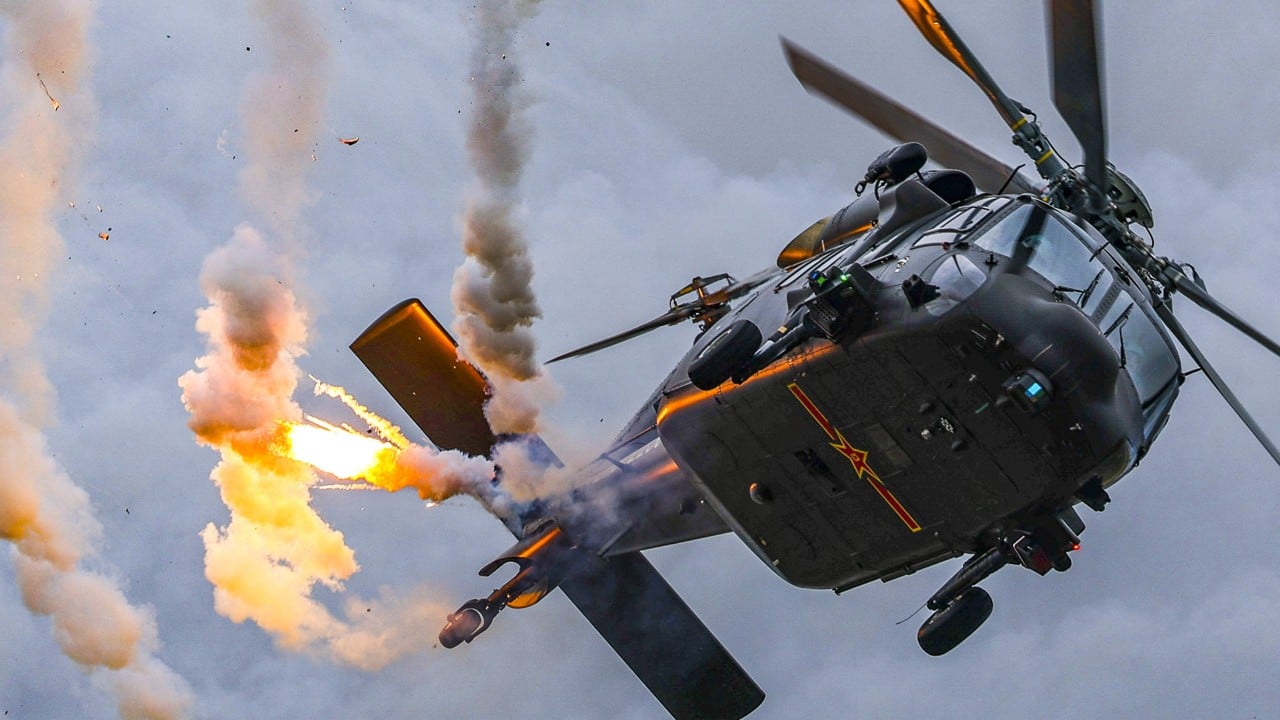
The operational architecture of the People’s Liberation Army (PLA) has long been constrained by a structural deficit in medium-lift rotary assets. While heavy-lift platforms handle bulk logistical transfers and light helicopters manage localized reconnaissance, the tactical fulcrum—the 10-ton multi-role utility helicopter—remained an unfulfilled operational requirement for decades. The rapid proliferation of the Harbin Z-20 platform fundamentally alters this equation. By establishing a standardized, fly-by-wire, high-altitude-capable hull, China is shifting its rotary-wing doctrine from a fragmented, platform-specific support model to a unified, network-centric maneuver force.
The strategic implications of this transition extend across three distinct domains: high-altitude plateau operations along the Line of Actual Control (LAC), expeditionary vertical envelopment via the People’s Liberation Army Navy (PLAN) surface fleet, and the evolution of organic close air support within air assault brigades.
The Three Pillars of Rotary Standardization
To evaluate how the Z-20 resolves historical structural limitations, the platform must be broken down into its core technological components. The baseline architecture replaces legacy imported systems—principally the Russian Mi-17 series and a finite pool of 1980s-era civilian Sikorsky S-70C-2s—by resolving three interlinked engineering bottlenecks:
- Aerodynamic Lift Mechanics: Unlike the four-bladed rotor design of the legacy H-60/S-70 architecture, the Z-20 utilizes a five-bladed main rotor assembly. This modification increases the total blade surface area, distributing aerodynamic load more efficiently and reducing the required rotor blade radius for a given lift requirement. The resulting increase in thrust-to-weight ratio allows the aircraft to maintain an operational service ceiling near 6,000 meters.
- Thermal and Power Dynamics: The platform is powered by twin domestic WZ-10 turboshaft engines, generating approximately 1,600 kW (2,100 shp) each, with an emergency military thrust rating of 2,000 kW. This power plant provides a crucial margin of excess power required for Hover-Out-of-Ground-Effect (HOGE) profiles at altitudes exceeding 4,000 meters, where air density decreases significantly, degrading engine compressor efficiency and rotor lift.
- Flight Control Automation: The integration of a digital fly-by-wire (FBW) flight control system removes legacy mechanical linkages. This system reduces airframe empty weight, automatically dampens aerodynamic turbulence in complex topography, and enables precise flight envelope protection during high-stress tactical maneuvers.
High Altitude Topography and the Power Function
The primary geographical driver for the Z-20 program is the southwestern theater, where the Tibetan Plateau presents severe physical constraints on rotorcraft performance. The mathematical relationship governing helicopter performance in these environments is defined by density altitude—an expression of pressure altitude adjusted for non-standard temperature.
As altitude increases, air density ($\rho$) decreases according to the barometric formula:
$$\rho = \rho_0 \cdot \left(1 - \frac{L \cdot h}{T_0}\right)^{\frac{g \cdot M}{R \cdot L}}$$
Where:
- $\rho_0$ is sea-level air density
- $L$ is the temperature lapse rate
- $h$ is the altitude
- $T_0$ is sea-level standard temperature
- $g$ is acceleration due to gravity
- $M$ is the molar mass of Earth's air
- $R$ is the universal gas constant
This reduction in air density impacts the system in two ways. First, aerodynamic lift drops proportionally with density, requiring higher rotor speeds or greater blade pitch angles, which increases parasitic drag. Second, the mass flow rate of oxygen into the turboshaft engines decreases, dropping engine torque output.
Legacy PLA assets like the Mi-171 faced severe payload penalties under these conditions, often forcing a trade-off between fuel volume and troop carrying capacity. The Z-20 mitigates this constraint through integrated active rotor de-icing systems and the high thermal margins of the WZ-10 engine. This allows the PLA Army (PLAA) to execute rapid-insertion missions with a standard complement of 12 to 15 equipped infantrymen directly onto high-altitude ridges, bypassing ground-based choke points.
Maritime Integration and the Anti Submarine Warfare Deficit
While the land-based variants stabilize the PLA's continental periphery, the naval variants (Z-20J utility and Z-20F Anti-Submarine Warfare) address a critical vulnerability in western Pacific maritime strategy.
[PLAN Surface Combatant] ◄─── Data Link ───► [Z-20F ASW Variant]
                                                    │
                                        ┌───────────┴───────────┐
                                        ▼                       ▼
                            [Under-Nose Surface Radar]   [Dipping Sonar]
                                        │                       │
                                        ▼                       ▼
                            (Surface Target Track)      (Acoustic Signature)
Historically, the PLAN's surface combatants—including Type 052D destroyers and Type 054A frigates—relied on the lightweight Z-9 or the bulky, imported Ka-28 for organic aviation. Both platforms introduced distinct tactical operational constraints:
- The Z-9 Limitation: At a maximum takeoff weight of approximately 4 tons, the Z-9 lacks the payload capacity to simultaneously carry a full suite of search sensors (dipping sonar, sonobuoys, surface search radar) and offensive weapons (lightweight acoustic homing torpedoes). PLAN frigates were frequently forced to deploy pairs of Z-9s to accomplish a single anti-submarine warfare (ASW) task—one acting as the hunter, the other as the killer.
- The Ka-28 Limitation: The coaxial-rotor Ka-28 possesses excellent lifting capability but features an excessively high vertical profile. This design asset imposes significant hangar height requirements, complicating shipboard storage and raising the vessel's radar cross-section and center of gravity.
The 10-ton Z-20F resolves this operational dichotomy by consolidating sensor and weapon payloads onto a single airframe that is compatible with standard shipboard hangars. The Z-20F incorporates a chin-mounted surface search radar, a ventral dipping sonar well, an internal sonobuoy launcher array, and pylons for lightweight torpedoes or anti-ship missiles. By deploying the Z-20F from the extended flight decks of newer Type 052D and Type 055 destroyers, the PLAN expands its acoustic screening radius, pushing the defensive perimeter outward against modern nuclear and diesel-electric submarines.
Doctrinal Evolution: The Air Assault Maneuver Model
The introduction of the Z-20T armed assault variant marks a shift in how the PLAA conceptualizes offensive ground maneuvers. Rather than serving purely as battlefield transport, rotary-wing assets are being integrated directly into combined-arms strike formations.
The tactical deployment of these assets within modern air assault brigades relies on a highly coordinated structural flow designed to achieve rapid local dominance.
The Z-20T's dual-role architecture—retaining a 12-man troop cabin while adding structural hardpoints for AKD-9 or AKD-10 anti-tank guided missiles—allows a single flight element to conduct both insertion and suppression missions simultaneously. This multi-functionality compresses the kill chain during littoral operations or urban penetration maneuvers, where delayed fire support often results in high casualty rates for isolated air-dropped forces.
Logistical Vulnerabilities and Platform Constraints
Despite these technical and doctrinal advances, the rapid expansion of the Z-20 fleet introduces several acute systemic vulnerabilities that limit immediate operational effectiveness:
- Pilot Supply Bottlenecks: Modern multi-role helicopters utilizing fly-by-wire flight control and network-centric avionics demand a highly specialized pilot skillset. The expansion rate of the airframe production lines currently outpaces the institutional throughput of the PLA's aviation academies, resulting in an operational lag between hull delivery and combat readiness.
- Maintenance Intensity Metrics: The transition from simple mechanical linkages to complex digital fly-by-wire architectures, active rotor de-icing systems, and sophisticated electronic warfare suites increases the required maintenance man-hours per flight hour. Generating reliable field logistics networks in austere plateau environments or aboard extended maritime deployments represents a significant operational hurdle.
- Dimensional Internal Volume Restrictions: Because the Z-20 was optimized from its inception for multi-service commonality, it omits a rear cargo ramp in favor of a traditional tail wheel configuration. This design choice limits internal cabin loading to personnel and light palletized cargo. Tactical all-terrain vehicles, light artillery pieces, or heavy infantry support weapons must be moved via external sling-loads, exposing the cargo to aerodynamic drag and weather hazards while restricting the helicopter's maximum transit speed.
The expansion of the Z-20 family represents a calculated effort to standardize China's medium-lift capability across its army, air force, and navy. By solving the technical hurdles of high-altitude engine performance and multi-sensor naval integration, the platform effectively closes a long-standing gap in China's defense architecture. However, the ultimate velocity of this modernization effort depends less on airframe production figures and more on the PLA's capacity to field mature logistical networks, sustain advanced maintenance cycles, and train operators capable of executing complex vertical maneuver doctrine.
For a visual breakdown of how modern militaries utilize medium-lift platforms for low-altitude penetration and tactical troop insertion, the technical insights provided in this analysis of rotary aviation roles highlight the comparative evolution of utility helicopter designs.