Step onto a farm in mid-July, right when the sun bakes the dirt into gray, cracked pottery. Pick up a handful. It feels dead. It drifts through your fingers like powdered bone, pale and stripped of everything that once made it springy underfoot.
For decades, farmers watched that soil slowly wash away into rivers or blow into the road. They dumped synthetic nitrogen on it to force one more crop out of the ground, watching the earth grow paler with every single harvest. We built a global food system on top of a decaying bank account, drawing down life that took ten thousand years to accumulate. Don't miss our previous article on this related article.
Then came an idea so simple it sounded like madness: spread billions of tons of crushed mountain rock over the fields.
The Chemistry of Stardust
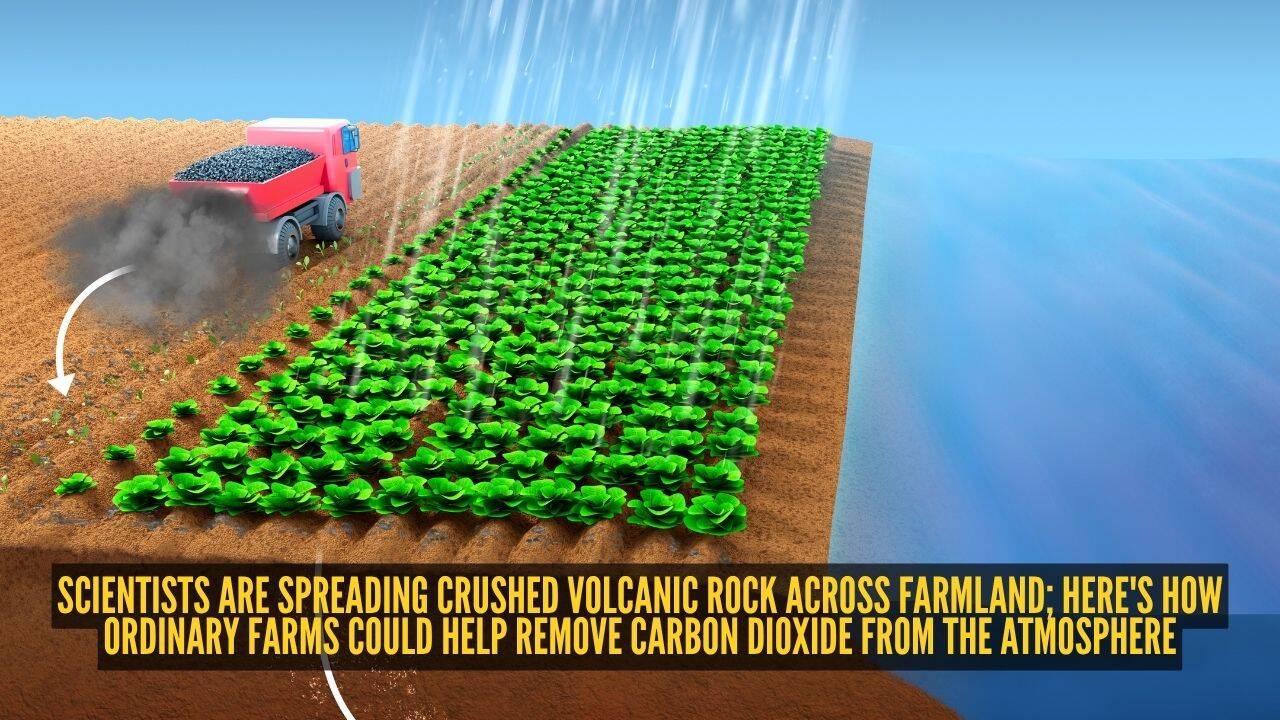
Under an open sky, a tractor crawls across a field in the Midwest. Instead of spraying liquid chemical fertilizers, it pulls a spreading rig throwing fine, dark dust into the air. The cloud smells of rain on dry asphalt—earthy, metallic, sharp. To read more about the background of this, MIT Technology Review provides an informative breakdown.
This is basalt. It is volcanic rock, ground down until it feels like flour.
When rain hits basalt dust, a chemical dance begins. Rainwater is naturally slightly acidic because it absorbs carbon dioxide as it falls through the sky. When that water touches the crushed rock, it breaks down the silicate minerals inside. In that quiet chemical reaction, the rock grabs hold of the carbon dioxide dissolved in the water, turning it into bicarbonate ions.
Water drains through the dirt, carrying those ions deep into the ground, eventually washing them out to the ocean where they lock away carbon for thousands of years.
Think of it as acceleration. Earth already washes carbon out of the sky using mountains and rain. It is how our planet regulates its temperature over geological epochs. The planet, however, operates on a timer measured in millions of years. We do not have millions of years. By grinding basalt into microscopic grains, we expand its surface area millions of times over.
We take a process that takes eons and compress it into seasons.
The Invisible Stakes Beneath Our Feet
It is easy to treat soil like dirt. Dirt is cheap. Dirt is what you wash off your shoes. Soil, though, is a living, breathing lung.
When industrial agriculture stripped the minerals out of the ground, it did not just make crops dependent on artificial inputs. It crippled the soil's natural sponge. Compacted, dead dirt cannot hold water. Rain hits hard ground, sweeps off the top layer, and floods nearby towns.
When crushed basalt mixes with that same degraded earth, something remarkable happens.
As the rock dissolves, it releases calcium, magnesium, iron, and trace minerals long drained away by intense farming. The soil chemistry shifts. Microbes wake up. Worms return. The ground begins to hold moisture again, swelling like a dried sponge dropped into a bucket of water.
A farmer running this experiment does not just see a carbon offset line item on a computer screen. They see corn stalks standing thicker against August droughts. They see runoff water running clear instead of mud-brown after a thunderstorm.
The Math Behind the Dust
Can rock dust actually cool a planet?
Let us look at the raw mechanics. If applied across vast stretches of global farmland, enhanced rock weathering could pull billions of tons of carbon dioxide out of the atmosphere every year. Farmland is already accessible. Farmers already have heavy equipment designed to spread lime and fertilizers. The logistics chain exists.
Consider the contrast between this and direct air capture machines. Chemical air scrubbers require massive energy inputs, complex engineering, and trillions of dollars in brand-new industrial plants. Rock dust requires a quarry, a crusher, and a tractor.
It is low-tech engineering scaled across millions of acres.
Yet, skepticism is fair. Crushing rock takes energy. Hauling thousands of tons of basalt on diesel trucks creates emissions right now, offsetting a portion of the carbon the rock will eventually capture over its lifetime. If you haul basalt five hundred miles by truck, you erode the very benefit you built. The math only works if quarries are local, if transport is efficient, and if the rock is ground to the precise particle size that balances fast weathering with low grinding energy.
It is not magic. It is hard, dusty logistics.
A Legacy Written in Stone
Stand in the middle of a treated field after a light morning rain.
Look closely at the mud around your boots. You will see micro-sparkles catching the light—tiny flecks of ancient earth dissolving quietly beneath young green shoots.
We spent a century treating the ground as a blank stage, a sterile platform to hold up crops while we poured in synthetic chemicals. We treated the sky as a limitless trash dump for our exhaust. Enhanced rock weathering forces us to look at both systems at once, binding the atmosphere above to the dirt below through the medium of ancient volcanic fires.
It turns out the solution to our modern, light-speed atmospheric crisis was sitting quietly in the bedrock all along, waiting to be ground into dust and scattered to the wind.