Winning a Democratic primary in South Carolina is like winning a coin toss before boarding a plane with one engine. The celebration looks great on local television, the donor emails write themselves, and national pundits immediately start drafting fan fiction about a "changing South."
Stop falling for it. You might also find this connected article useful: Inside the Midterm Wreckage That Upended the Republican Majority.
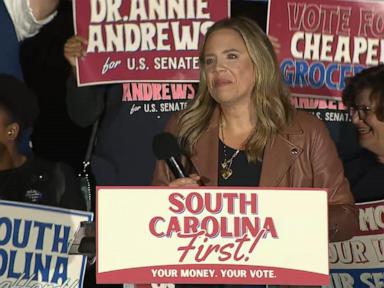
Every two years, political media falls into the same predictable trap. A charismatic, credentialed, articulate Democrat secures a statewide nomination in a deep-red stronghold. Cameras roll. Supporters cheer. Pundits declare that this time, the grassroots energy, the fundraising haul, and the candidate's personal biography might finally crack the electoral math. We just saw it again with Annie Andrews addressing her supporters after her projected win in the South Carolina Senate race.
The coverage surrounding her victory speech follows a tired script. It frames a primary victory as momentum toward a November upset. It treats fundraising totals and emotional rally clips as proof of structural viability. That framing misses the actual mechanics of Southern politics, donor incentives, and how modern Senate races are won or lost. As discussed in latest reports by TIME, the results are notable.
If you want to understand what Annie Andrews's win actually means, stop watching the victory speech and start looking at the structural reality of South Carolina's electorate, the national Democratic donor machine, and the difference between a viral campaign and a competitive one.
The Primary Illusion in Deep-Red States
A primary win only proves one thing: you convinced the most motivated sliver of your own party's base to show up on a Tuesday in June. In a state like South Carolina, where the Democratic primary electorate represents a fraction of the total voting population, winning that room says almost nothing about your ability to persuade the voters who decide general elections.
I have watched political consultants and national party committees burn tens of millions of dollars on this exact mirage over the last decade. In 2020, Jaime Harrison raised a staggering $130 million in South Carolina against Lindsey Graham. The national press treated every fundraising quarter like a seismic event. Harrison gave great speeches. His ads saturated every screen in the state. On election night, he lost by more than ten percentage points.
The reason was never candidate quality. Harrison was disciplined, well-funded, and omnipresent. The reason was inelastic partisanship.
In modern federal elections, ticket-splitting has nearly evaporated. Political scientists like Alan Abramowitz and Gary Jacobson have documented this decline for decades: voters align their Senate votes with their presidential preferences at rates hovering around 90 percent. South Carolina has not voted for a Democratic presidential candidate since Jimmy Carter in 1976, nor has it elected a Democratic U.S. Senator since Fritz Hollings won his final term in 1998.
When media outlets run breathless headlines around a primary victory speech, they confuse intra-party enthusiasm with cross-party persuasion. Annie Andrews is a pediatrician, a gun-violence prevention advocate, and an effective communicator who previously ran a high-profile House campaign against Nancy Mace in 2022. She knows how to command a microphone and energize progressive voters. None of that changes the baseline math of a state where Republican candidates routinely clear 54 to 58 percent of the vote without breaking a sweat.
Why National Media Loves the Underdog Speech
If the electoral math is so lopsided, why does political media treat a South Carolina Democratic primary win like a major inflection point?
Because conflict sells, and biographical contrast makes for effortless storytelling.
A pediatrician taking on entrenched Washington politics is a clean narrative arc. Cable producers and digital editors do not want to publish an article saying, "Candidate Wins Nomination, Faces Steep Structural Deficit Through November." That kills clicks. Instead, they clip the most impassioned three minutes of the victory speech, slap "WATCH" in the headline, and imply that a competitive general election is underway.
This creates a feedback loop that warps political coverage:
- Media outlets amplify the speech because it fits an inspiring underdog trope.
- Out-of-state small-dollar donors see the clip on social media and send $25 contributions from California, New York, and Illinois.
- Campaigns report massive fundraising numbers, which the media then cites as "proof" that the race is tightening.
- November arrives, and the partisan baseline reasserts itself with brutal precision.
Look closely at where the money in these races comes from. In high-profile red-state Senate campaigns, the overwhelming majority of itemized individual contributions flow from outside the state's borders. Out-of-state donors are not buying a realistic path to 50 percent plus one; they are buying emotional catharsis. They dislike the Republican incumbent or the broader GOP agenda, so they fund whichever Democrat has the sharpest clip on their timeline.
That is not a strategy for winning a Senate seat. It is a fundraising business model.
What Makes a Red-State Democrat Actually Competitive?
To be fair to Andrews and her supporters, dismissing every Democratic campaign in a conservative state as pointless is just as lazy as pretending every primary winner is on the verge of an upset. Party-building matters. Down-ballot infrastructure matters. Running credible candidates forces the opposition to spend money they would rather deploy in swing states like Pennsylvania, Michigan, or Georgia.
There is a real strategic argument for contested races everywhere. If Democrats cede states entirely, local party committees wither, voter rolls go unmaintained, and margins in neighboring congressional districts erode.
However, if the goal is actually winning a statewide race in a state with a heavy Republican lean—not merely raising money or building a national profile—the playbook looks nothing like standard national Democratic messaging.
Consider the rare Democrats who have actually won or come within striking distance in red states over the past decade: Jon Tester in Montana, Joe Manchin in West Virginia, Sherrod Brown in Ohio, and Andy Beshear in Kentucky. Look at what separates their campaigns from the standard viral-clip model:
- Ideological friction with their own national party: They openly break with national Democratic orthodoxy on energy, regulations, or cultural flashpoints, proving to skeptical voters that they are independent actors rather than reliable votes for Senate leadership.
- Hyper-local economic framing: They talk about specific local industries, infrastructure, and pocketbook costs rather than nationalized cultural battles that trigger immediate partisan sorting.
- Years of unglamorous retail presence: They build trust in rural counties long before a Senate cycle begins, showing up in places where their party typically gets 20 percent of the vote just to lose by 65 percent instead of 80 percent.
Compare that blueprint to the modern online-driven Senate campaign. Annie Andrews built her national profile largely through her background as a pediatrician advocating on gun safety and reproductive healthcare—issues that deeply motivate the Democratic base and suburban women, yet serve as instant partisan sorting mechanisms among independent and lean-Republican voters in South Carolina.
In a Democratic primary, lean into those issues and you win decisively. In a South Carolina general election, lean into those exact same framing devices without a massive economic counter-narrative, and you hand the Republican opponent an easy ad campaign tying you directly to national progressive politics.
The Questions Voters Should Actually Be Asking
When a candidate wins a major primary, search traffic spikes around predictable questions: Can Annie Andrews win in November? How much money has she raised? What did she say in her victory speech?
Those are the wrong questions. If you want to evaluate whether this campaign will move the needle in South Carolina, ask these instead:
Does her coalition expand beyond existing Democratic precincts?
Winning Charleston, Columbia, Greenville's urban core, and the Black Belt counties along the I-95 corridor is the floor for any South Carolina Democrat, not the ceiling. A viable general election campaign must cut into Republican margins in fast-growing suburban and exurban counties like Horry, Lexington, Spartanburg, and York. If the campaign's message only resonates in precincts that already vote blue, the November ceiling is capped around 43 percent.
Where is the money being spent?
Raising $10 million or $20 million means nothing if 60 percent of it goes back into digital fundraising ads, consultant retainers, and list acquisition to raise the next $10 million. Watch the Federal Election Commission (FEC) filings not for total receipts, but for burn rate and field investment. Campaigns built for clicks spend heavily on digital acquisition; campaigns built to win spend early on voter registration, precinct captains, and persistent persuasion media.
Is the campaign forcing Republicans onto defense?
A challenger only has a shot in an unfavorable state when the Republican incumbent or nominee makes an unforced error that breaks through to low-information voters—a major scandal, a disastrous debate moment, or a sharp economic downturn blamed squarely on the party in power. Absent an external shock, challenger speeches rarely alter the trajectory of a federal race.
The Real Cost of the Viral Campaign Cycle
There is a hidden downside to celebrating every high-profile red-state primary victory as a potential breakthrough: opportunity cost.
Every dollar an out-of-state donor sends to an unwinnable or long-shot Senate race in South Carolina is a dollar not going to a winnable state legislative race in North Carolina, a competitive House seat in Nebraska, or a razor-thin Senate battleground in the Midwest.
Political strategists hate admitting this publicly because the small-dollar fundraising ecosystem rewards spectacle over return on investment. Consultants make a percentage of media buys. Digital firms take a cut of online ad spend. Nobody inside the campaign-industrial complex gets paid to tell donors, "Save your money for a district decided by 1,200 votes."
Imagine a scenario where national progressive donors redirected just 30 percent of the hundreds of millions poured into long-shot red-state Senate campaigns over the past three cycles into state Supreme Court races, secretaries of state, and swing-district state legislatures. The policy impact on voting laws, redistricting, reproductive rights, and state budgets would have been monumental. Instead, much of that capital evaporated into expensive broadcast television ads in states that were never truly in play.
This does not diminish Annie Andrews's personal accomplishment in winning her party's nomination. Running for federal office takes grueling effort, personal sacrifice, and genuine conviction. Stepping into the arena in a state where the structural deck is stacked against your party requires grit.
Grit, however, is not a substitute for electoral math.
Watch the Filings, Not the Podium
Victory speeches are theater. They are designed to project inevitability, thank volunteers, and generate a 48-hour news cycle that keeps donors opening their wallets. Watching Annie Andrews address her supporters tells you she is a polished, passionate candidate who earned the trust of South Carolina Democrats.
It tells you nothing about November.
If you want to know whether this Senate race will be anything more than another expensive exercise in partisan gravity, ignore the victory clips. Open the FEC quarterly reports, track the county-by-county registration shifts in the South Carolina State Election Commission data, and watch whether the campaign ever breaks from national Democratic talking points to speak directly to the economic anxieties of rural and exurban South Carolinians.
Until those numbers move, the speeches are just noise.