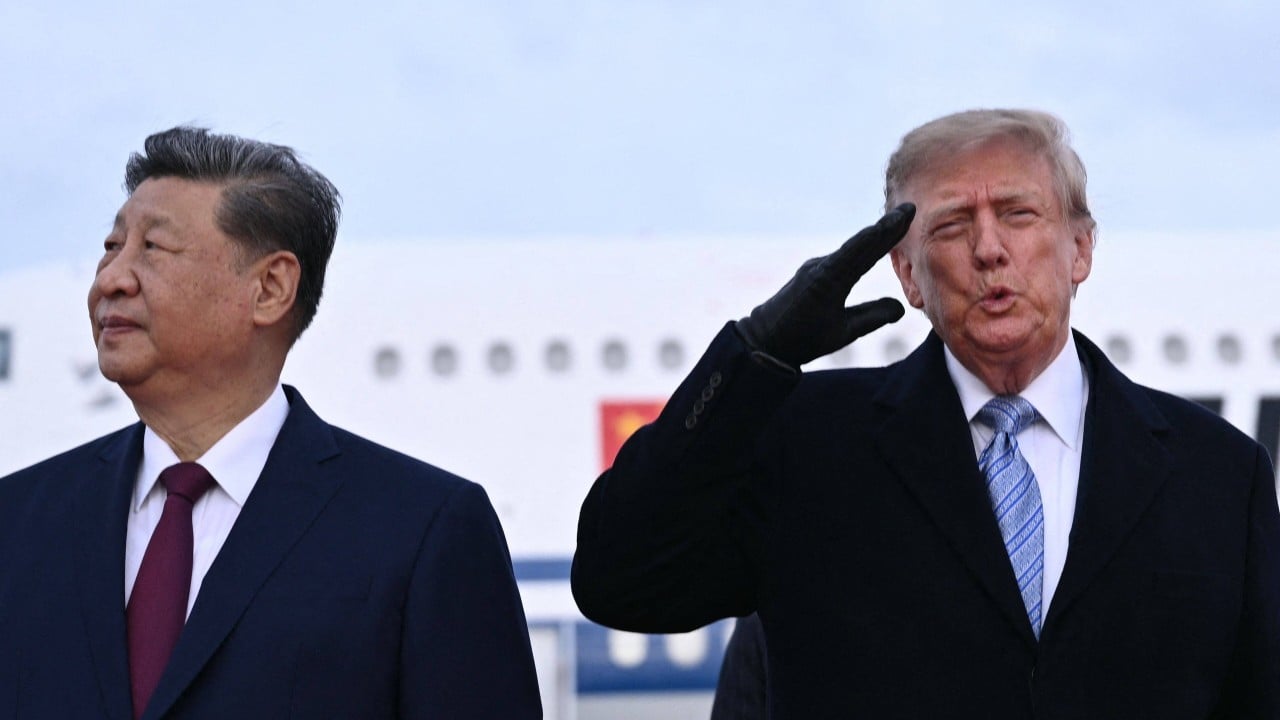
Diplomatic receptions are rarely exercises in spontaneous hospitality. When state visits commence on a military tarmac rather than behind closed doors, the staging is a calculated signaling mechanism designed to establish a psychological baseline before bilateral negotiations begin. The arrival of Chinese President Xi Jinping at Joint Base Andrews, greeted planeside by U.S. President Donald Trump amid a high-decibel military flyover, offers a masterclass in how physical staging and sensory shock are utilized in modern statecraft.
Analyzing the mechanics of this high-stakes reception requires stripping away surface-level media commentary and examining the structural components of the event: the spatial dynamics of the tarmac greeting, the operational signaling of the military display, and the asymmetric behavioral responses of the principals involved. Building on this topic, you can also read: Soft Power and Syntax The Diplomatic Weaponization of Language.
The Protocol Inversion: Why Tarmac Receptions Matter
Standard diplomatic protocol dictates that visiting heads of state are received at the White House or State Department with structured pomp, reserving the airfield arrival for lower-tier delegations or standard ambassadorial handoffs. Breaking this convention by meeting a counterpart directly at the airbase shifts the negotiation leverage point.
By stepping onto the tarmac at Joint Base Andrews, the host breaks traditional protocol to project urgency and personal investment. This tactic compresses the spatial distance between arrival and negotiation, setting an intense tone immediately upon disembarkation. However, it also introduces operational variables that cannot be entirely scripted. When statecraft relies on live military hardware, the environment ceases to be a controlled indoor theater and becomes subject to acoustic and kinetic realities. Observers at The New York Times have also weighed in on this matter.
The Acoustic Shock Variable and Behavioral Asymmetry
The inclusion of a supersonic military flyover—featuring heavy assets like B-1 bombers roaring overhead during the national anthem—serves a dual-purpose signaling function. Domestically and internationally, it projects raw national power and technological dominance. Yet, it simultaneously introduces a high-decibel environmental disruption right at the focal point of the ceremony.
The contrasting physical reactions of the two leaders captured on camera provide a study in behavioral control under sudden sensory stimuli. President Trump’s visible flinch or wince upon the unexpected arrival of the roaring jets highlights a common physiological vulnerability to sudden, high-decibel acoustic shock. Conversely, President Xi’s static, impassive posture reflects hyper-rehearsed or temperamentally disciplined stimulus filtering.
From an analytical standpoint, these micro-expressions are frequently over-interpreted by pundits looking for signs of political vulnerability or strength. In reality, they represent baseline human reflexes interacting with an uncalibrated acoustic environment. A multi-ton supersonic jet passing at low altitude generates sound pressure levels that trigger involuntary startle responses regardless of a leader's geopolitical standing. The strategic error lies not in the biological reflex itself, but in staging an unpredictable acoustic variable directly above the heads of the negotiating principals.
The Structural Subtext of Bilateral Deterrence
The juxtaposition of a red-carpet welcome with a heavy military display is an exercise in communicative dissonance. It attempts to project simultaneous messages: an openness to economic and diplomatic engagement paired with an unyielding reminder of strategic and military competition.
This dual-track signaling is designed to manage domestic constituencies while communicating strength across the table. For Washington, displaying advanced aviation assets during a summit that touches on contentious issues such as trade policy, regional security, and advanced technology acts as a blunt-force anchor. For Beijing, absorbing this display without a visible reaction is a calculated counter-measure designed to project strategic fatigue and long-term resolve.
Strategic Execution
The primary takeaway from the Andrews tarmac summit is that high-level statecraft is increasingly vulnerable to theatrical over-engineering. When physical staging incorporates unpredictable variables like low-altitude military flyovers, the risk shifts from subtle diplomatic signaling to unintended optics.
Future state visits must decouple the delivery of national security messaging from the delicate physics of initial diplomatic handshakes. Operational predictability remains the bedrock of effective negotiation; introducing raw, deafening kinetic displays into a greeting ceremony creates unnecessary friction where precision is required.
Trump Greets Xi with Military Flyover at Airport
This video footage from the search results provides a visual record of the arrival ceremony and the military flyover at Joint Base Andrews.