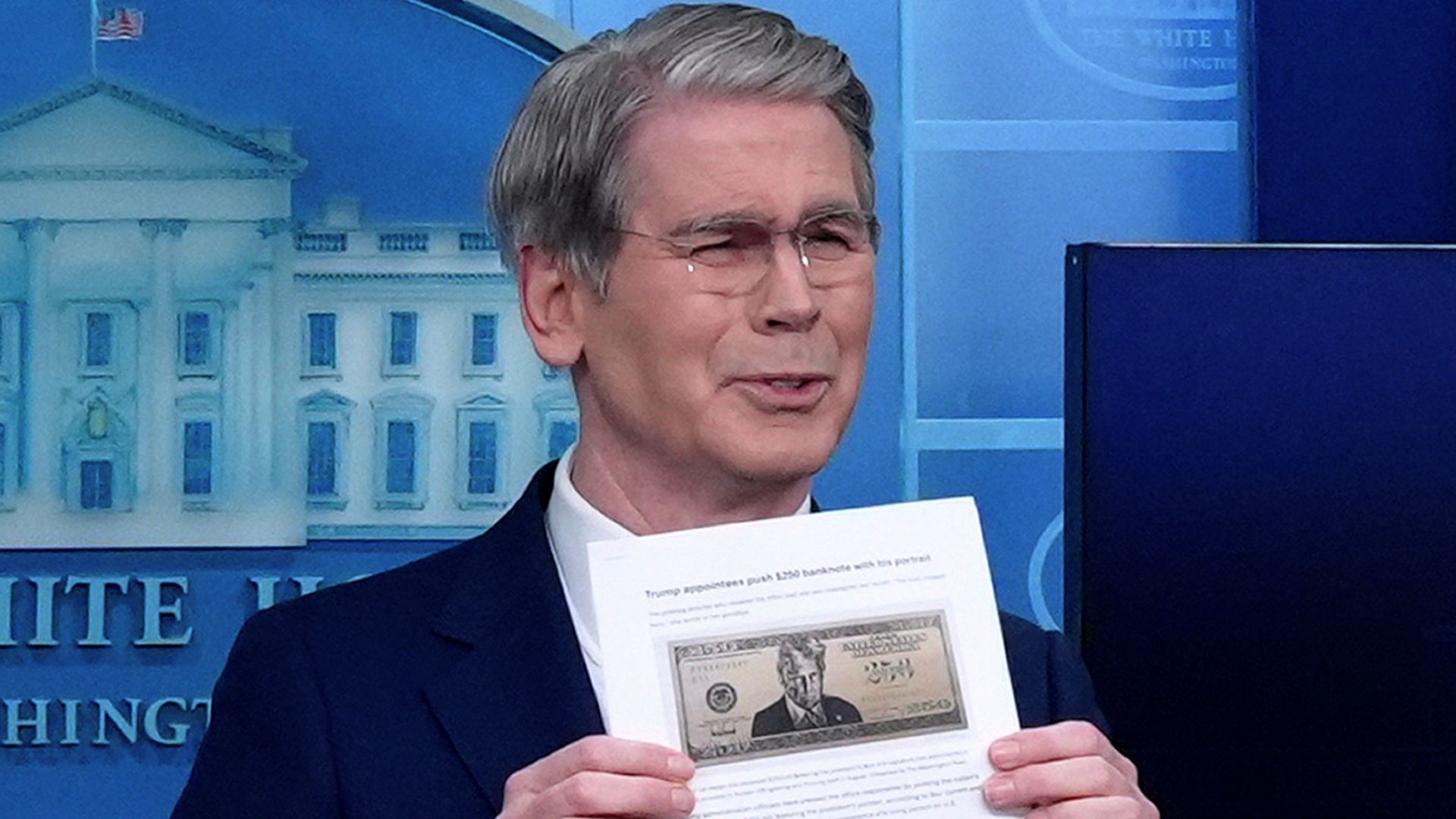
The physical artifact of fiat currency operates simultaneously as a medium of economic exchange and a sovereign communication platform. The disclosure by Treasury Secretary Scott Bessent that the Bureau of Engraving and Printing (BEP) has completed advance design protocols for a $250 banknote featuring President Donald Trump represents a calculated disruption of monetary tradition. While popular commentary framing this development focuses on the symbolic or political dimensions, an objective analysis requires evaluating the institutional mechanisms, legal constraints, and structural friction inherent in modifying national currency architecture.
To evaluate the feasibility and systemic impacts of this initiative, the proposal must be deconstructed through three precise analytical frameworks: statutory compliance, operational manufacturing pipelines, and the broader integration of sovereign branding.
The Legal Bottleneck: Statutory Controls and the 1866 Precedent
The primary structural impediment to the issuance of the proposed banknote is a rigid statutory constraint that removes currency design from unilateral executive authority. Under 31 U.S. Code Section 5114, the Secretary of the Treasury is explicitly restricted to depicting the portraits of deceased individuals on United States currency and securities.
This statute is not an arbitrary administrative rule; it is a permanent legislative boundary established by Congress in 1866. The historical context of the restriction provides insight into its durability:
- The Spencer Clark Precedent: In 1866, Spencer Clark, the superintendent of the National Currency Bureau (the predecessor to the BEP), printed his own likeness on a five-cent fractional currency note.
- Legislative Reaction: The resulting public and congressional backlash regarding administrative overreach prompted immediate legislative intervention, stripping executive branch officials of the authority to place living individuals on legal tender.
Because Donald Trump is a living individual, the BEP cannot legally initiate production beyond preliminary digital or physical mock-ups without explicit legislative intervention. The mechanism for this intervention exists in H.R. 1761, the "Donald J. Trump $250 Bill Act," originally introduced by Representative Joe Wilson.
The structural flow of this legislative strategy requires a precise sequence of approvals:
[House Financial Services Committee] ➔ [Full House Floor Vote] ➔ [Senate 60-Vote Cloture Threshold] ➔ [Presidential Signature]
The legislative bottleneck lies primarily within the Senate. With a narrow 53-seat Republican majority, overcoming the 60-vote cloture threshold to pass a statutory exception to Section 5114 presents a formidable legislative barrier. Consequently, the Treasury’s current actions constitute administrative contingency planning rather than imminent issuance.
The Industrial Pipeline: Capital Expenditure and Security Integration
A frequent error in analyzing currency modification is treating a banknote as a simple print product rather than a highly engineered security instrument. Banknotes function as a frontline defense against counterfeiting, requiring sophisticated supply chains, specialized chemical substrates, and advanced optical physics.
The operational timeline outlined by career officials within the BEP reveals a severe mismatch between political timelines and industrial realities. Under normal operating parameters, the development of a novel denomination requires six to eight years. This extended timeline is dictated by a rigid, multi-stage engineering loop.
Substrate and Material Sourcing
U.S. currency relies on a unique 75% cotton and 25% linen blend manufactured exclusively by specialized contractors. Introducing a $250 denomination requires testing the physical durability of this substrate against the specific tactile and mechanical demands of automated sorting machines, ATMs, and vending systems nationwide.
Tactile and Optical Security Features
High-value denominations require complex anti-counterfeiting layers. These include color-shifting inks, 3D security ribbons, embedded threads, and microprinting. Integrating these features into a brand-new portrait matrix—specifically one featuring the color specifications and Semiquincentennial logos requested by the executive—requires extensive lithographic and intaglio plate engraving testing.
Automated Machinery Recalibration
The introduction of a non-standard denomination ($250) introduces a massive friction point into the commercial banking infrastructure. Every high-speed currency counter, ATM dispenser, and Federal Reserve processing system would require software updates and physical recalibration to recognize, validate, and store the note.
The political pressure applied by Treasury appointees to expedite this pipeline creates an operational bottleneck. The sudden reassignment of veteran BEP Director Patricia Solimene—who reportedly maintained that unauthorized production violated standard procedural timelines—underscores the friction between fast-tracked executive timelines and rigorous industrial quality-control parameters.
Sovereign Consolidation: The Macro Strategy of Institutional Branding
The proposed $250 note does not exist in isolation. It is a single component within a coordinated, multi-agency initiative to leverage the United States Semiquincentennial (the 250th anniversary of independence) to consolidate a distinct aesthetic across federal institutions.
Analyzing the broader operational footprint reveals that where statutory boundaries are absolute (as in paper currency), the administration faces delays; where executive branch autonomy is broader, implementation has proceeded rapidly.
| Government Instrument / Asset | Regulatory Mechanism Required | Implementation Status |
|---|---|---|
| Federal Paper Currency ($250 Note) | Congressional Statutory Amendment (Overturning 31 U.S.C. § 5114) | Stalled in Committee; Preliminary Mock-ups Only |
| Commemorative 24-Karat Gold Coin | U.S. Commission of Fine Arts Approval (Exploiting Existing Commemorative Minting Statutes) | Unanimously Approved; Moving to Production |
| Paper Currency Signatures ($100 Note) | Executive Discretion (Treasury Secretary Authority under 1861 Framework) | Approved; Printing Scheduled |
| Limited Edition Passports | Department of State Administrative Rulemaking | Approved; Rollout Initiated |
| Federal Real Estate Banners (DOJ, etc.) | General Services Administration (GSA) Management Discretion | Deployed |
The integration of the president's signature onto standard circulating paper currency—replacing the traditional dual-signature matrix of the Treasurer and the Treasury Secretary—represents a structural shift in the visual identity of U.S. debt instruments since civil-war era paper tender was codified. By shifting the legal basis toward executive action where statutes are ambiguous or permissive, the administration circumvents legislative gridlock.
Strategic Forecast and Operational Trade-offs
The trajectory of the $250 banknote depends entirely on whether the legislative path can be cleared before the conclusion of the Semiquincentennial celebrations. If Congress fails to pass the necessary statutory exception, the Treasury’s preparatory work will remain confined to an archival design exercise—a high-fidelity prototype incapable of legal tender status.
From a strategic perspective, the push to design the bill despite legislative resistance serves a clear administrative function: it establishes a turnkey asset. By ensuring the Bureau of Engraving and Printing completes the design phase, the administration guarantees that if a legislative window opens, the time-to-market for the physical currency is reduced from years to months.
However, this strategy carries operational risks. Diverting specialized BEP engineering talent and security printing assets toward a contingency project decelerates ongoing, mandatory security updates for existing denominations, such as the long-delayed redesigns of the $20, $50, and $100 notes intended to combat international counterfeiting rings. The core trade-off under review by Treasury leadership remains whether the maximization of immediate symbolic branding justifies the disruption of long-term currency modernization schedules.