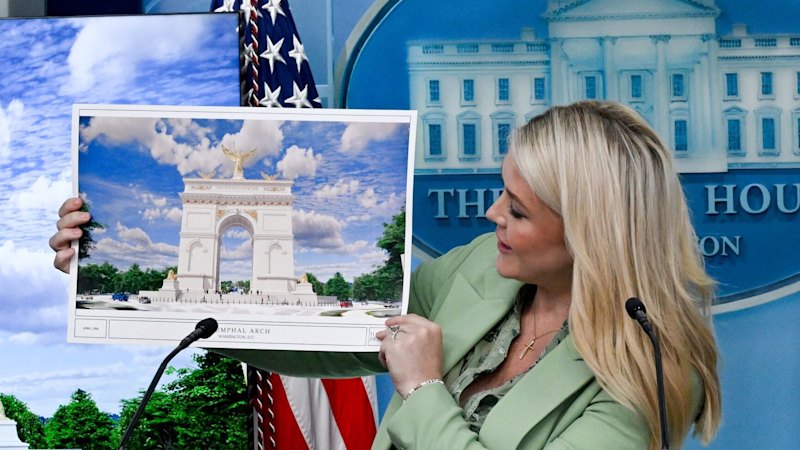
Political branding at the scale of the "triumphal arch" functions less as traditional architecture and more as a high-velocity feedback loop between symbolic capital and voter psychology. When Donald Trump utilizes the concept of a monument—whether literal or rhetorical—he is engaging in a process of hegemonic signaling. This mechanism converts massive physical or conceptual scale into perceived inevitability. The expert who originally conceptualized the "triumphal arch" now expresses concern because the scale of the signal has decoupled from the structural integrity of the underlying movement. In a strategy-driven analysis, this represents a transition from a sustainable brand moat to an over-leveraged asset.
The Triad of Symbolic Accumulation
The efficacy of the triumphal arch as a political device rests on three distinct operational pillars. If any of these pillars weaken, the entire brand architecture risks a catastrophic pivot from "authoritative" to "performative."
- Massive Scale as a Barrier to Entry: By proposing projects or rhetoric of extreme magnitude, the actor forces opponents to respond to the scale rather than the substance. This consumes the opponent’s cognitive and financial resources, effectively setting the terms of engagement on the actor's home turf.
- Historical Compression: Triumphal arches are historically used to memorialize victories after the fact. By adopting this imagery during an ongoing campaign or tenure, the actor attempts to "pre-memorialize" success. This creates an aura of historical inevitability that discourages internal dissent and demoralizes external competition.
- The Expert-Validator Paradox: To gain initial legitimacy, political actors often co-opt technical experts. However, as the brand grows, it inevitably outpaces the technical constraints defined by those experts. The current tension between the original architect of the arch concept and its current application highlights the breaking point where the "myth" of the brand becomes unmanageable for the "makers" of the brand.
The Cost Function of Symbolic Escalation
Every increase in the "size" of a political symbol carries a corresponding increase in maintenance overhead. This is not merely a financial cost but a reputational one. In a data-driven framework, the "Triumphal Arch" can be modeled as a high-risk asset with a diminishing return on visibility.
- Entropy of Novelty: As the arch (or the rhetoric surrounding it) becomes "bigger than ever," the incremental impact of further expansion drops. To maintain the same level of public attention, the actor must exponentially increase the audacity of the claim.
- The Fragility of Perfection: A larger monument provides a larger target. In political strategy, a grand symbol creates a single point of failure. If the "arch" is the brand, any blemish on the arch is a blemish on the entire organization. This creates a high-stakes environment where the actor cannot afford even minor tactical retreats.
- Expert Defection Costs: When the "expert who proposed it" voices worry, it signals to the market (voters and donors) that the project has moved from the "calculated risk" phase into the "irrational exuberance" phase. This defection introduces a specific type of risk known as authoritative decay, where the technical foundation of a claim is stripped away, leaving only the raw political will.
Causality in the Feedback Loop of Worry
The concern expressed by the original proposer is not merely aesthetic or ethical; it is structural. We can map the cause-and-effect relationship of this "expert anxiety" through the following logic chain:
Increased Scale -> Increased Technical Impossibility -> Reliance on Pure Perception -> Loss of Expert Control -> Strategic Drift.
Once strategic drift occurs, the brand is no longer steered by a clear objective. Instead, it is steered by the need to feed the "bigger than ever" narrative. This creates a bottleneck where the actor becomes a prisoner of their own previous escalations. They cannot scale down without appearing weak, yet they cannot scale up without risking a total break from reality.
The Liquidity of Political Capital
The "triumphal arch" serves as a physical manifestation of political capital. In a healthy system, capital is liquid; it can be moved, reinvested, or used to hedge against losses. By "building" a symbol this large, the actor has moved their capital into an illiquid fixed asset.
If the political environment shifts—as it often does during economic downturns or global crises—the actor cannot easily pivot. They are tied to the arch. This illiquidity is what the expert fears most. The arch is no longer a tool for the leader; the leader has become a maintenance worker for the arch.
Vulnerability Metrics in Monumental Branding
To quantify the risk of this "bigger than ever" strategy, we must look at the Brand-to-Reality Gap (BRG). This metric measures the distance between the projected strength of the symbol and the actual legislative or electoral power held by the actor.
- Low BRG: The symbol accurately reflects the power. This is a "Stable State."
- High BRG: The symbol is vastly more impressive than the actual power. This is a "Bubble State."
The current trajectory of the "triumphal arch" suggests a High BRG. The expert’s worry is a leading indicator of a bubble burst. When the gap between the monumental claim and the realized output becomes too wide, the audience undergoes a "suspension of disbelief" failure. At this point, the symbol ceases to inspire awe and begins to invite ridicule or scrutiny, which are the two most potent solvents of political authority.
The Mechanics of Structural Overreach
The "bigger than ever" phenomenon is a classic example of Scale-Induced Vulnerability. In biological systems, this is known as the Square-Cube Law: as an object grows in size, its weight increases at a much faster rate than its strength.
In political branding, as the "arch" grows:
- Complexity Increases: The number of stakeholders required to maintain the illusion grows, increasing the probability of a leak or a public defection.
- Reaction Speed Decreases: Large brands are slow to move. By committing to a "triumphal" narrative, the actor loses the ability to use "underdog" or "insurgent" tactics, which are often more effective in volatile environments.
- The Cost of Failure Becomes Terminal: Small projects can fail and be forgotten. A "triumphal arch" that collapses, either metaphorically or literally, becomes a permanent landmark of failure.
Strategic Recommendation for Risk Mitigation
The actor currently faces a choice: continue the escalation or begin a process of Symbolic Consolidation.
Escalation is the default path but leads to the "Expert’s Nightmare"—a total decoupling from feasibility. Consolidation, however, requires the actor to pivot the narrative from "Size" to "Utility." Instead of the arch being "bigger than ever," the narrative must shift to how the arch "functions for the people." This grounds the symbol in tangible reality, closing the Brand-to-Reality Gap.
For those monitoring the competitor's movement, the expert's defection is the most critical data point. It indicates that the internal logic of the project is no longer holding. The strategic move for an observer is to wait for the moment of maximum BRG. At that peak, any minor disruption—a failed policy, a lost court case, or a negative economic report—will have a disproportionate impact on the brand's perceived value. The larger the arch, the louder the sound when the foundation cracks. Focus on the tension between the architect and the monument; that is where the structural failure will begin.