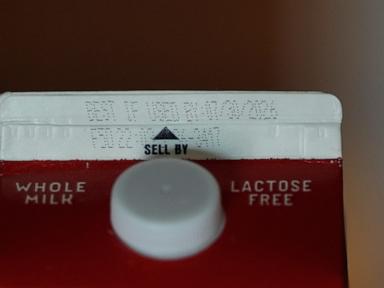
California Assembly Bill 660, taking effect July 1, 2026, represents a mandatory structural shift in consumer product packaging rather than a minor regulatory update. By eliminating consumer-facing "sell-by" dates and standardizing the remaining language into dual quality and safety vectors, the mandate attempts to correct a market failure rooted in information asymmetry.
To analyze the efficacy of this policy, one must evaluate the operational mechanics of the food supply chain, consumer psychology, and the economic friction points that occur when localized state mandates conflict with centralized national distribution networks.
The Tri-Partite Failure of Legacy Labeling
The legacy ecosystem of food date labeling relies on more than 50 distinct phrases applied arbitrarily by manufacturers, processors, and retailers. This fragmentation introduces systemic noise into consumer decision-making. The economic and behavioral drivers of food waste can be isolated into three distinct vectors.
1. The Bounded Rationality of the Consumer
The United States Department of Agriculture (USDA) indicates that confusion surrounding dating terms contributes to approximately 20% of residential food waste. When confronted with a date lacking standardized context, consumers consistently misinterpret stock-rotation data as safety limits. A survey from the Natural Resources Defense Council (NRDC) found that 91% of consumers occasionally discard food past its "sell-by" date due to pathogens anxiety, while 25% always do so. Because consumers operate under bounded rationality—relying on heuristics rather than biochemical testing—they default to a risk-averse disposal strategy.
2. Retail Inventory Misalignment
The "sell-by" designation was engineered exclusively for commercial inventory management, signaling the optimal point for stock rotation to ensure shelf availability elsewhere before quality degradation. However, exposing this internal retail metric to the end consumer creates an external supply chain rupture. When downstream buyers see a past-due inventory management date, the perceived utility of the item drops to zero, forcing early disposal of inventory that remains biochemically sound.
3. Institutional Inefficiencies and Waste Banks
The friction of unstandardized labels extends into the secondary distribution market. Food banks and pantries frequently experience artificial supply shortages because recipients reject free, nutrient-dense items bearing a past "sell-by" date. This cultural resistance undercuts food recovery operations in a state where one in five residents faces food insecurity.
The Mechanics of Assembly Bill 660
The legislative intervention of AB 660 codifies a binary nomenclature framework that separates organoleptic decay from microbial risk. The policy does not mandate that food items carry dates; rather, it introduces a strict conditional requirement: if a manufacturer chooses to apply a date label, it must conform to the dual-channel classification system.
                  ┌───────────────────────────────┐
                  │    AB 660 Date Label Rules    │
                  └───────────────┬───────────────┘
                                  │
         ┌────────────────────────┴────────────────────────┐
         ▼                                                 ▼
┌─────────────────────────────────┐       ┌─────────────────────────────────┐
│     Quality Date Category       │       │       Safety Date Category      │
├─────────────────────────────────┤       ├─────────────────────────────────┤
│ • "BEST if Used by"             │       │ • "USE by"                      │
│ • "BEST if Used or Frozen by"   │       │ • "USE by or Freeze by"         │
│ • Micro-packaging: "BB"         │       │ • Micro-packaging: "UB"         │
└─────────────────────────────────┘       └─────────────────────────────────┘
The Quality Vector
Designed for shelf-stable or slow-degrading products where expiration implies diminished flavor, texture, or aesthetic appeal rather than public health risks.
- Mandated Terminology: "BEST if Used by" or "BEST if Used or Frozen by"
- Micro-packaging Abbreviation: "BB"
The Safety Vector
Reserved for highly perishable matrices prone to microbial proliferation or chemical destabilization, where consumption past the threshold poses an acute health hazard.
- Mandated Terminology: "USE by" or "USE by or Freeze by"
- Micro-packaging Abbreviation: "UB"
To preserve retail operations, the statute permits a narrow exemption: inventory management dates remain permissible only if presented in a coded format not easily deciphered by the consumer, and they are expressly forbidden from utilizing the phrase "sell by." Pre-existing federal statutes preserve legacy exceptions for infant formula and eggs.
Supply Chain Cost Functions and Bottlenecks
While the environmental upside is clear—diverting organic waste from landfills where it generates 41% of California’s point-source methane emissions—the operational reality for food producers introduces immediate friction.
The SKU Proliferation Dilemma
Because food distribution networks operate on a national scale, a localized ban creates a bifurcation strategy problem for enterprise brands. Manufacturers face a choice between two operational frameworks:
- Dual-SKU Production: Maintaining separate packaging lines for California and the rest of the domestic market. This preserves legacy labeling elsewhere but increases SKU overhead, storage complexity, and manufacturing changeover costs.
- Universal Standardization: Adopting California’s mandate across all domestic inventory to maintain a single, streamlined supply chain. Given California’s market share as the world’s fifth-largest economy, this regulatory leverage often forces national compliance by default.
The Friction of Risk Allocation
Shifting from a conservative "sell-by" model to an extended "best if used by" timeline transfers the liability envelope. Under the legacy model, grocers cleared inventory early, mitigating product liability risks. Under the standardized system, extended shelf exposure increases the reliance on cold-chain integrity. If a distributor or retailer fails to maintain strict temperature controls, a product may spoil before its standardized quality date, exposing the manufacturer to brand erosion or litigation despite accurate labeling.
Strategic Action Plan for CPG Executives
To navigate this regulatory transition without incurring compliance penalties or margin compression, consumer packaged goods (CPG) companies must deploy a structured operational playbook.
- Audit the Formulation Matrix: Corporate quality assurance teams must audit every SKU to draw a clear line between quality and safety parameters. Do not default to safety labeling unless supported by microbial challenge testing; over-indexing on "USE by" text will trigger the same reactionary consumer disposal behaviors the law seeks to eliminate.
- Deploy Coded Inventory Identifiers: Transition internal stock rotation tracking to encrypted alphanumeric strings or 2D data matrices. This maintains warehouse management system tracking capabilities while meeting the consumer-facing concealment mandates of the California Food and Agricultural Code.
- Execute Phase-Out Asset Scheduling: Use the permitted sell-through windows to exhaust existing packaging assets. Coordinate with procurement teams to align the depletion of legacy film and label stocks with the manufacturing cut-off dates, avoiding write-offs on non-compliant packaging components.
- Enforce Cold-Chain Service Level Agreements: Revise distribution contracts to include stricter temperature tracking provisions. If products are to remain on shelves closer to their actual biochemical thresholds, exposure to thermal variance during transport must be minimized through end-to-end data logging.