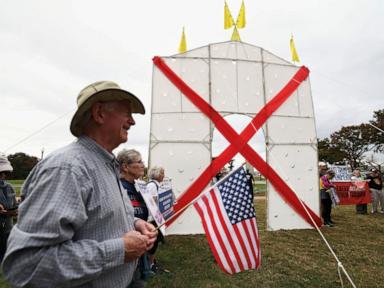
National monuments serve as physical anchors for collective memory, national identity, and civic ideology. When a state monument project intersects with partisan iconography, the resulting conflict is rarely a simple debate over urban planning or aesthetics. Instead, it triggers a structured collision between state-sanctioned memory and institutional counter-narratives. The controversy surrounding proposed architectural additions to national spaces—specifically project proposals associated with presidential legacies like the proposed triumphal structures or arch projects—illuminates a precise mechanism of political friction: the deployment of veteran authority against perceived ideological overreach.
To understand why veteran opposition to civic architectural projects carries disproportionate political weight, one must analyze the structural mechanics of moral authority, symbolic capital, and the specific cost functions of civic protest.
The Triad of Symbolic Capital in Civic Architecture
Civic space is governed by a tripartite framework of legitimacy. When an architectural proposal disrupts any of these three pillars, institutional resistance becomes inevitable.
- Historical Continuity: Monuments must anchor themselves within an established historical canon. An architectural intervention perceived as egoistic or partisan breaks the chain of continuous civic narrative, shifting the structure's function from a public tribute to an instrument of self-aggrandizement.
- Sacred Ground Dynamics: Physical locations set aside for national remembrance carry a non-monetary, high-value civic sanctity. Altering these spaces introduces a competitive tension between the existing sacrifices commemorated there and the new political narrative being introduced.
- Institutional Stewardship: The authority to design and erect national structures relies on consensus-based commissions, historical advisory boards, and public commentary phases. Circumventing or accelerating these processes degrades procedural legitimacy.
When critics frame a civic structure as "blasphemous," they are not invoking religious dogma in a traditional sense; they are applying a secular blasphemy framework. This occurs when a political actor attempts to privatize or rebrand public civic sanctity for individual or partisan leverage.
The Mechanism of Veteran Counter-Mobilization
The entry of military veterans into civic disputes alters the political calculus through three primary mechanisms.
1. Asymmetric Moral Authority
Veterans possess a unique category of social proof within national political discourse. Because military service requires an implicit contract of self-sacrifice for the state, veteran commentary on national symbols operates with an inherent credibility shield. When a civilian political figure promotes a monument, opposition from political opponents is easily dismissed as partisan friction. However, when decorated veterans frame the same monument as a violation of civic integrity, the partisan defense fails to neutralize the critique.
2. The Cost Function of Civic Dissent
Organized veteran opposition imposes a specific political cost function on project proponents:
- Reputational Degradation: Proponents who typically align with pro-military rhetoric face direct narrative contradiction when opposing veteran groups.
- Media Amplification: The juxtaposition of military service records against political ambition creates a high-contrast narrative structure that commands disproportionate media coverage.
- Institutional Friction: Veteran advocacy groups frequently possess direct access to legislative committees, regulatory oversight bodies, and historical preservation councils, allowing them to convert public discourse into administrative delays.
3. Reclaiming the Narrative of Sacrifice
Public monuments often seek to align their subjects with the abstract concept of national sacrifice. Veteran advocacy directly challenges this alignment by drawing a sharp distinction between operational military sacrifice and political ambition. By asserting that a proposed structure dishonors existing service members or historical precedents, opposition leaders effectively detach the project from its intended mantle of patriotism.
Strategic Dynamics of Civic Space Disputes
The trajectory of public opposition to state-sponsored architectural projects follows a predictable sequence of operational phases.
[Proposal & Symbolic Re-framing]
            │
            ▼
[Mobilization of High-Credibility Messengers]
            │
            ▼
[Procedural & Regulatory Friction]
            │
            ▼
[Institutional Compromise or Abandonment]
Phase 1: Symbolic Re-framing
Opponents shift the public framing of the project from "urban enhancement" or "presidential honor" to "unauthorized expansion" or "civic sacrilege." This stage relies on high-impact language designed to challenge the project's foundational legitimacy.
Phase 2: Mobilization of High-Credibility Messengers
Opposition leadership secures endorsements from individuals whose credentials shield them from routine political counterattacks. Veteran leaders, military historians, and non-partisan preservationists are mobilized to anchor the coalition.
Phase 3: Regulatory and Procedural Friction
The coalition shifts focus from public rhetoric to legal and administrative channels. This involves challenging environmental impact reports, contesting zoning exemptions, appealing to federal commission guidelines, and lobbying legislative funding committees.
Phase 4: Institutional Costs Outweigh Symbolic Gains
As procedural delays accumulate, the financial and political capital required to sustain the project escalates. Sponsors face a diminishing return on investment: the structure, initially intended to project power and permanence, becomes a permanent symbol of division and administrative paralysis.
Structural Implications for Civic Strategy
Managing disputes over national monuments requires recognizing that public space is a non-renewable political resource. Sponsors of major civic architecture projects routinely underestimate the friction generated when personal or partisan branding overlaps with established national memory.
To navigate or evaluate these conflicts objectively, analysts must track three key variables rather than relying on superficial media reporting:
- The Credibility Profile of the Opposition: Resistance led by non-partisan credentialed actors (veterans, historians) creates significantly higher political drag than resistance led by political advocacy groups.
- Regulatory Choke Points: The number of independent approval steps required (e.g., National Capital Planning Commission, historic preservation boards) directly correlates with the probability of project modification or cancellation.
- Narrative Alignment: Projects that successfully integrate into pre-existing historical frameworks survive; projects that position themselves as structural disruptions face sustained moral and procedural counter-offensives.
The ultimate longevity of any national architectural initiative depends not on the political power of its instigators, but on its capacity to withstand rigorous scrutiny under the established frameworks of civic sanctity and public trust.