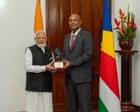
The velvet box snaps shut with a precise, heavy click. Inside lies a medal forged from gold and dipped in centuries of statecraft. For the cameras, it is a flash of brilliant metal against a dark tailored suit. For the diplomats watching from the wings, it is something entirely different. It is currency.
To the casual observer scanning the evening headlines, the sheer volume of international honors bestowed upon Indian Prime Minister Narendra Modi can look like a relentless exercise in vanity. Critics mock the frequency of these ceremonies, painting a picture of a leader eager to collect glittering tokens on every foreign tarmac. They see a superficial parade of sashes, collars, and titles.
They are looking at the frame and missing the entire picture.
Geopolitics is rarely about the medal itself. It is about the theater of obligation. When a nation hands its highest civilian honor to a foreign leader, it is not merely saying thank you for past cooperation. It is anchoring its own future to the trajectory of a rising superpower.
The Currency of the Protocol
Think of a traditional marketplace. Trust is built through handshake agreements, long-standing relationships, and tangible exchanges. Now, scale that up to the brutal, unforgiving arena of global diplomacy, where traditional currencies of raw military power and economic dominance are constantly shifting. In this space, the state honor functions as a unique asset class.
Consider the geography of these awards. The Order of Abdulaziz Al Saud from Saudi Arabia. The State Order of Ghazi Amir Amanullah Khan from Afghanistan. The Grand Collar of the State of Palestine. The Order of St. Andrew from Russia. The Grand Cross of the Legion of Honour from France. This is not a random assortment of accolades. It is a carefully mapped constellation of strategic interests.
When New Delhi negotiates energy security with the Gulf, or maritime defense frameworks with Europe, the public-facing ceremony sets a cultural precedent. It signals to domestic populations and international markets alike that the relationship has moved past transaction into the territory of shared destiny. A prime minister coming to collect an award is the public consummation of months—sometimes years—of grueling, backroom bureaucratic alignment.
The critics miss the mechanics of the leverage. They ask why a leader with an overwhelming domestic mandate needs validation from a tiny island nation or a European republic. The answer lies in the psychological architecture of international relations. An award accepted is an unspoken commitment acknowledged. It binds the giver and the receiver in a public pact that is remarkably difficult to break when geopolitical winds change.
The Human Mechanics of Statecraft
Picture a mid-level diplomat working late into the night in an embassy in Riyadh or Paris. The desks are piled high with trade data, defense procurement contracts, and visa policy updates. Progress is agonizingly slow. Grammatical nuances in a joint statement are debated for days.
Then comes the announcement: the host country intends to confer its highest civilian honor upon the visiting Indian prime minister.
Suddenly, the bureaucratic gridlock melts away. The award creates a hard deadline. It forces disparate government ministries to align their priorities because you cannot hand a man a medal of supreme honor while simultaneously stalling a multi-billion-dollar trade negotiation. The ceremony becomes the engine that drives the policy, not just the decoration at the end of it.
This is the hidden gravity of international relations. Nations use these honors to court India’s massive consumer market, its formidable tech workforce, and its vital strategic position in the Indo-Pacific. By elevating the individual leader, they are paying a premium to secure the attention of the state he represents.
Beyond the Glittering Facade
The narrative surrounding these trips often focuses on the spectacle. The red carpets. The military honor guards. The grand banquets. It is easy to dismiss it all as elite theater detached from the daily realities of the citizens living in the countries involved.
But look closer at the friction points of modern history. When global supply chains fractured, or when energy markets convulsed under the weight of conflict, the lines of communication that stayed open were often those wrapped in the formal ties of high diplomacy. The trust built during those highly choreographed award ceremonies translates directly into priority access to resources, intelligence sharing, and economic cushions during global crises.
It is a game of strategic patience. A country that honors India’s leader today is banking goodwill for a tomorrow where they might need New Delhi’s diplomatic weight in a fractured United Nations, or its naval presence in contested waters.
The medals themselves will eventually sit in glass cases, static artifacts of a specific political era. But the structural shifts they facilitated—the maritime lanes opened, the tech corridors secured, the energy pipelines guaranteed—will outlast the politicians who signed the treaties.
The true measure of these overseas trips is not found in the weight of the gold pinned to a lapel. It is found in the quiet, permanent realignment of global influence, one heavy velvet box at a time.