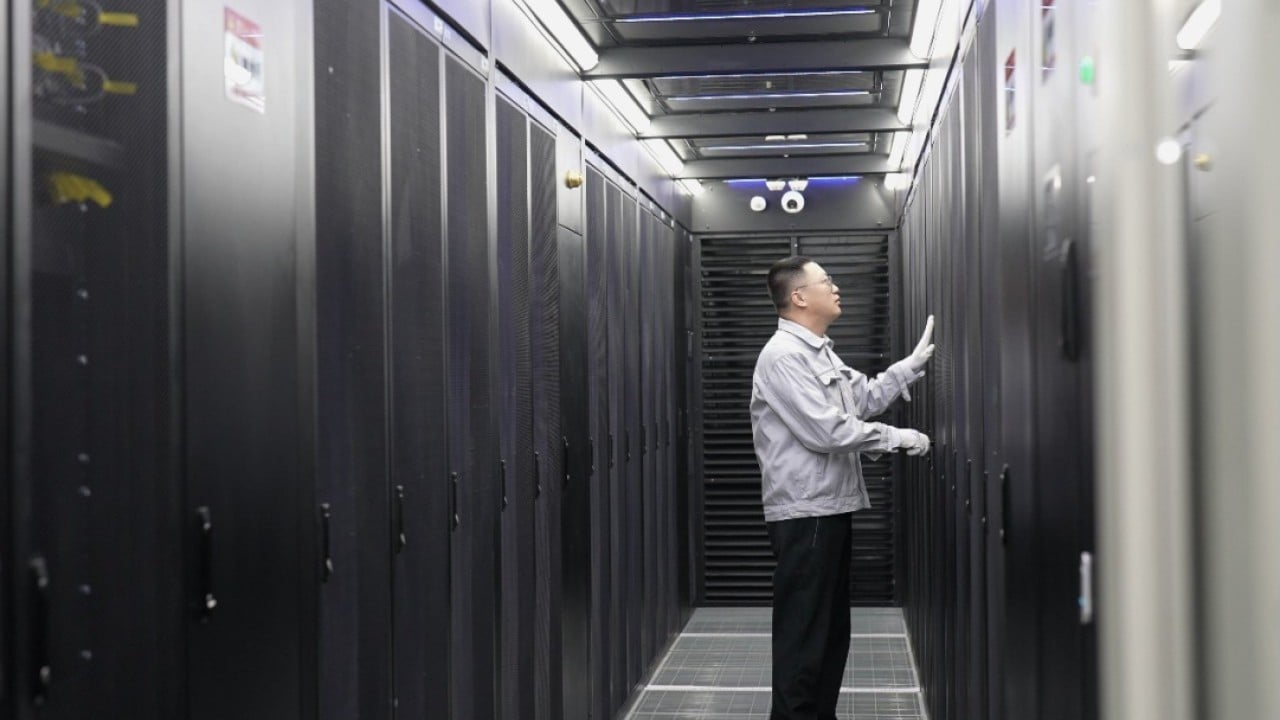
Capital expenditure in artificial intelligence infrastructure is rarely constrained by ambition. It is constrained by megawatts, cooling thermal envelopes, and geographic arbitration. When state-backed telecom operators expand facility nodes into interior provinces, they are executing a deliberate macroeconomic strategy to decouple compute deployment from coastal power grid bottlenecks. China Mobile's recent expansion of its Hohhot computing facility in Inner Mongolia, pushing nominal operational capacity to 20,100 petaflops, offers a clear blueprint of how large-scale state capital attempts to solve physical resource limits.
Evaluating this development requires looking past nominal performance figures and examining the underlying structural mechanics: the energy economics of remote clustering, the logistical transmission mechanics linking western generation assets to eastern demand centers, and the inherent trade-offs between capital deployment and verified utilization.
The Geography of Power Arbitrage
Data center placement is fundamentally an exercise in energy logistics. Coastal Tier-1 metropolitan clusters like Beijing, Shanghai, and Shenzhen possess the dense economic demand for artificial intelligence model training and inference, but their local power grids and land footprints cannot sustain the exponential scaling of hyperscale cluster architecture.
Inner Mongolia resolves this constraint through a structural arbitrage of land cost, ambient cooling efficiency, and baseline electrical supply.
- Thermal Envelopes: The northern continental climate provides extended periods of ambient low temperatures, reducing the power usage effectiveness ratio by minimizing mechanical chiller dependence.
- Energy Mix: Proximity to domestic coal reserves and extensive renewable generation assets (wind and solar integration in northern grids) secures large-scale power purchase agreements.
- Land Acquisition: Vast tracts of inexpensive industrial-zoned land permit modular campus expansion without the prohibitive real estate acquisition costs of eastern urban centers.
By situating a 120-megawatt IT power addition in Hohhot, operators bypass local grid saturation in the capital region while maintaining logical proximity to primary economic consumers.
The Vector of Transmission and Latency Mechanics
A remote compute hub is economically viable only if the latency profile and bandwidth capacity of the underlying network can support remote training workloads and distributed inference requests. The Hohhot expansion explicitly targets the Beijing-Tianjin-Hebei economic cluster, routing approximately 90 percent of its designated capacity toward eastern demand nodes.
This topology creates a dependency on ultra-low-latency backbone infrastructure, specifically high-capacity optical transport networks and backbone routing protocols capable of handling distributed parallel computing tasks.
[ Inner Mongolia Computing Hub ]
       │ (120 MW IT Power / 20.1 Exaflops Peak)
       ▼
[ Ultra-Low Latency Backbone Network ]
       │ (90% Allocated Capacity)
       ▼
[ Beijing-Tianjin-Hebei Demand Nodes ]
When multi-node training clusters span hundreds or thousands of kilometers via long-haul fiber, latency variance introduces synchronization bottlenecks. While inference workloads tolerate higher latency thresholds, distributed model training requires deterministic, low-jitter interconnects. The economic viability of moving compute nodes inland rests entirely on whether network packet loss and transit latency degrade accelerator utilization rates below the cost savings achieved on cheap power.
Nominal Capacity Versus Realized Utilization
Announcements of multi-exaflop milestones are frequently reported as metrics of immediate capability, yet architectural analysis requires separating nameplate capacity from operational deployment.
- Precision Ambiguity: Aggregate petaflop figures often conflate mixed-precision floating-point operations (FP16, BF16, INT8) used in artificial intelligence workloads with double-precision (FP64) scientific computing metrics. Without specified precision matrices, raw performance numbers function primarily as macroeconomic indicators rather than direct benchmarks.
- The Accelerator Mix: The long-term resilience of facilities like the Hohhot installation depends on the semiconductor supply chain. Deploying indigenous accelerator architectures involves distinct compiler ecosystems and software toolchains compared to legacy Western hardware stacks. Code migration overhead can temporarily suppress effective throughput.
- Tenant Commitment: Infrastructure deployment precedes software demand. Constructing physical shell, power distribution units, and liquid-cooling manifolds represents a fixed capital outlay. The operational velocity of the facility is governed by long-term service contracts with cloud providers, large language model developers, and state-backed research institutions.
If enterprise tenants face software integration friction or if capital expenditure outpaces active model training demand, physical facilities experience amortization drag while awaiting software ecosystem maturity.
Strategic Economic Synthesis
The scaling trajectory of interior computing hubs demonstrates a shift from urban-adjacent data centers to resource-optimized regional grids. This model prioritizes macro-level power availability over immediate physical proximity to end-users, absorbing network transport costs in exchange for uninterrupted energy supply.
Future infrastructure efficiency will not be measured by peak theoretical throughput alone, but by the ratio of sustained workload execution to megawatt-hour consumed, the mitigation of long-haul network jitter, and the velocity at which software frameworks adapt to heterogeneous domestic silicon. The strategic play shifts from building raw square footage to driving software-hardware co-design that eliminates idle compute cycles across distributed regional nodes.