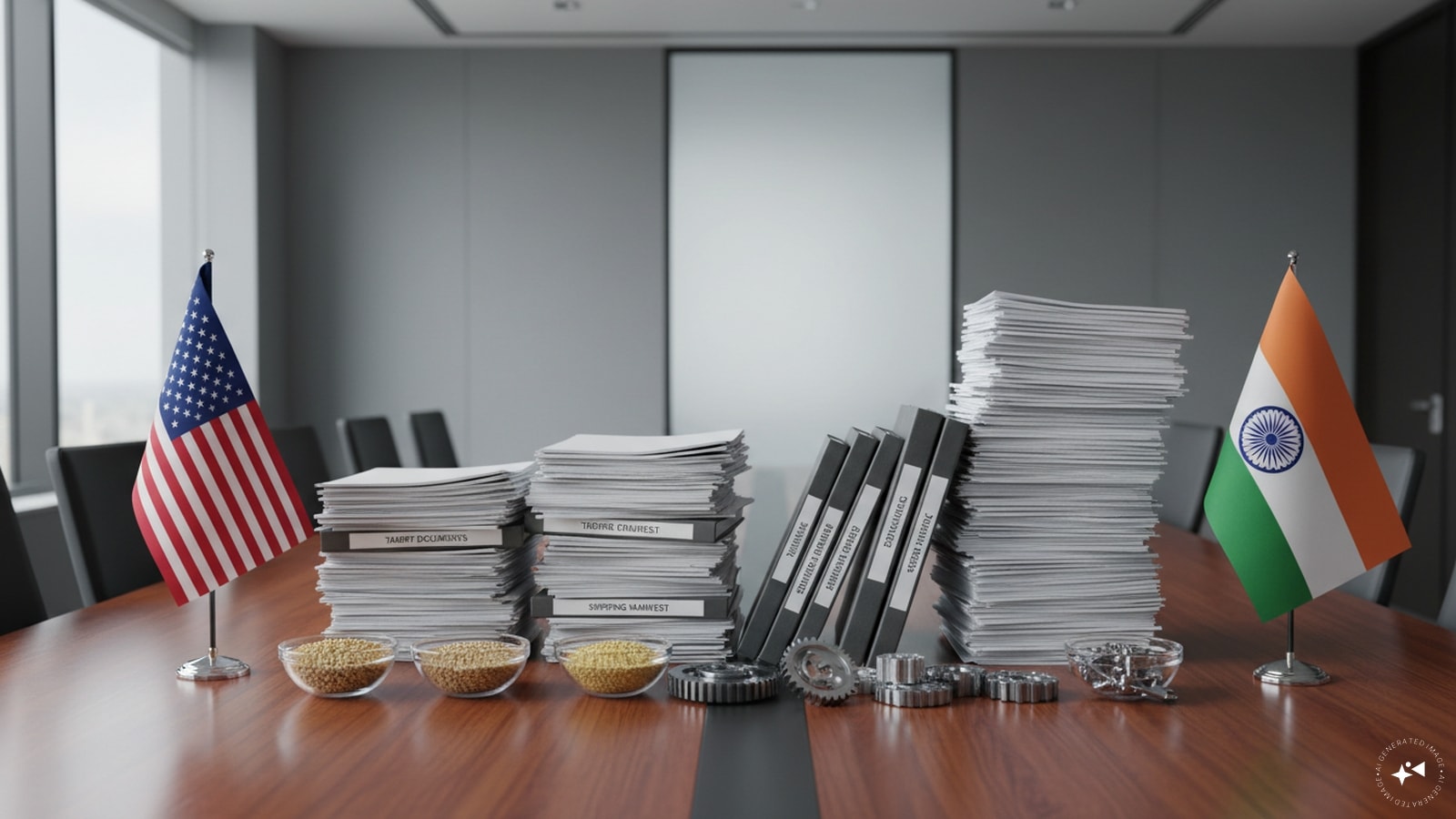
The fluorescent lights in a Tiruppur garment factory hum with a low, anxious vibration at three in the morning. Outside, the humid Tamil Nadu air smells of damp earth, diesel exhaust, and fried dough from a roadside tea stall. Inside, stacks of folded cotton polo shirts—destined for big-box retailers in Ohio and Texas—sit wrapped in clear plastic, waiting for a shipping manifest that suddenly costs twice as much to clear through customs.
For a factory floor manager—let us call him Rajesh, a hypothetical composite of thousands of mid-sized Indian exporters watching their margins evaporate—international trade policy is not an academic debate conducted in air-conditioned think tanks. It is the difference between paying overtime to forty-two seamstresses or quietly turning off the sewing machines on a Friday afternoon. When tariffs spike in Washington, the shockwave does not stop at the port of Los Angeles. It travels across the Pacific, down through the Indian Ocean, and lands squarely on Rajesh’s ledger.
Now, the political winds in Washington have shifted once again, and the phone lines between New Delhi and the Potomac are warming up.
A recent assessment from the Global Trade Research Initiative—known in policy circles as GTRI—points to a fascinating, high-stakes reality. Following mid-term electoral setbacks, President Donald Trump faces mounting domestic pressure to deliver visible, quick-fire economic wins. When a presidency hits political turbulence at home, foreign trade deals suddenly become attractive trophies. They offer headlines. They project momentum. They allow a leader to walk up to a podium and announce that America is winning again.
And that creates a trap for India.
When someone across the table is in a hurry to sign a paper, the worst thing you can do is match their speed.
The Architecture of a Rush Job
To understand why speed is the enemy of a good trade agreement, consider how a hasty deal actually gets built. Think of a comprehensive bilateral trade pact like constructing a suspension bridge across a wide, unpredictable river. Every cable—whether it governs pharmaceutical patents, agricultural subsidies, steel tariffs, or digital data flows—carries immense weight. If you rush the engineering just so politicians can cut a ribbon before the next news cycle, the bridge looks magnificent on television. Until the first heavy truck drives across it.
GTRI’s warning cuts right to the bone of this dynamic. A politically motivated push from Washington for a rapid trade deal will almost certainly focus on low-hanging fruit that satisfies American domestic constituencies—lowering Indian import duties on American agricultural goods, easing market access for tech giants, or securing quick procurement commitments—while leaving India’s core structural demands gathering dust in a side room.
I remember sitting in a cramped trade compliance office in Mumbai years ago, watching a veteran customs broker flip through a three-hundred-page tariff schedule with ink-stained fingers. He laughed—a dry, bitter sound—as he pointed to a clause that looked like a triumph on paper. On the surface, duties had been slashed. Buried four appendices deep, however, were non-tariff barriers, strict testing certifications, and quota triggers that effectively locked Indian goods out of the market anyway. "The headline belongs to the minister," he told me, tapping the page with his pen. "The fine print belongs to the lawyers."
That memory has stayed with me because trade negotiations are rarely lost in the grand speeches. They are lost in the quiet hours when one side wants a photo opportunity more than the other side wants structural fairness.
What Washington Wants When the Clock Is Ticking
Politics, at its core, is the management of impatience. After a mid-term loss, an administration loses legislative runway. Passing sweeping domestic laws through a divided or hostile Congress becomes an exhausting trench war. Executive actions on trade, by contrast, remain one of the few levers a president can pull with relative autonomy.
For Donald Trump, trade has always been both a worldview and a stage. Tariffs are the opening bid; a bilateral deal is the grand finale. If domestic political capital is thinning, securing a trade agreement with one of the world’s fastest-growing major economies serves a dual purpose. First, it signals to American voters and financial markets that the administration can still close major international bargains. Second, it fits neatly into a broader strategic narrative of reshaping global supply chains away from China.
Yet look closely at what a quick Washington-driven deal typically demands from New Delhi.
American negotiators arrive with a crisp, well-rehearsed shopping list:
- Agricultural Access: Lower tariffs on American almonds, apples, dairy products, and poultry, opening India’s massive consumer market to US farm states—regions that happen to be vital electoral battlegrounds.
- Industrial and Tech Concessions: Reduced duties on high-end electronics, medical devices, and specialized machinery, alongside softer rules on data localization and digital taxation.
- Procurement Pledges: Commitments from Indian state-owned and private enterprises to buy more American liquefied natural gas, defense equipment, and commercial aircraft.
None of these demands are inherently unreasonable in a balanced negotiation. Trade, after all, is an exchange of comparative advantages. The danger lies in asymmetry. If Washington pushes for an "early harvest" deal—a stripped-down agreement focused primarily on tariff reductions that benefit US exporters—India risks giving away its highest leverage chips before the real game even begins.
The Invisible Ledger of Reciprocity
What does genuine reciprocity actually look like for India? Strip away the diplomatic jargon, and it comes down to a simple principle: if I open my front door so your merchants can sell in my living room, you cannot keep your back door deadbolted when my workers and manufacturers knock.
For years, Indian exporters have operated under a quiet, persistent disadvantage in the United States. While India’s average tariffs are higher on paper—a fact American critics love to cite—the United States protects its market through a dense thicket of regulatory hurdles, steep peak tariffs on labor-intensive goods, and restrictive visa regimes.
Take textiles and apparel, the lifeblood of towns like Tiruppur and Surat. Indian garments entering the US face tariffs that can climb into the double digits, even as competing nations enjoy preferential duty-free access. Meanwhile, in the services sector—where India holds a genuine global edge—Indian IT professionals and engineers face escalating visa fees, unpredictable rejection rates, and social security double-taxation rules that strip away billions of dollars in earnings without providing corresponding retirement benefits.
Consider what happens if New Delhi signs a rapid deal that lowers duties on American apples and medical devices without securing ironclad concessions on these exact fronts.
First, domestic Indian farmers—already navigating volatile monsoons and thin margins—face sudden price pressure from heavily subsidized American agricultural imports. Second, Indian manufacturers remain stuck behind the same tariff walls in the US, watching orders drift toward Vietnam or Bangladesh. Third, and most damaging of all, India surrenders its primary bargaining leverage. Once you lower your tariffs in a mini-deal, you cannot lower them a second time when you eventually sit down to negotiate the issues you actually care about.
You have spent your currency on an appetizer, leaving nothing in your pocket for the main course.
The Ghost of Deals Past
History is littered with nations that mistook diplomatic warmth for economic alignment. During the first Trump administration, Washington and New Delhi spent months dancing around a limited trade package. There were high-profile rallies, warm handshakes, and endless speculation that a deal was days away. Yet behind closed doors, the talks stalled precisely because the two sides had fundamentally different definitions of fairness.
When the US revoked India’s Generalized System of Preferences status in 2019—stripping away duty-free treatment for billions of dollars in Indian exports—New Delhi responded with measured retaliatory tariffs on twenty-eight American products. It was messy. It frustrated business lobbies on both sides. But it established an unmistakable boundary: India would not absorb unilateral economic punches simply to preserve a pleasant diplomatic atmosphere.
That historical precedent matters deeply right now. Behavioral patterns in trade negotiations rarely vanish; they merely change costumes. An administration under mid-term pressure will naturally try to frame a quick agreement as a win-win partnership, using strategic warmth—shared concerns over Indo-Pacific security, technology cooperation, and defense ties—to nudge Indian negotiators toward flexibility on trade.
And let us be honest about the psychological pressure that creates in New Delhi. Saying "no" or "not yet" to a superpower is never comfortable. There is always the lingering fear that holding out for strict reciprocity might sour broader strategic goodwill, or invite fresh tariff threats from a White House known for using unpredictability as a negotiating tool. That uncertainty is real, and pretending otherwise would be naive. Even seasoned trade diplomats feel the weight of choosing between an imperfect deal today and an uncertain standoff tomorrow.
Yet yielding to that anxiety is how countries end up locked into lopsided treaties for decades.
Four Pillars India Cannot Afford to Trade Away
If New Delhi chooses to engage with a newly eager Washington—and it should—GTRI’s analysis highlights the exact boundary lines that must hold firm. Rather than rushing toward a headline-friendly signing ceremony, Indian negotiators have an opportunity to turn Washington’s urgency into India’s structural gain.
1. Restoration and Expansion of Duty-Free Market Access
Any tariff reductions India offers on American industrial or agricultural goods must be matched dollar-for-dollar by meaningful tariff cuts on Indian labor-intensive exports. Textiles, footwear, leather goods, gems, jewelry, and marine products are not mere line items; they are massive employment engines. If American consumers get cheaper Indian imports while Indian factories gain predictable, low-tariff entry, both economies win. Without this, tariff reduction is a one-way street.
2. Certainty for Skilled Professionals and Services
India’s economic engine runs heavily on services, yet trade talks routinely treat services as an afterthought. A truly reciprocal agreement must address the mobility of skilled professionals—securing predictable visa pathways, streamlining processing, and finally resolving the long-standing Totalization Agreement deadlock so Indian workers in the US are not forced to pay into a social security system from which they can rarely collect benefits.
3. Guardrails Against Non-Tariff Ambush
Lowering a tariff to zero means nothing if a shipment gets held up at a port for six months over shifting sanitary standards or opaque regulatory reviews. Indian pharmaceuticals, generic drugs, and agricultural exports frequently collide with sudden US regulatory hurdles. Reciprocity requires mutual recognition agreements and transparent dispute-resolution timelines so customs rules cannot be weaponized as backdoor protectionism.
4. Protection of Policy Space for Domestic Industry
India is in the middle of a multi-decade push to build its own manufacturing base—from semiconductors to green energy components. A hasty trade deal that bans local content requirements, restricts digital governance, or forces premature patent extensions would kneecap India’s industrial transformation before it reaches maturity. Every major economy, including the United States, used protective policy space during its own industrial rise. India cannot afford to sign away the ladder while it is still climbing it.
The Power of Sitting Still
There is an old rule among seasoned negotiators: the person who cares least about leaving the room without a deal holds all the cards.
Right now, time is working in New Delhi’s favor, not against it. India’s domestic market continues to expand at a pace that global corporations simply cannot ignore. Whether a trade deal is signed in six months or two years, American tech firms, defense contractors, and consumer brands still need access to India’s rising middle class and engineering talent. Washington, by contrast, is operating on an unforgiving political calendar where every quarter counts toward the next electoral cycle.
If the White House wants a trade deal quickly because domestic politics demand a victory, New Delhi should welcome the conversation with polite enthusiasm—and then lay a thick, uncompromising ledger of reciprocal demands squarely across the table.
Back in that Tiruppur garment factory, the morning shift is arriving as the night crew heads home. The machines never truly stop; they simply change hands. Rajesh checks the shipping rates one more time before locking his office door, hoping the politicians thousands of miles away remember what is actually being traded when they sign their names. Not abstract numbers on a briefing memo. Livelihoods. Leverage. And the right to build something that lasts long after the applause fades.