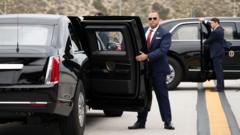
The motorcade is not a parade. It is a missile made of chrome and carbon fiber, designed to punch a hole through the chaotic geography of a major metropolis. Inside that central vehicle sits the most heavily targeted human being on earth. Yet, every single time the doors swing open and a figure steps out into the camera flash, there is a distinct possibility that the man waving to the crowd is not the man running the country.
This is not a conspiracy theory born in a dark forum. It is logistics.
To understand the architecture of modern statecraft, you have to look past the podiums and the press briefings. You have to look at the geometry of deception. For decades, the security details tasked with protecting American presidents have relied on a sophisticated, shifting architecture of decoys, duplicate fleets, and tactical choreography known informally within intelligence circles as the shell game.
Consider what happens next: A city holds its breath. Streets are sanitized hours in advance. Manhole covers are welded shut. Rooftops sprout silhouettes of men and women with binoculars and long guns. And somewhere in that labyrinth of cordoned-off asphalt, a twin motorcade splits off toward a secondary destination, carrying a decoy whose posture, suit, and wave have been practiced down to the millisecond.
It is exhausting to think about. It is terrifying to execute.
When you spend your life studying the mechanics of threat mitigation, you realize that visibility is a trap. The more people who know where you are, the easier it is to draw a line from their eyes to a rifle scope. Therefore, the primary objective of modern executive protection is not just defense; it is systemic ambiguity.
Imagine, for a moment, the psychological weight carried by the body doubles and specialized decoy coordinators. (Note: While official agencies rarely confirm the active use of physical body doubles due to operational security, historical precedents from the twentieth century onward demonstrate that parallel movement tactics and decoy vehicles are standard operating procedure). These are individuals who willingly absorb the invisible crosshairs. They drive the empty lead car. They step into the blinding light of the tarmac. They become human lightning rods, drawing the speculative gaze away from the actual target.
The strategy relies on a principle as old as warfare itself: distraction through symmetry.
When two identical armored sport utility vehicles leave a hangar, they look identical to the naked eye. Their weights are identical—often reinforced with heavy military-grade steel plates that push the gross vehicle weight rating past standard limits. Their tinted windows obscure the interior with equal opacity. Even the electronic signatures, the radio frequencies bouncing off their antennas, are managed to ensure that electronic intelligence-gathering yields conflicting results.
An adversary watching from a high-rise window does not see a person. They see a puzzle. And by the time they solve it, the pieces have already moved.
Security is rarely glamorous. Mostly, it is a relentless accumulation of tedious details handled by people who drink too much lukewarm coffee in windowless conference rooms. They map sewer lines. They calculate the exact turning radius of a presidential limousine on a narrow European street. They analyze the structural integrity of hotel loading docks.
And then, they add the layer of the shell game.
Why go to such elaborate lengths? Because the nature of global threat vectors has fundamentally mutated. We no longer live in an era where danger wears a uniform or announces itself with a declaration of war. Threat actors range from state-sponsored cyber-cells to radicalized lone wolves utilizing commercial technology. A drone purchased online can be modified to carry a payload in a suburban garage. In this environment, predictability is fatal.
If a motorcade route is published in advance—even loosely—it becomes a mathematical equation waiting to be solved by someone with ill intent. To break that equation, the Secret Service introduces variables. They shift departure times by ninety seconds. They utilize alternate landing zones at military airfields that are miles away from the scheduled public arrival point. They use multiple identical helicopters, landing them simultaneously in different quadrants of a sprawling estate, letting rotor wash obscure which cabin holds the executive.
It is a dance of shadows.
I remember talking to a retired federal security consultant years ago, a man whose eyes had that permanent, scanning twitch common to those who spend decades evaluating worst-case scenarios. He didn't talk about politics. He talked about angles. He talked about the time it takes for a bullet to travel three hundred yards versus the reaction time of a human muscle twitch.
"People think protection is about being tough," he told me, leaning over a greasy diner table. "It's not. Protection is about being confusing. If they don't know where to aim, they don't pull the trigger. Confusion is our best armor."
That conversation stuck with me because it exposes the profound fragility at the heart of absolute power. The more authority a person wields, the more isolated they become, and the more elaborate the machinery required simply to keep them breathing through another Tuesday.
The public rarely sees this machinery. We see the pageantry. We see the red carpet rolled out across the tarmac of Air Force One. We see the crisp salute, the smile, the brief wave to the cameras before the doors close. We are conditioned to accept this surface reality as the entirety of the experience.
Yet underneath that polished veneer lies a frantic choreography of misdirection.
Think about the decoy motorcades that sweep through Washington, D.C., during the State of the Union or international summits. Multiple routes are planned, mapped, and rehearsed by tactical drivers who know every pothole and bottleneck on the eastern seaboard. Decoy vehicles speed down avenues with sirens wailing, clearing traffic, drawing the stares of tourists and potential threats alike, while the actual principal is moving quietly in a nondescript van or via an underground transit network that most citizens forget exists beneath the capital.
This is the hidden cost of leadership in the modern age. It demands the total erasure of spontaneity. You cannot walk down a sidewalk, buy a cup of coffee, or sit on a park bench without turning the surrounding three block radius into a tactical theater of war.
And so, the shell game continues.
It scales up with every technological advancement. As drone surveillance becomes more sophisticated, countermeasures evolve to spoof GPS signals and project false thermal signatures. As facial recognition software grows more pervasive, operational protocols adapt to obscure movement patterns through artificial congestion and rapid vehicle transfers.
The game is played in silence. It is played without applause.
When the motorcade finally arrives at its destination, and the doors open, and the president steps out to address the nation, the tension in the command vehicle finally breaks. For a few brief minutes, the variables are locked down. The theater becomes reality.
Until it is time to leave again, and the shadows rearrange themselves for the journey back into the dark.