The marble floors of the capital are designed to absorb sound, but they do a poor job of muting consequence.
Step into the humming corridors where influence is traded by the syllable, and you realize quickly that politics is not merely a contest of ideas. It is an intricate choreography of attention. Every politician learns the pivot early. The quick turn of the shoulder. The slight lift of the chin. The artful dismissal disguised as a rush to somewhere more urgent. It is a physical language born of necessity, deployed whenever the temperature in the room rises uncomfortably high. For a deeper dive into similar topics, we suggest: this related article.
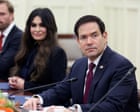
Marco Rubio knows this language fluently.
When reporters cornered him recently about allegations involving Kimberly Guilfoyle—specifically, the pressure applied to a donor to settle a personal credit card debt—the response was a masterclass in calculated deflection. A shrug. A tight, practiced smile. A swift maneuver down the hallway. Nothing to see here. Move along. For further information on the matter, detailed analysis can also be found at The Washington Post.
It is easy to watch these moments on a screen and dismiss them as standard political theater. We sigh. We change the channel. We accept that power protects its own and that accountability is a rare commodity traded only when cameras are too bright to ignore. But behind that casual brush-off lies a much deeper, more troubling reality about how money, loyalty, and personal debt intersect in the modern political arena.
Consider what happens when the private ledger bleeds into the public sphere.
In the ecosystem of high-stakes fundraising, the boundaries between institutional support and personal survival have always been porous. Campaigns are multi-million-dollar machines fueled by relationships, favors, and an unspoken code of conduct. Donors are not just contributors; they are patrons. They expect access, validation, and a sense of shared mission. When a high-profile surrogate steps outside those professional bounds—when a request for political backing morphs into a demand for personal financial bailouts—the machinery stumbles.
Yet, the instinct of leadership is rarely to investigate. It is to insulate.
Rubio’s brush-off was not an aberration. It was a reflex. In a political climate hyper-saturated with daily scandals, admitting fault or even engaging with the messy details of a donor dispute is treated as an unforced error. Better to minimize. Better to treat the inquiry as an annoyance rather than a signal of deeper dysfunction.
This brings us to the invisible stakes of the story.
We talk endlessly about policy, polling numbers, and ideological purity. We dissect debate performances and legislative scorecards as if politics were a dry academic exercise. But power is fundamentally human. It is driven by ego, desperation, ambition, and the frantic scramble to maintain status. When a campaign surrogate allegedly leans on a donor to clear a personal balance, it exposes the raw, transactional underbelly of the entire system. It reminds us that behind the polished podiums and soaring rhetoric, the bills are piling up, and someone has to pay them.
Or, more accurately, someone is expected to be pressured into paying them.
Let us be honest about the mechanics of this pressure. Wealthy donors are accustomed to being courted, not cornered. When a figure of national prominence makes a direct appeal for funds, the psychological weight is immense. Saying no carries a cost. It risks access, influence, and social standing within elite circles. To use that leverage for a personal credit card bill—rather than a political committee or a policy initiative—is a profound breach of the unwritten social contract between the donor class and the political establishment.
And yet, when the press asks about it, the silence is deafening.
Or worse, it is met with that trademark shrug.
Why do we tolerate this? Perhaps because cynicism has become our default defensive mechanism. We expect so little from our leaders that minor ethical tremors barely register on the Richter scale anymore. A brushed-off question becomes white noise. We wait for the next outrage to wash over us, numbed by the sheer velocity of the news cycle.
The danger of this numbness is insidious. When accountability is routinely outsourced to apathy, power stops pretending to care altogether. The shrug becomes institutionalized.
Imagine standing in that hallway. Imagine watching the cameras flash and hearing the sharp, urgent questions ricochet off the stone walls. You look into the eyes of the official as they turn away, smoothly sidestepping the inquiry with a practiced quip. There is no remorse there. No hesitation. Just a cold calculation of self-preservation.
That is the true subject of the story. Not just the credit card, not just the donor, and not just the specific campaign personalities involved. It is the widening chasm between the public’s right to know and the political class's absolute determination not to tell.
As long as the shrug remains an acceptable answer, the architecture of accountability will continue to crumble. The questions will keep coming, echoing down empty corridors, bouncing off marble floors that were built to listen, but never required to answer.