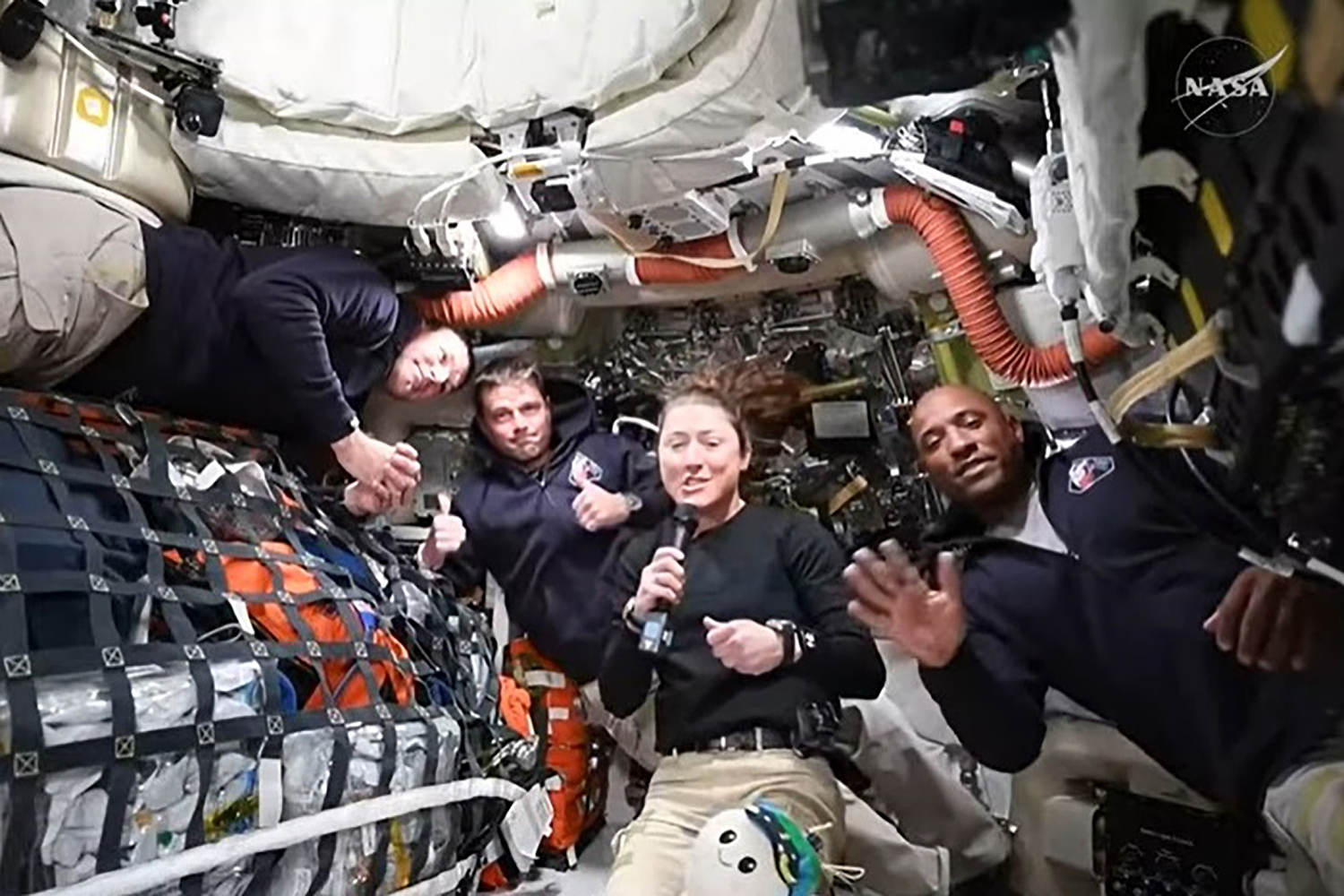
We’re finally back. After fifty years of staring at the Moon through telescopes and grainy archival footage, human beings are actually out there again. On April 1, 2026, the Artemis 2 mission screamed off the pad at Kennedy Space Center, carrying four astronauts into the deep black.
This isn't a repeat of 1969. It’s something much more complex. NBC News correspondent Tom Costello recently spoke with the crew—Commander Reid Wiseman, Pilot Victor Glover, and Mission Specialists Christina Koch and Jeremy Hansen—as they pushed their spacecraft, named Integrity, toward the lunar far side. If you think this is just a high-tech "flyby," you're missing the point. This mission is the stress test for everything that comes next. For an alternative look, see: this related article.
Testing the Limits of Integrity 400,000 Kilometers from Home
The crew chose the name Integrity for their Orion capsule because it wasn't just a buzzword; it was a baseline. When Costello caught up with them, the conversation wasn't about the view—though that's spectacular—it was about the hardware.
Orion is currently hurtling toward a point roughly 7,600 kilometers beyond the Moon. That’s farther than any human has ever traveled from Earth. But the real story isn't the distance. It’s the life support. Unlike the International Space Station, which sits comfortably within Earth’s magnetic shield, Integrity is bathing in deep-space radiation. Further analysis on the subject has been published by The Verge.
During the flight, the crew has been meticulously testing the Environmental Control and Life Support System (ECLSS). They’re checking if the scrubbers can keep up with four active humans in a confined space for ten days. They’re monitoring how the nitrogen-oxygen mix holds up under the pressure of deep-space thermal shifts. If something breaks here, there’s no quick trip home in a Soyuz. They are on a free-return trajectory, meaning physics is their only engine if the main thrusters fail.
Why We Aren't Landing Yet
I get the frustration. You’ve probably seen the comments online: "We did this 50 years ago, why can't we just land?" It sounds like a fair question until you look at the engineering reality.
Apollo was a sprint fueled by Cold War panic. We spent 5% of the federal budget to get there, stuck a flag in the dirt, and left. Artemis is a marathon. NASA is building a sustainable presence, which means they can't afford a single "oops" moment. Artemis 2 is the bridge.
- Manual Handling: Victor Glover has been practicing "proximity operations." He’s literally hand-flying the massive Orion capsule near the spent upper stage of the SLS rocket. This isn't just for show; it’s the skill set needed to dock with the Lunar Gateway and landing craft on future missions.
- The Heat Shield: There was a lot of drama about the heat shield's "charring" during the uncrewed Artemis 1 flight. NASA Administrator Jared Isaacman and his team spent months debating if it was safe. The fact that these four are up there now means they’ve bet their lives on the fix.
- Communication Blackouts: Costello’s reports highlighted the "temporary communication issues" NASA faced shortly after launch. In deep space, you don't have a 5G signal. Losing contact for even a few minutes while traveling at 40,000 km/h is enough to make any flight director’s heart stop.
A Crew That Actually Looks Like Us
The makeup of this crew is a massive departure from the "Right Stuff" era of the 60s. We’ve got Christina Koch, who holds the record for the longest single spaceflight by a woman. There’s Victor Glover, the first person of color to head into deep space. Jeremy Hansen is the first non-American to leave low Earth orbit.
When Costello spoke to them, you didn't hear the stiff, robotic responses of the past. You heard the weight of the moment. They aren't just pilots; they're electrical engineers, physicists, and veterans who understand that they are the "test pilots" for a permanent lunar base.
They’re currently living in a space about the size of a large SUV. They’re exercising daily to prevent bone density loss and eating dehydrated meals while traveling through a vacuum that would kill them in seconds. It’s gritty, it’s cramped, and it’s the most important job on the planet right now.
What Happens When They Loop Back
The mission is scheduled to end around April 11, 2026, with a splashdown in the Pacific. But the work doesn't stop when the parachutes open.
The data being gathered right now—the radiation levels, the suit pressurized performance, the manual flight telemetry—is the foundation for Artemis 3. That’s the mission where we finally put boots back on the ground, specifically at the lunar South Pole.
If you want to follow along, stop looking for "official" polished PR clips. Watch the raw feeds. Look at the telemetry data NASA releases. This is the first time in history we have high-definition, real-time access to a lunar mission. Use it.
Don't just watch the headlines for the splashdown date. Dig into the mission logs. If you’re a student or an engineer, look at the Orion’s thermal protection system specs. If you’re just a fan of the stars, realize that for the first time in your life, there are humans orbiting another celestial body. Pay attention, because by the time Artemis 3 rolls around in 2028, the "impossible" will start looking like a routine Tuesday.