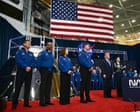
History isn't handed out to just anyone. When the Artemis II crew walked up to receive the highest space honor the nation has to offer, nobody was surprised. They earned it.
You see, flying around the Moon isn't a joyride. It's a high-stakes gamble with physics, engineering, and raw human endurance. Most people forget how terrifying actual spaceflight remains. They watch a sleek rocket lift off on TikTok, sip their coffee, and scroll away. They don't think about the thousands of components vibrating at frequencies that could shake your teeth loose. They don't think about radiation belts.
Let's clear something up right now. Getting a medal from the government might look like a ceremonial photo-op for politicians, but for astronauts, it marks a physical threshold crossed. These individuals put their lives on the line to push human presence further into the void than anyone has gone in half a century.
The Weight of the Moonshot
Space is hard. Really hard.
When NASA announced the four crew members for Artemis II—Reid Wiseman, Victor Glover, Christina Koch, and Jeremy Hansen—the aerospace community let out a collective breath. This wasn't a PR lineup. This was a tactical selection of veterans and specialists who knew how to keep calm when warning lights started flashing inside a cramped capsule.
Think about the psychological toll. You are strapping yourself into a machine designed to escape Earth's gravity, aiming for a hunk of rock floating a quarter of a million miles away, and trusting math you can't even visualize.
The Congressional Space Medal of Honor doesn't get handed out for participation trophies. It's reserved for astronauts who distinguished themselves by exceptionally meritorious efforts and contributions to the welfare of the nation and humankind. Past recipients read like a roster of absolute legends: Neil Armstrong, John Glenn, Jim Lovell. Adding the Artemis II crew to that wall makes sense. They bridged the gap between Apollo nostalgia and twenty-first-century reality.
What They Actually Faced
People talk about the technology, but human grit remains the core engine of space exploration.
The Orion spacecraft isn't a spacious luxury cruiser. It's a tight, noisy workstation packed with miles of wiring and computer systems that have to survive extreme thermal shifts. During their mission profile, the crew tested life support systems, navigation backups, and manual piloting modes that human hands haven't controlled at lunar distances since the Nixon administration.
If something went wrong out there, Houston couldn't just send a repair technician. They had to rely on their training, their checklists, and their own nervous systems.
I've talked to engineers who worked on the flight control software, and they'll tell you off the record that the margin for error was razor-thin. Every burn had to happen at the exact second calculated by flight dynamics. Miss your window by a fraction of a second, and you're entering the wrong orbital trajectory.
That's why recognition matters. It validates the sweat equity behind the glossy press conferences.
Why This Mission Changes the Game
We stopped going to the Moon for a long time. That creates cultural amnesia.
Younger generations grew up thinking space was just for billionaires with rockets or uncrewed probes taking pretty pictures of distant nebulae. Artemis II shattered that illusion. It proved that human beings still belong out there among the stars.
The honors bestowed upon these four astronauts represent more than past deeds. They serve as an investment in future momentum. When kids see real explorers getting decorated for flying around the Moon, career choices shift. Engineering classrooms fill up. Physics departments get funded.
You want to build a space-faring civilization? You have to celebrate the people who actually open the door.
Don't let the media spin cycle fool you into thinking space travel is routine now. It isn't. Every single launch is a controlled explosion held together by strict discipline and brilliant minds.
Read up on the mission telemetry if you doubt the complexity. Look at the orbital mechanics. Study the entry corridors. You'll quickly realize that the medal they pinned on those flight jackets wasn't just shiny metal. It was heavy with the burden of survival.
Keep your eyes on the horizon. The next chapter of deep space exploration is writing itself right now, and the groundwork laid by this crew will dictate how far we go next.