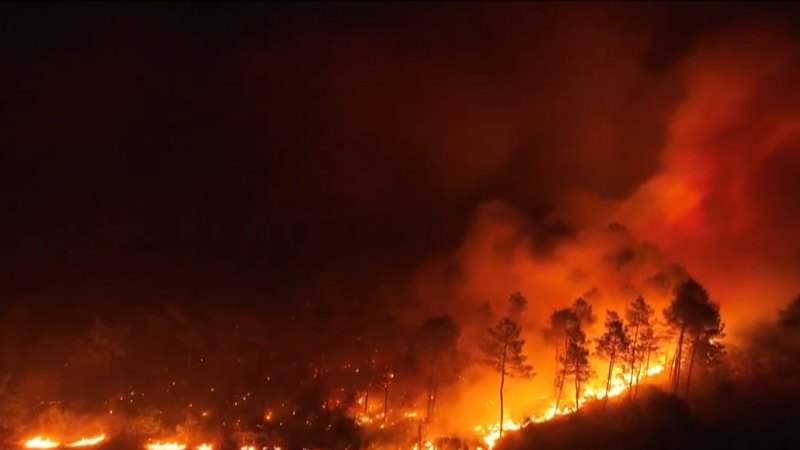
The smell hits you long before you see the smoke. It is a dry, metallic scent—the smell of centuries-old pine needles being toasted into oblivion.
For the residents of the Gironde, that scent is no longer a seasonal curiosity. It is a haunting.
I remember sitting on a terrace in a small village nestled between the vast, orderly rows of the Landes forest, back when the air still tasted only of resin and salt. My host, an elderly man named Jean-Pierre, pointed toward the horizon. He didn't see a forest; he saw a legacy. He had planted those trees himself, watched them grow from spindly saplings into a cathedral of green that provided both his livelihood and his sanctuary.
Today, that cathedral is a furnace.
When we speak of wildfires in France, the statistics arrive with a sterile coldness. We hear about hectares burned, the number of firefighters deployed, the precise wind speed in kilometers per hour. But numbers do not capture the sound of a forest dying. They do not describe the frantic, clumsy evacuation of a family trying to decide which keepsakes to cram into the trunk of a Peugeot, or the hollow silence that descends when the birds stop singing because the heat has already claimed the canopy.
The reality is that France is changing.
The climate has turned the Mediterranean basin into a tinderbox. What was once a manageable seasonal risk has metastasized into a year-round threat. The winters are drier, the springs shorter, and the summers are absolute, unrelenting sieges. The soil, once deep and thirsty, has become hydrophobic—repelling the very water that could save it. When the fires come, they do not just burn the wood; they sterilize the earth, leaving behind a scarred, grey wasteland that will take generations to heal.
Consider what happens next: the fire hits a stand of maritime pines. These trees have evolved to deal with minor, low-intensity burns, but these are not the fires of the past. These are crown fires. They leap from treetop to treetop with the speed of a galloping horse.
The strategy of the men and women on the ground—the pompiers—has shifted from containment to desperation. They are no longer fighting fires; they are fighting the clock. They stand in the path of a wall of heat so intense it creates its own weather patterns. Sudden, erratic gusts of wind caused by the fire’s own thermal updrafts can turn a safe zone into a trap in a heartbeat.
It is a terrifying, messy, and deeply human struggle.
There is a pervasive myth that these disasters are purely the result of bad luck or neglect. The truth is far more complex. Decades of monoculture—planting the same fast-growing species in tightly packed rows—have created an artificial environment that is essentially a high-density fuel load. When you stack matchsticks perfectly in a box, you only need one spark. We built this, and now we are watching the price of that efficiency come due.
I spoke with a woman near the base of the Pyrenees who lost her home last August. She didn't talk about policy or atmospheric pressure. She talked about her dog, the photograph of her grandmother she forgot on the mantelpiece, and the feeling of her boots melting into the asphalt of her driveway as she scrambled to get into the car.
Her grief was not theoretical. It was sharp, immediate, and utterly devastating.
This is the hidden cost of the modern era. We have spent centuries viewing nature as a resource, a backdrop, a bank account to be drawn upon. We forgot that we are part of the system. When the forest burns, we lose more than timber. We lose the cooling effect of the shade. We lose the natural filters for our water. We lose the quiet corners where we go to remember who we are when the demands of the city fade away.
But the fire also reveals the depth of the human spirit.
In the wake of the evacuations, I saw strangers opening their homes to families they had never met. I saw local bakers working through the night to feed the weary crews who were stumbling back from the front lines, their faces blackened by soot and exhaustion. There is a primal, beautiful instinct to protect one another when the sky turns an bruised, apocalyptic orange.
We are left with a choice.
We can continue to treat these events as isolated tragedies, waiting for the smoke to clear so we can rebuild exactly as we did before. Or, we can acknowledge the fundamental shift in our relationship with the land. We need to rethink how we manage our forests, moving away from simple, fast-burning plantations toward more diverse, resilient ecosystems. We need to respect the fire, acknowledging that it is a tool when managed and a monster when ignored.
The fire is not an enemy to be defeated in a single battle. It is a symptom of a world that is running too hot.
As I look at the photographs of the charred remains of the Landes, I think of Jean-Pierre. He is gone now, but his trees—those he planted as a young man—were the ones that burned. There is a profound sadness in that, but also a call to action. We are the stewards of what remains. If we do not learn the lesson written in the ash, we are simply waiting for the next spark.
The sun sets over the horizon, casting long, bruised shadows over the blackened stumps. The air is still, but it is not quiet. Somewhere in the distance, a siren wails. The watch continues. The world holds its breath, waiting for the first scent of smoke to break the fragile, hard-won peace.