The air sixty kilometers southeast of Paris did not feel like Europe anymore. It felt like an oven door left open in July.
Clement Boher stood in his yard in the village of Le Vaudoué, watching the horizon turn the color of a bruised plum. The scent came first—sharp, chemical, the unmistakable stench of resin and pine cooking under a monstrous heat. Then came the plumes, thick and towering, rising like black columns over the ancient canopy of the Fontainebleau forest. You might also find this connected article useful: Why Moscow is Laughing at the Myth of Lindsey Graham's Russia Toughness.
Fontainebleau is not just a collection of trees. It is a UNESCO biosphere reserve, a former royal hunting estate where kings once rode, a labyrinth of sandstone boulders and ancient oaks wrapped around quiet, centuries-old villages. It is a place that belongs to the damp, cool memory of northern France. Fires like this are supposed to happen in the sun-baked hills of the south, along the Mediterranean coast, or deep in the pine barrens of Gironde. Not here. Not seventy kilometers from the capital.
Clement did what hundreds of his neighbors did. He packed a single backpack. He checked the fuel in his car. He waited by the door, staring at a sky that grew darker by the minute. As reported in recent reports by The Guardian, the effects are worth noting.
"Like everyone else, we're on standby," he muttered, his voice tight with the specific kind of dread that comes when the landscape you trust turns hostile. "Vehicles ready and a backpack packed. All we can do is wait."
A few miles away, a police cruiser pulled to the side of a dirt track near the edge of the ignition zone. The officers stepped out into the sweltering heat, their boots crunching on tinder-dry moss. They spotted him almost immediately. An eighteen-year-old man, standing in the shadows of the drying brush. He had no criminal record. He looked like any other teenager you might pass on the streets of Melun or Fontainebleau. Except for his hands. They were stained deep, charcoal black with fresh soot. And in his pocket, he carried a simple plastic lighter.
He was arrested on the spot, alongside another suspect, as the first of two massive fires tore through the undergrowth, eventually consuming over 1,300 hectares of historic woodland.
The Ten Sparks
To understand the fury of the Fontainebleau fire, you have to understand how a forest dies.
When Interior Minister Laurent Nunez arrived at the emergency operations center, the map laid out before him looked like a war zone. Fire investigators had already mapped the origin of the blaze. They didn't find one single accident—a discarded cigarette, a broken glass bottle focusing the sun’s rays, a spark from a passing train.
They found ten.
Ten distinct ignition points, deliberately spaced within a single perimeter of just one thousand meters. It was a calculated geometry of destruction. Whoever struck those matches understood exactly what the weather had spent weeks preparing. France was suffocating under its third severe heatwave in less than three months. The vegetation was not merely dry; it was functionally dead, starved of moisture, waiting for a spark. The ten separate fires quickly fed into one another, creating a massive wall of flame that outran the initial response teams.
Consider what happens when a fire reaches that scale. The heat generates its own wind, pulling oxygen toward the center of the blaze and throwing embers hundreds of yards ahead into the unburned forest.
The state responded with an iron fist, deploying four Canadair water-bombing aircraft—an unprecedented sight in the skies over the greater Paris region—alongside Dash planes and heavy helicopters. For the first time in memory, these massive aircraft skimmed the surface of the River Seine, scooping thousands of liters of water directly from the artery of northern France to dump onto the burning canopy.
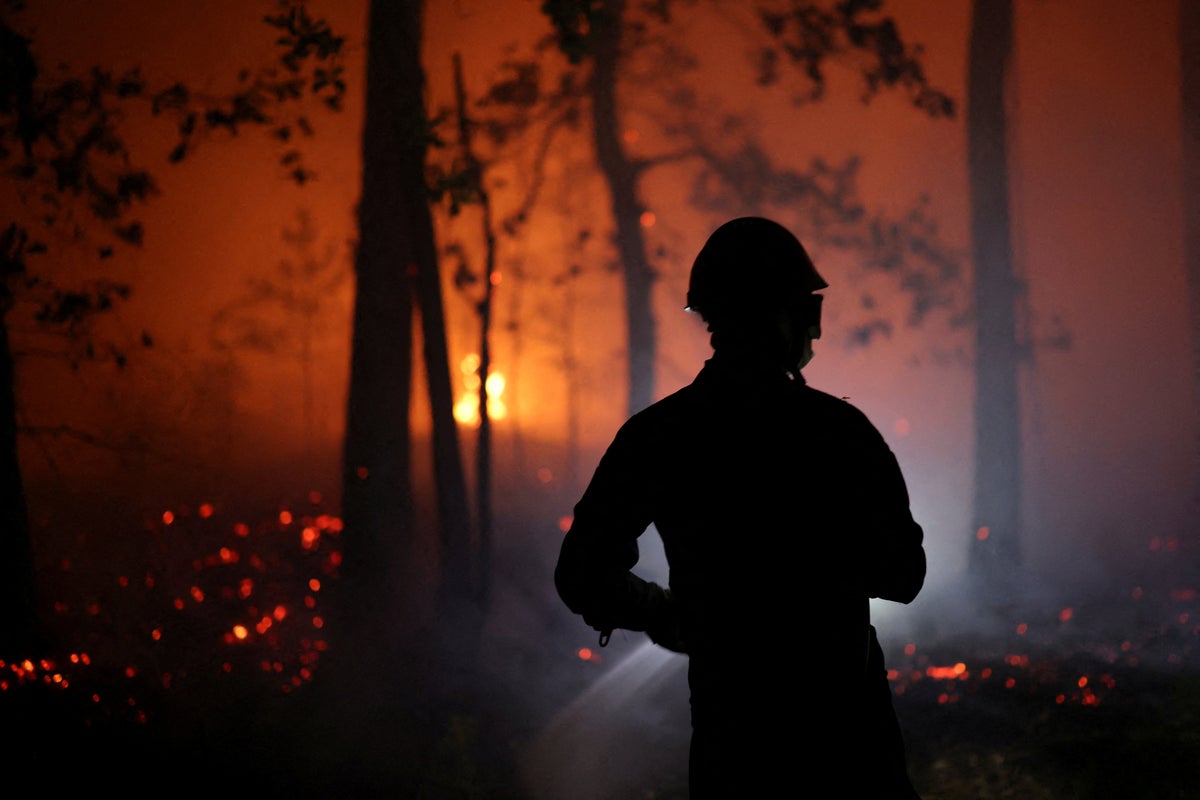
By Monday night, the planes had made 187 water drops. Six hundred firefighters remained on the ground, working in exhausting, rib-cracking shifts as the flames continued to push through the dark.
The fire was winning. The wind refused to cooperate.
The Human Cost of Dry Timber
A crisis like this reveals the fragile threads that hold a modern society together.
The A6 motorway, the great black asphalt ribbon connecting Paris to Lyon and the sunlit south, went dark. Authorities shut it down as thick smoke blinded drivers, turning a routine holiday travel weekend into a chaotic gridlock. High-speed TGV trains, the pride of French infrastructure, ground to a halt as smaller secondary fires threatened the tracks.
Nearly one thousand people were forced to abandon their homes with whatever they could carry in their arms.
But amidst the flight, there was defiance. Farmers who had spent their lives working the fields bordering the forest didn't run. They hooked heavy water cisterns to their tractors, driving directly toward the smoke to wet down the edges of the fields, creating makeshift firebreaks with their own hands. Cindy Fuyard, a forty-five-year-old nurse from Le Vaudoué, fled her home when the evacuation order came—but she returned hours later. She didn't return to salvage her belongings. She came back to open her gates, giving the exhausted ground crews unrestricted access to her swimming pool so they could refill their pumps.
"With global warming, it was to be expected," Cindy said, looking out at the charred horizon.
Her voice lacked shock. It carried only a weary, heartbreaking resignation.
A Nation Set Ablaze
The tragedy of Fontainebleau is that it is not an isolated incident. It is a symptom.
Across France, the numbers tell a terrifying story. Since the beginning of the year, wildfires have destroyed roughly 32,000 hectares of land. To put that in perspective, that is an area double the size of the destruction recorded during the same period last year. The country is burning at a rate it has never seen before, driven by an exceptional, historic drought that has turned the entire nation into a powder keg.
But nature is only providing the fuel. Humans are providing the fire.
Minister Nunez revealed a chilling statistic during his evening television address: authorities have arrested 59 people across the country on suspicion of deliberate or accidental arson during this single heatwave cycle. Half of them are adults. The other half are minors. Some are repeat offenders.
It leaves a haunting question hanging over the blackened remains of the Fontainebleau biosphere: Why? What possesses an eighteen-year-old with a clean record to walk into a historic forest during the hottest week of the year and strike ten separate matches? Is it malice? Nihilism? A desperate desire to see something burn?
The answers will have to wait for the courts. For now, the focus remains on the ground, where the smoke still rises, and the air remains heavy with the scent of lost history.
As the sun sets over Seine-et-Marne, the aircraft are forced to land, leaving the battle to the six hundred men and women holding the line in the dirt. They stand between the shifting wind and the ancient stones of the palace, their faces masked, their eyes stinging, fighting for every single tree.

